

History
Summer of ’65: Council considers pay rides on Aerial Lift Bridge
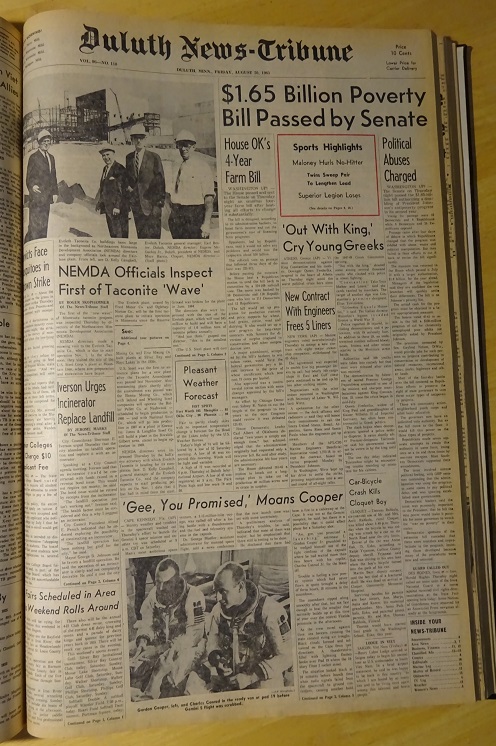
Fifty years ago — Aug. 20, 1965 — the DNT reports the Duluth City Council will consider a proposal to permit “scenic rides on the Aerial Lift Bridge at a fee of 25 cents.” (more…)
Summer of ’65: Griggs Hall opens at UMD
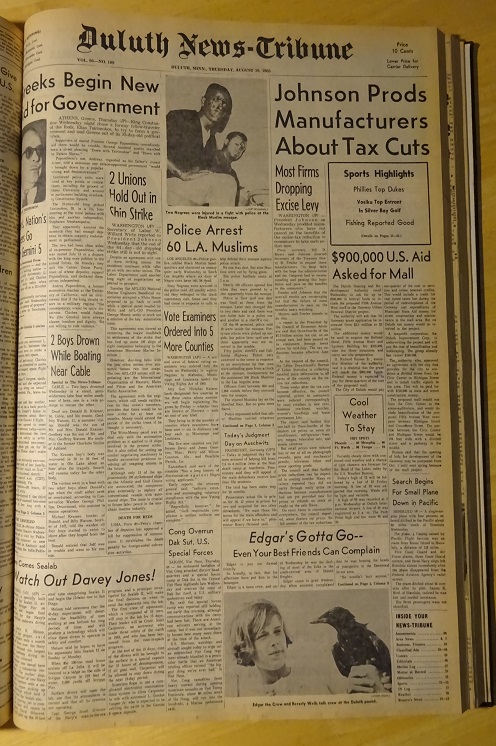
Fifty years ago — Aug. 19, 1965 — the DNT reports a new, unnamed residence hall, designed to house 202 students, will be dedicated on Aug. 20. (more…)
Summer of ’65: New TV station in the works for Duluth
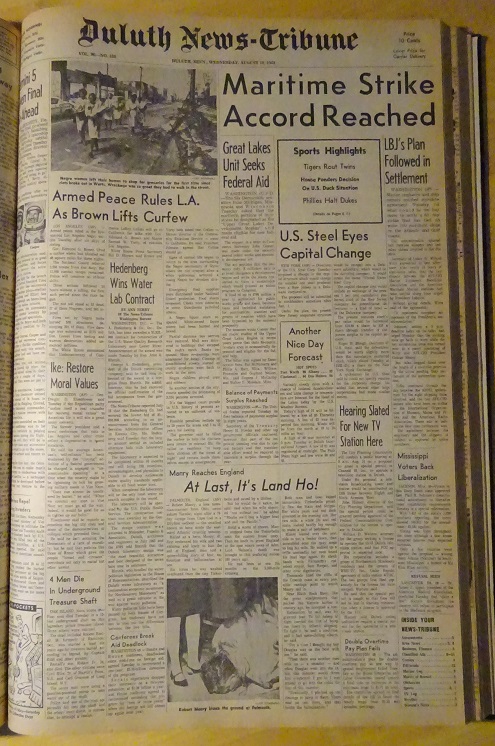
Fifty years ago — Aug. 18, 1965 — the DNT reports the Duluth Planning Commission will conduct a public hearing on a proposal to grant a special permit to Channel 10, Inc., to operate a television station. (more…)
Summer of ’65: Arenas planned for Two Harbors and Silver Bay
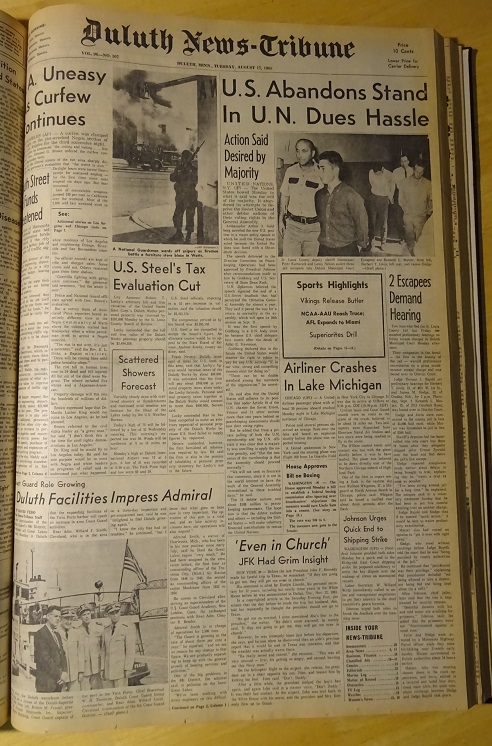
Fifty years ago — Aug. 17, 1965 — the DNT reports plans are in the works for community arenas to be built in Two Harbors and Silver Bay. (more…)
Summer of ’65: Bob Magie wins big one, ends Leo Spooner’s reign
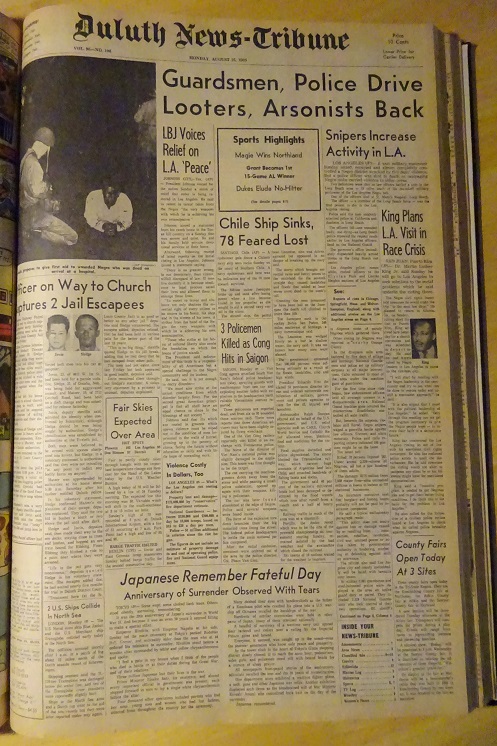
Fifty years ago — Aug. 16, 1965 — the DNT reports Leo Spooner’s four-year domination of local golf had ended at the hands of two youngsters. (more…)
Summer of ’65: USS Duluth Christened by Humphrey’s Daughter
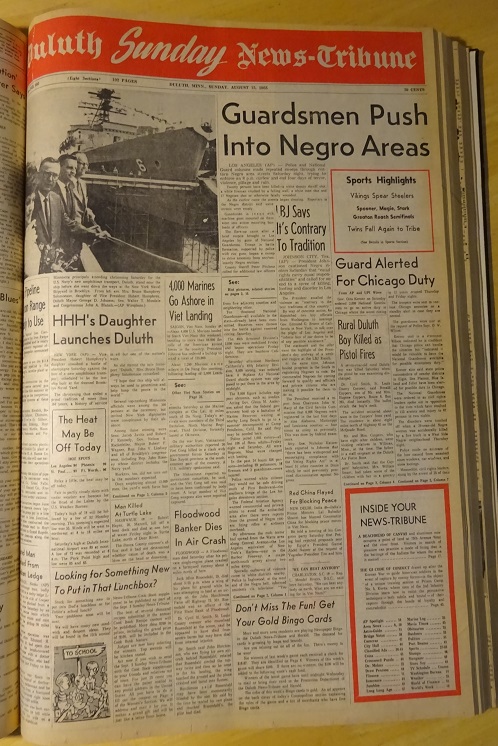
Fifty years ago — Aug. 15, 1965 — the DNT reports (via AP wire out of New York) several top-ranking Minnesota officials were among the 300 persons at a ceremony to christen the USS Duluth. (more…)
Summer of ’65: UFO Sightings Reported Over Duluth
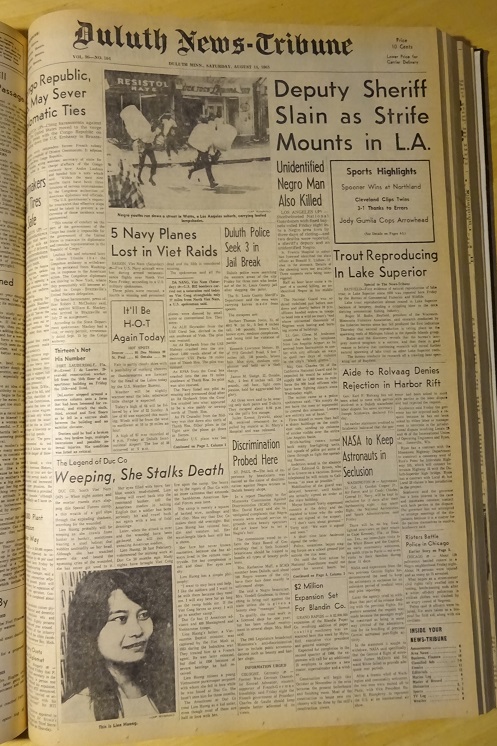
Fifty years ago — Aug. 14, 1965 — the DNT reports sightings of unidentified flying objects over Duluth. The article’s title, by the way is …

… which leads one to believe there was another story on the subject in previous days, but careful eyes couldn’t find one in the Aug. 1-13 editions. (more…)
Summer of ’65: Car Crashes into Hank’s Grocery
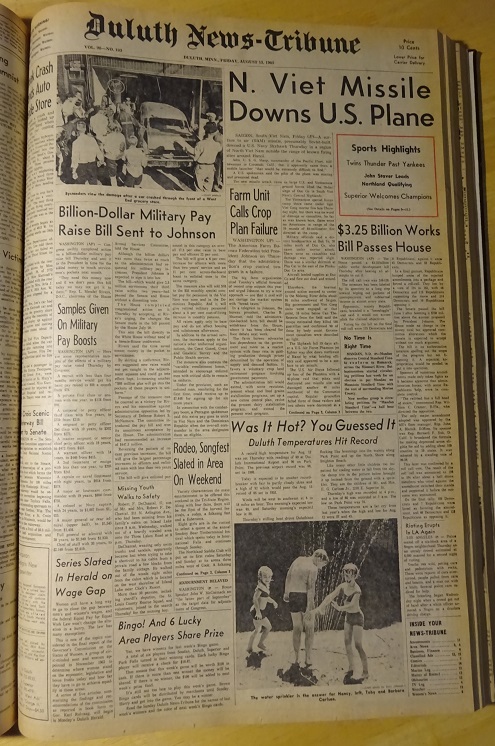
The Duluth News Tribune’s Aug. 13, 1965 edition reports three persons sustained minor injuries when a 71-year-old Duluth woman crashed into the front of Hank’s Grocery at 2332 W. Third St. in the friendly West End neighborhood. The location is the present-day site of Bark Avenue Pet Grooming. (more…)
Summer of ’65: I-35 Route Proposed on DM&IR Railway
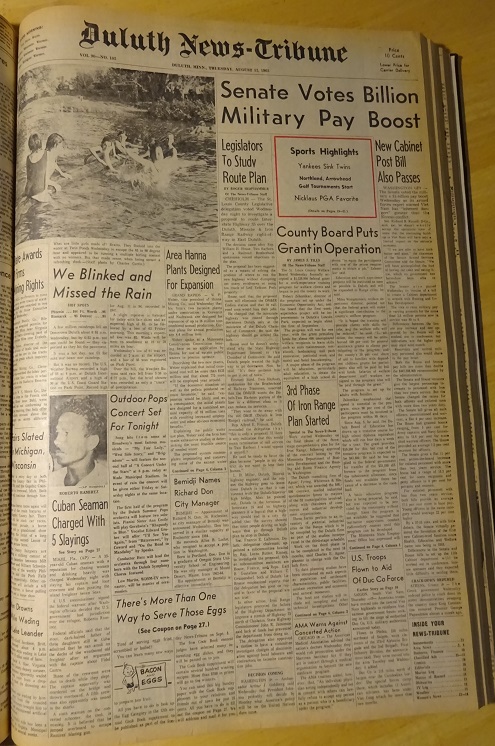
Fifty years ago — Aug. 12, 1965 — the DNT reports the St. Louis County Legislative delegation will explore a proposal to route Interstate Highway 35 over Duluth, Missabe & Iron Range Railway right-of-way. The great I-35 debate, of course, wouldn’t ultimately be settled for another two decades. (more…)

Summer of ’65: Duluthian Talked Off High Bridge
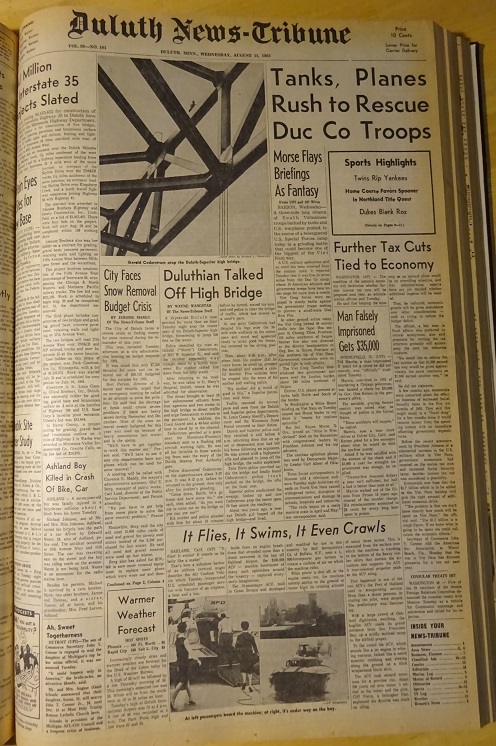
Fifty years ago — Aug. 11, 1965 — the DNT reports a 25-year-old Duluth man stood perched atop the center span of the Duluth Superior High Bridge — now known as the John A. Blatnik Bridge — threatening to jump to the water. “The incident was apparently brought about by a family argument,” the paper noted. “His mother talked him down from his lofty stand.” (more…)
Summer of ’65: NLRB Sets Hearing in Labor Dispute
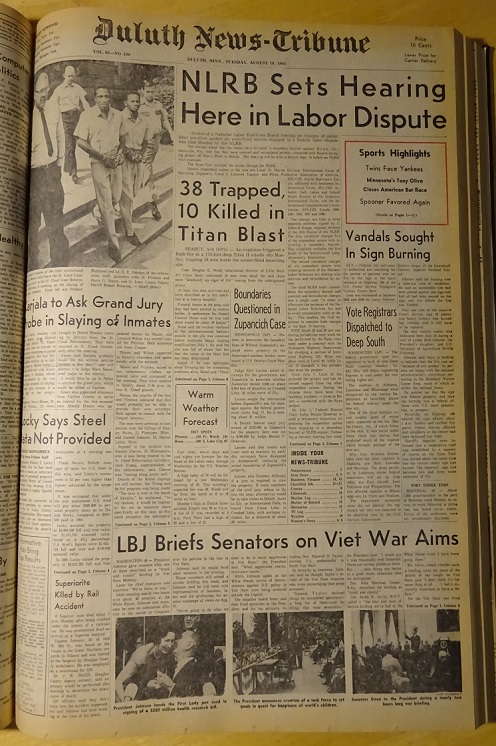
Fifty years ago — Aug. 10, 1965 — the DNT reports the National Labor Relations Board will hold a hearing on charges of unfair labor practices against six Duluth waterfront unions engaged in a labor dispute. (more…)
Summer of ’65: Ground Breaking Set for New YMCA
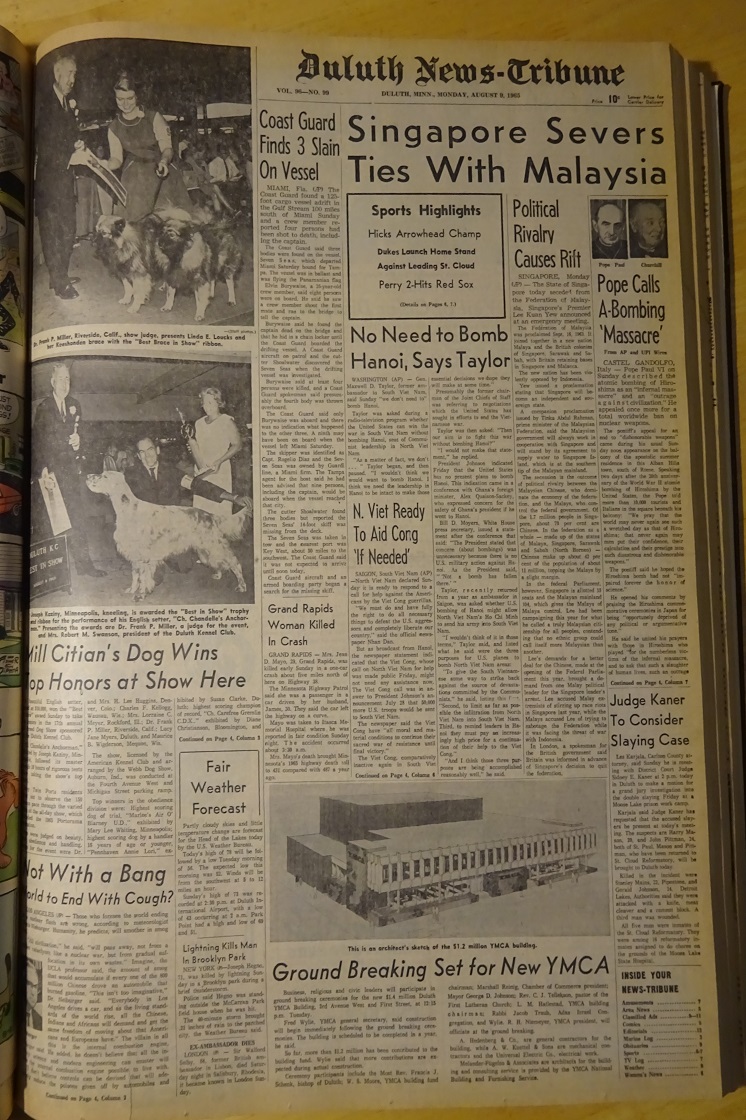
Fifty years ago — Aug. 9, 1965 — the DNT reports there will be a groundbreaking ceremony the next day for a new $1.4-million Duluth YMCA. (more…)
Summer of ’65: Weather Pushes Folk Festival to Armory
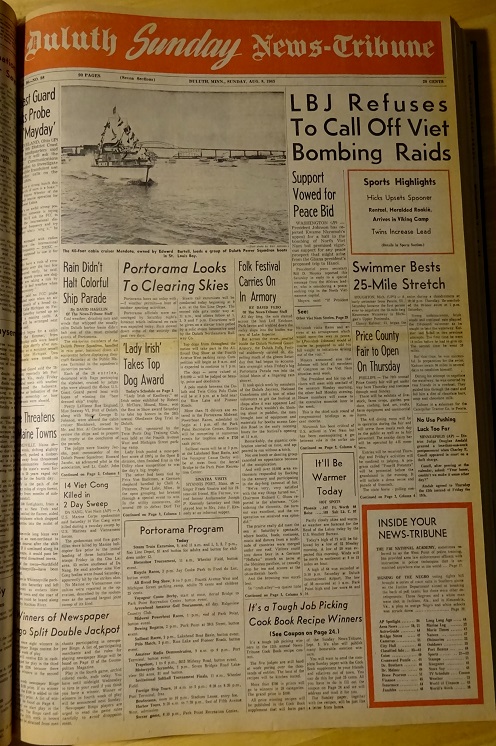
Fifty years ago — Aug. 8, 1965 — the DNT reports the 18th annual Duluth International Folk Festival abandoned its home at Leif Erikson Park to avoid rainy conditions, moving the party across the street to the Duluth National Guard Armory. (more…)
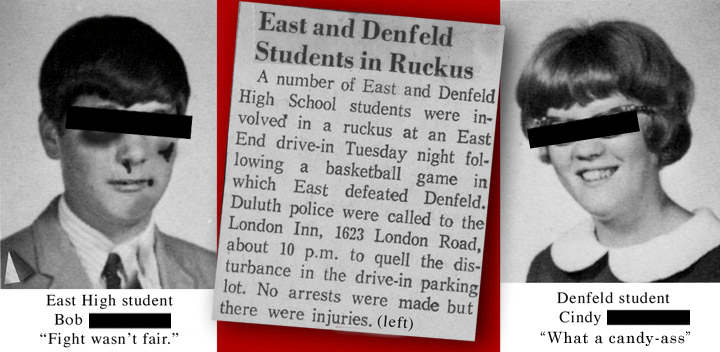
Summer of ’65: Weather Steals Show from Portorama Parade
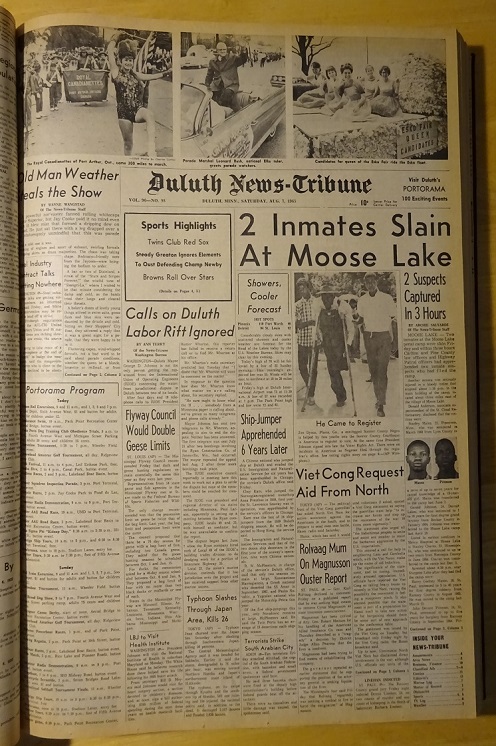
Fifty years ago — Aug. 7, 1965 — the DNT reports a “powerful nor’easter” threatened to put a damper on the annual Portorama Parade, but some 30,000 spectators toughed out the inclement weather. (more…)
Summer of ’65: Duluth Moving Toward Fifth Avenue Mall
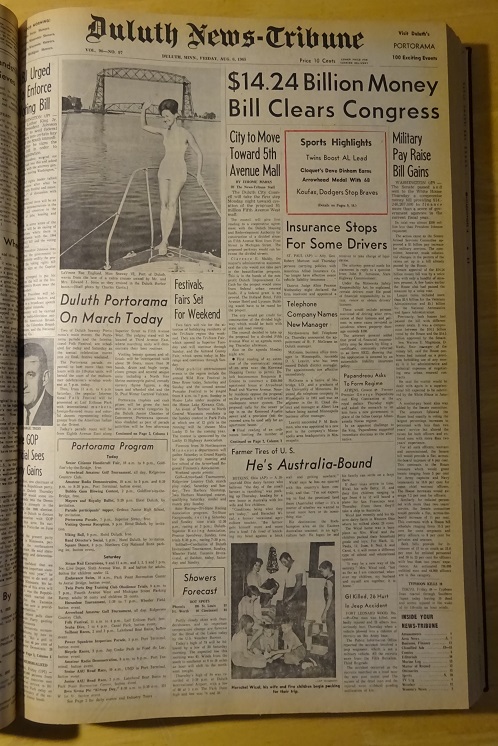
Fifty years ago — Aug. 6, 1965 — the DNT reports the Duluth City Council is reviewing a proposal for the development of a $1 million mall at Fifth Avenue West in the area where the Radisson Hotel and Duluth Public Library were later built. The context of the story seems to indicate the discussion is not about a shopping mall, but instead something like the decorative median with trees that stands in the middle of the avenue today. (more…)
Summer of ’65: Norwegian seamen face Twin Ports soccer team
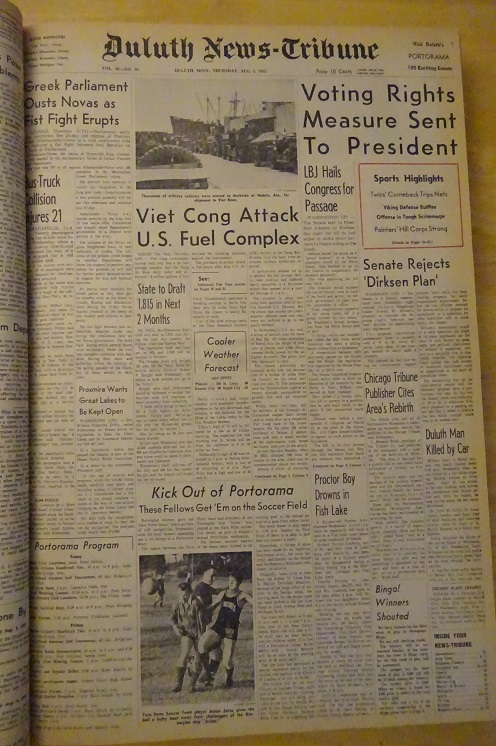
Fifty years ago — Aug. 5, 1965 — the DNT reports of Norwegian seamen giving the Twin Ports soccer team “an hour of stiff competition … with the local booters squeaking out a 1-0 victory.” (more…)
Summer of ’65: Du Lhut’s Statue on Way Here
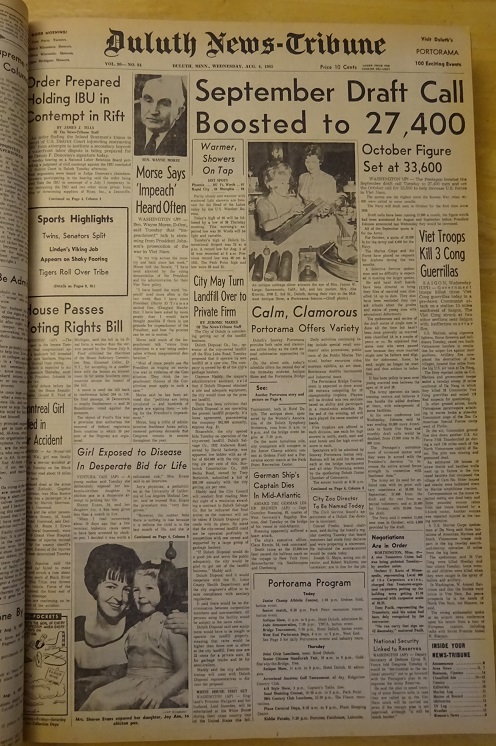
Fifty years ago — Aug. 4, 1965 — the DNT reports a bronze statue of Daniel de Gresolon, the Sieur Duluth, is on a ship at Leghorn, Italy, and due to arrive in Duluth in about three weeks. It will be installed in the courtyard at the University of Minnesota Duluth. (more…)
Summer of ’65: Brunette Awarded Seaway Laurels
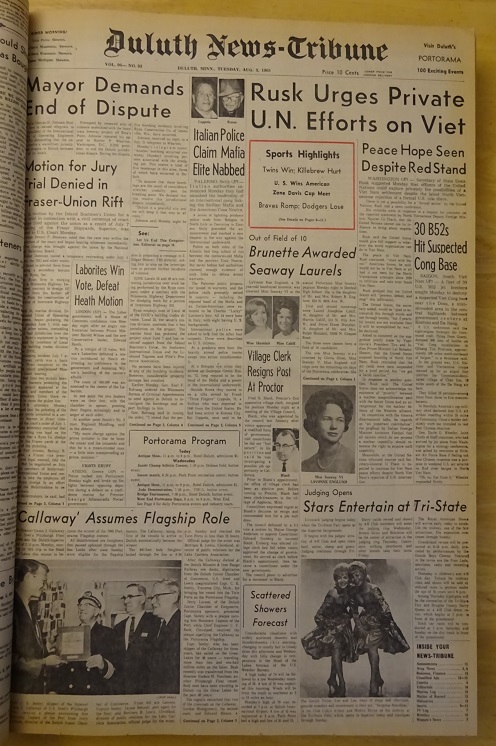
Fifty years ago — Aug. 3, 1965 — the DNT reports on the ongoing Portorama Festival, with the crowning of Miss Seaway VI LaVonne Rae Englund. The “19-year-old hazel-eyed brunette” won the pageant held at Denfeld High School. Runners up were Laurel Josephine Cahill and Joyce Diane Hietalati. (more…)
Summer of ’65: Trailer at Dredging Project Hit by Bomb
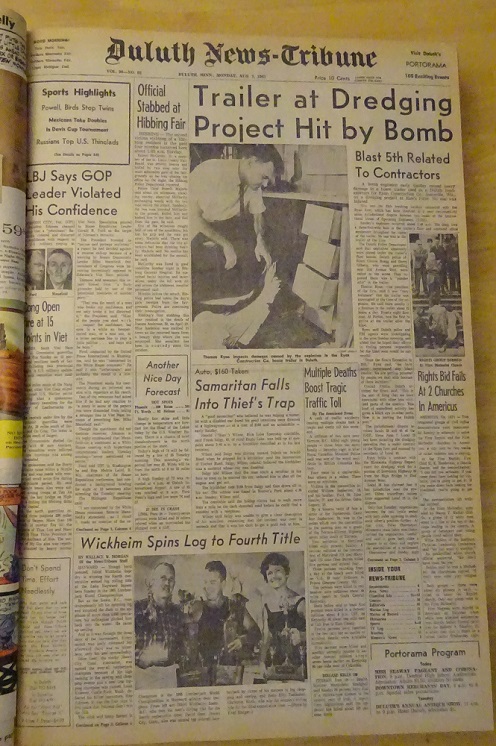
Fifty years ago — Aug. 2, 1965 — the DNT reports of a bomb explosion at a house trailer used by Ryan Construction of Janesville, Wis., on a dredging project at Rice’s Point. No one was injured. (more…)
Summer of ’65: Superior Gambling Raid
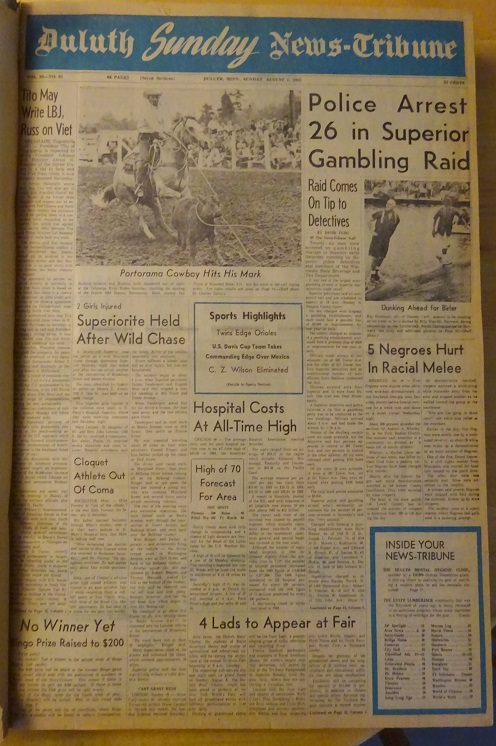
Fifty years ago — Aug. 1, 1965 — the DNT reports of a gambling raid in Superior that was “one of the largest mass gambling arrests in Superior that detectives could recall.” Another article, at the mid-right of the page, will raise eyebrows for its racially offensive headline, though such a thing was sadly common at the time. It is a story out of Americus, Ga., by the way, and not Duluth. (more…)
Summer of ’65: Introduction

A while back, Harbor City International School Mathematics Teacher Jenny Ahern passed along to me a bound edition of Duluth News Tribune’s from August of 1965. Somehow the book made its way to the school, and the school didn’t have a practical use for it. Since we are now 50 years removed from the ol’ “Summer of ’65,” I’ll be posting some clips each day for the next month. Prepare for nostalgia.
Hooks Dauss of the Duluth White Sox
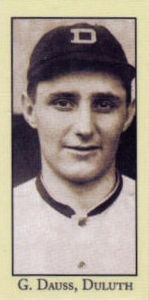
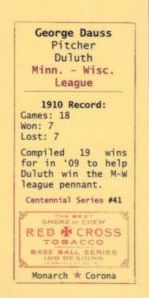
George August “Hooks” Dauss pitched in the Major Leagues for the Detroit Tigers for 15 seasons following his stint with the Duluth White Sox. There are numerous images of him on the Internet in a Tigers uniform, but Duluth images are seemingly nonexistent. The baseball card above is a bit of a deception, because the “D” on the cap is for “Detroit.” The card is a “Corona Centennial reprint,” although the word “reprint” implies there was an original card like this 100 years ago, which wouldn’t seem to be the case. Anyway, as shown below, the image on the card is of Dauss as a Tiger. (more…)
Mesaba, Missabe or Mesabi? What’s correct?
This is a perfect question for all you PDDers. Is Mesaba spelled Mesaba, Missabe or Mesabi? Was the street named after the area of Northern Minnesota? The two are spelled different. What was the building named after? It has a third spelling. I’ve lived here 25 years and am still trying to figure this out. Help!