

Lake Superior
Death of a Piano
The 2026 documentary Death of a Piano follows four years of Duluth’s SubSuperior Underwater Music and Art Festival. It features Troy Rogers and numerous other artists as they construct and experiment with Hexas — a modular, reconfigurable platform constructed from five-foot hexagonal floating docks for the purpose of serving as a rogue stage on Duluth’s waterfront. A discarded piano emerges as a central character as festival participants decide how to conduct a proper sendoff.
Directed and edited by Tomas Soderberg.
Jonathan Thunder’s Dream Lake Vibes
[This post originally contained an embedded video that is no longer available at its source.]
Duluth’s Jonathan Thunder presents an hour’s worth of ambient wave sounds blended with a mix of piano jazz playing under a surreal full moon illuminating Uncle Harvey’s Mausoleum on the Shores of Lake Superior.
The water is 32 degrees
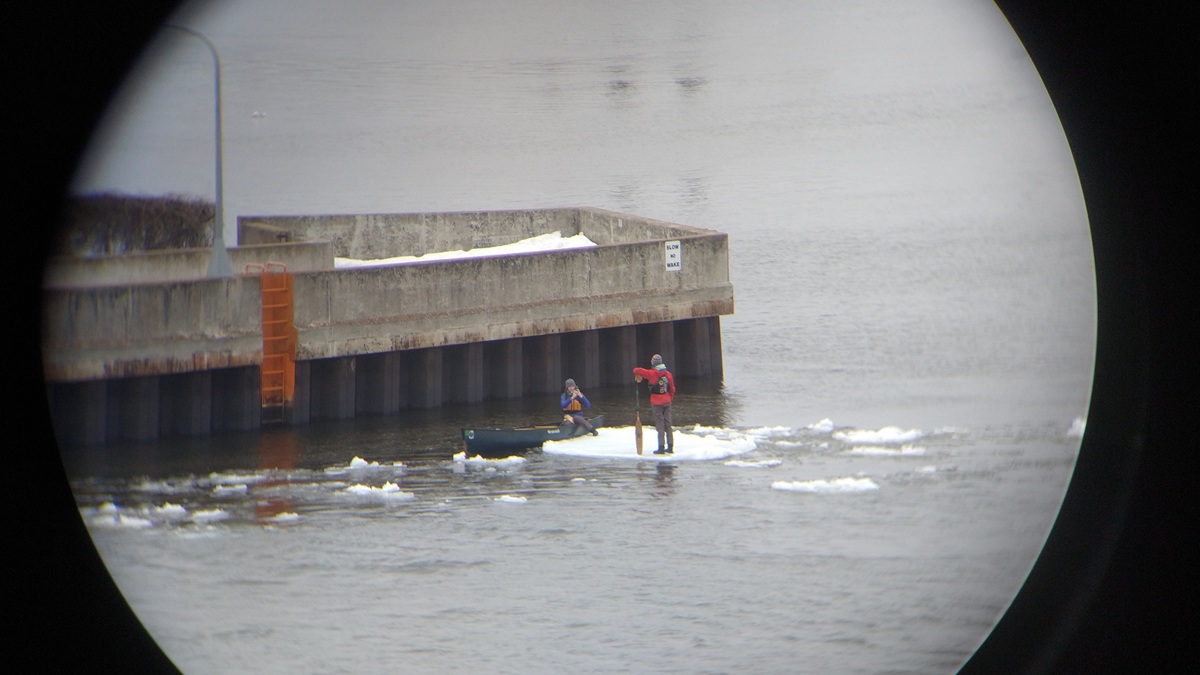
Two canoeists paddled into the Duluth Ship Canal Thursday morning. They took turns standing up in the canoe, getting out and standing on a chunk of ice. They took photos of each other. (more…)
Lake Superior: Biggest Skate Rink in the World
One last skate.
Skating the big lake
I saw ice houses out there so I got my skates.
Our Changing Relationship to Lake Superior, 1975-2025

The SS Edmund Fitzgerald. (Image via the U.S. Army Corps of Engineers)
A new collection of works by Duluthians speaks to their changing relationship to Lake Superior. I am including the intro, which I wrote, below. For more, visit openrivers.lib.umn.edu. (more…)
Chasing the Sunset in Duluth
The latest video from “The Frozen Photog” Adam Jagunich features scenes from sunset at Park Point and Brighton Beach in Duluth.

Gas Freighter Elvina

The November 1910 issue of Power Boating magazine included a photo from the Duluth Ship Canal.
The caption reads:
Elvina, a 53-foot gasoline freighter, “beating it” out of Duluth harbor on her way to Cornucopia, 40 miles across Lake Superior, which she makes back and forth every day in the season. With 40 tons of freight and passengers, as shown in the photo, she makes ten miles an hour. Her power plant equipment is a four-cylinder, Campbell, 40-horsepower machine.
Music in the Weeds: Emma Tweten with Adam Kirsch
Grand Marais singer-songwriter Emma Tweten performs two original songs aboard the schooner Hjordis on Lake Superior, with Adam Kirsch on banjo.
Music in the Weeds is a new video series from WTIP North Shore Community Radio that showcases northern Minnesota artists performing original music at scenic and meaningful locations around Cook County. It is produced by M. Baxley and Will Moore.
Duluth tourism concept art

I made these dank memes. (more…)
A View from Montreal Pier: The R/V Blue Heron
 Not long after I disembarked from the research vessel Blue Heron in June, it was announced that a new form of life had been discovered inside the propeller shaft. A life form, hidden inside the extreme environment of the engine, cold and dark — it feels like how the Venom movies started. It feels maybe a little Lovecraftian, maybe, this shapeless life form, in the black goo.
My colleagues laugh at me for thinking in such melodramatic terms. But really, ever since that ride, I just keep learning how cripplingly limited my understanding of Lake Superior, and of our relationship to it, really was. I’m still trying to wrap my brain around it.
Finding the Blue Heron
The Blue Heron is docked in Superior on Montreal Pier, a research facility maintained by the University of Wisconsin-Superior. The site itself is a weird mishmash of history. The Montreal Pier, Quebec Pier and Allouez Bay are all a reminder of the deep affect French Jesuits and fur traders had on the Superior region.
By the early twentieth century, these piers were incredible sites of commerce. Superior was in competition with the Minneapolis area as the center of wheat and grain production, and several major companies built grain elevators and mills on the piers — Lake Superior Mills, Anchor, Listman, Cargill, and Belt Line. Most of these structures were destroyed in fires. (more…)
Weird clouds on July 11

Images taken over the span of a few minutes as dark rollers split off the main cloud bank like sideways funnel clouds, conflicting air masses in turbulence. (This kind of thing scared the heck out of me when I first moved here.) (more…)
On Board a Great Lakes Fireboat
Local YouTuber Vibe with Mike took a ride on the Duluth Fire Department’s fireboat.
Postcard from the Moonlight Over Lake Superior

This postcard, unmailed and undated, shows Downtown Duluth at night, circa perhaps the 1930s.

Arctic Bound: Sailboat Nord Hus arrives in Grand Marais
The 36-foot sailboat Nord Hus cast off from the Knife River Marina near Two Harbors on March 31 with a crew of four and temperatures hovering around 11 degrees. The first stop on the journey was Grand Marais. Explorers Lonnie Dupre and Pascale Marceau and crew plan to sail the Nord Hus from Grand Marais through the Great Lakes to the St. Lawrence Seaway and follow the Canadian North Shore to Newfoundland, eventually reaching the arctic channel between Elsemere Island and Greenland. The crew will be conducting a variety of scientific observations in collaboration with global partners. (more…)
Postcard from Along the Rocky Shores of Isle Royale

This undated postcard, published by E. C. Kropp Company, shows a rocky shore at Isle Royale, about 150 miles northeast of Duluth. The fourth-largest lake island in the world was established by President Franklin D. Roosevelt as a National Park on April 3, 1940 — 85 years ago today. (more…)
Coast Guard vs. Illegal Fishing Shelter
The Duluth-based YouTube channel Vibe with Mike has the story. Spoiler alert: Coast Guard wins.
PDD Geoguessr #29: Lake Superior Lighthouses

The Duluth North Pier Lighthouse (Photo by Matthew James)
On Nov. 10, 1975 — 49 years ago next week — the SS Edmund Fitzgerald sank in a Lake Superior Storm, killing all 29 crew members on board. As noted in Gordon Lightfoot’s ballad, “The Wreck of the Edmond Fitzgerald,” the ship sank during a November gale, a Great Lakes weather event in which Artic air from the north collides with Gulf air from the south, creating hurricane-level winds. With the Lake Superior Marine Museum’s Gales of November event approaching, this post takes a look at the lighthouses that historically guided Great Lakes ships to safety during these storms. It concludes with a Geoguessr that includes Lake Superior lighthouses in Minnesota, Wisconsin, Michigan, and Ontario. (more…)
Envisioning Threats to Great Lakes Shorelines
Duluth features prominently in this segment from the latest episode of Great Lakes Now, a monthly program focused on developments affecting the lakes. The show is produced by Detroit PBS in partnership with a network of PBS affiliates around the region.
The Wreck of the Adella Shores
On April 29, 1909, the Adella Shores was bound for Duluth with a cargo of 9,200 barrels of salt. The ship never arrived. Disappearing in a gale off Whitefish Point, Michigan, the location of the 195-foot wreck remained one of the lake’s unsolved mysteries. But the Great Lakes Shipwreck Museum has found it. (more…)
A Video Journal of Lake Superior
This video ran on a loop at the Duluth Art Institute’s “Water Works” show June 20 to Aug. 25, 2013. It hadn’t made it to the internet yet. (more…)
Lake Superior’s Warming Waters
Lots of Duluth up in here.
Screaming at Lake Superior
Last year, Duluthians gathered behind Leif Erickson Park to scream at Lake Superior. The April Fools’ Day screaming session was initiated by Ryan Glenn. “I originally posted the event […] to be sort of a joke, so in case it flopped it was on April 1,” they said. (more…)