

Duluth Deep Dive #13: Henry C. Richardson, Civil Rights Pioneer

A Black man, left, crosses Superior Street circa 1908. (Source: Library of Congress)
In 1904, more than 50 years before Rosa Parks refused to give up her seat on a Montgomery, Alabama bus, Henry Richardson fought against the common practice in Duluth restaurants to refuse service to people of color. When a waitress at a Superior Street restaurant would not take his order, he took the restaurant owner to court. This Duluth Deep Dive recounts the events and their aftermath.
While working on another Duluth Deep Dive post, I came across an article in the Minnesota Digital Newspaper Hub on Henry C. Richardson. Outside of these archives, I could not find any other mention of his fight for his basic rights to be upheld.
Henry Richardson was born in Richmond, Virginia on March 2, 1877. He moved to Duluth around the age of 16. The Afro-American Advance, a Black-owned newspaper based out of the Twin Cities that stayed in publication for just over a year, contains a couple of mentions of Henry’s social life when he was in his early 20s. A Dec. 9, 1899 column on St. Paul events notes, “Handsome jolly Henry Richardson, of Duluth, was in the city Thanksgiving day, calling on his many friends.” A Nov. 11 column from that same year states, “Mr. O. D. Claibome, Fred Mills and Henry Richardson will make up a fishing party which leaves Duluth Saturday for northern Minnesota. The boys expect to shoot large game, for they promise to remember ‘The Advance’ with deer or bear meat.” He served as treasurer of the Chrysanthemum Club in Duluth, a social club for the city’s Black community focused on fine dining. On Jan. 3, 1894, The Duluth Evening Herald noted that the night before the club had held a supper that served boiled Columbia river salmon, roast mallard duck, salted almonds and Neapolitan ice cream.
In 1901, the Minnesota legislature passed a law that required a licensed operator for every passenger elevator in cities with a population of more than 50,000. Henry and his brother, William, were in the first group of applicants to obtain a license1. Both men went to work for the First National Bank, a seven-story building on the northeast corner of Superior Street and Third Avenue West. Both brothers retired as elevator operators working for the bank, Henry in 19372 and William around 1950.
In 1902, when he was 25, Henry married Ethel Talbot and together they served as active members of St. Mark’s African Methodist Episcopal Church on Fifth Avenue East and Sixth Street. Ethel played the organ and served as the choir director for the church.3 Henry sang tenor.4 In 1932, he participated in the Third Annual People’s Concert in the Denfeld Auditorium, where he sang with the St. Mark’s Choir. Other performances in the event included Scottish bagpipers and a group of Ojibwe singers.5
Henry also bred dogs, specifically Italian greyhounds. The Duluth Herald from Oct. 30, 1923 reports that he took part in the first dog show of the Head of the Lakes Kennel Club. Two years later, on May 22, 1925, the Herald reported that he had won best of breed for his dog Regina (he was the only one who entered an Italian greyhound).
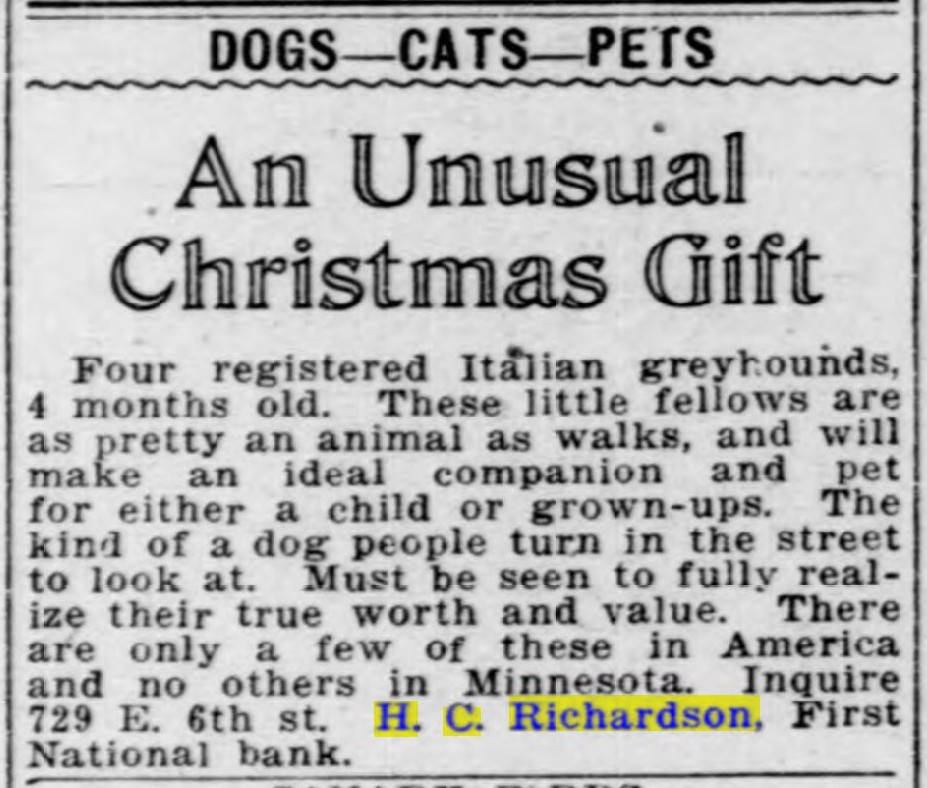
A classified ad placed by Henry C. Richardson in the Duluth Herald on Dec. 11, 1919.
In the fall of 1904, when Henry was 27 years old and in his third year of working as an elevator operator at First National Bank, he went out to lunch with a white friend. He and his friend chose to go to lunch at Haley’s Restaurant, midway down the block and across the street at 214 West Superior St.6 The restaurant was one of the better ones in Duluth. It was run by J.J. Haley, who later took it over as owner, with the Herald headline stating, “J.J. Haley Will Give Duluth Finest Restaurant in the West.”7 When Richardson and his friend decided to eat at Haley’s, the restaurant was in the process of building its reputation. It was part of an adjoining hotel that had recently been purchased by B.J. Cook and his brother Moses, and they had invested heavily in remodeling the restaurant. Just a few weeks before Richardson’s lunch there, on Sept. 26, 1904, The Duluth Evening Herald gave a glowing review:
B. J. Cook, proprietor of Haley’s restaurant, has just completed the remodeling of his place of business, making changes that transform this popular eating house into a thoroughly up-to-date establishment. Seven additional new and neatly arranged booths for private parties have been installed and the business men’s lunch counter has been moved to a more convenient location.
A feature that will meet with appreciation from both Duluth citizens and the traveling public is the addition, in the basement, of a first-class home bakery, to be run in connection with the restaurant. Those who hanker after the bread and pies “like mother used to make,” will find in Mr. Cook’s restaurant the fulfillment of their desires. Fresh home-made bread, pastries, hot rolls, buns, doughnuts and cakes will be available at all times, and Mr. Cook promises a genuine treat in the line of good things to eat at popular prices to all his patrons.
It seems likely that Richardson and his friend wanted to check out the new offerings for themselves when they chose it as their lunch destination. When they sat down, they overheard a conversation between their waitress, Annie St. Arnold, and the restaurant owner, B. J. Cook. 8 As quoted in the paper in the past tense, Annie told B. J. that she “didn’t have to wait on n****** and wouldn’t do it.”9 When Richardson complained to Mr. Cook, Cook said he had no control over who his employees chose to serve. Richardson then left the restaurant and immediately sought out the services of an
attorney.10
Attorney J. H. Whitley took the case,11as five years earlier, on March 6, 1899, the Minnesota State Legislator had passed the following act:
CHAPTER 41.
An act to protect all persons in their civil and legal rights.
Be it enacted by the Legislature of the State of Minnesota:
SECTION 1. That any person who excludes any other person within the State of Minnesota on account of race, color or previous condition of servitude from the full and equal enjoyment of any accommodation, advantage, facility or privilege furnished by innkeepers, hotelkeepers, saloonkeepers, managers or lessees, common carriers, owners, managers or lessees of theaters, or other places of amusement, or public conveyance on land or water, restaurants, barber shops, eating houses, saloons, or other places of public resort, refreshment, accommodation, or entertainment, or who denies, aids or incites another to deny to any other person because of race, creed or color, or previous condition of servitude, the full and equal enjoyment of any of the accommodations, advantages, facilities and privileges of any hotel, inn, tavern, restaurant, eating house, saloon, soda water fountain, ice cream parlor, public conveyance on land or water, theater, barber shop or other place of public refreshment, amusement, instruction, accommodation or entertainment, shall be deemed guilty of a misdemeanor, and, upon conviction thereof, shall be punishable by a fine of not less than twenty-five (25) dollars, nor more than one hundred (100) dollars, or imprisonment in the county jail for not less than thirty (30) nor more than ninety (90) days. And provided, that the punishment prescribed herein—the person aggrieved may have a lien in damages in a sum not exceeding five hundred (500) dollars to the party aggrieved to be recovered in a civil action.
Henry Richardson sued B, J. Cook for $500, the full amount to him entitled under the law.12
The Duluth Evening Herald’s reporting on the case does not reflect well on the city at the time. The paper’s mocking description of Richardson’s job, its failure to report on the relevant law that Cook broke, and its description of Richardson’s motivation as ‘revenge’ instead of ‘justice’ all suggest that the Herald expected its Duluth readers to find the situation amusing rather than upsetting. The initial story, published in the Duluth Evening Herald on Nov. 28, 1904, is presented in full below.

Is a gentleman of color to receive fair treatment at the hands of the fair waitresses that preside over the tables in Superior street restaurants, or is he to be relegated to the Bowery to eat with the woodsmen and dock laborers? That is the question which Judge Windom has to settle this afternoon.
Henry C. Richardson who is connected with the First National bank in the position of general manager of transportation from one floor of the building to another, has brought suit to collect the sum of $500 from B. J. Cook who owns a restaurant between Second and Third avenues west on Superior street.
Mr. Richardson asserts that he entered the restaurant recently to get his midday meal.
He removed his coat, looked over the menu and selected his meal.
Then he waited.
He beckoned a waitress who was passing with a load of steaming plates.
Then he waited some more.
He fixed another waitress with his glance. The waitress apparently had nothing to do but talk to a companion, but she simply couldn’t see Henry.
Mr. Richardson waited some more.
Then he appealed to the proprietor but the proprietor disclaimed any authority over the waitress, whom, he said, belonged to the union, and stated that a strike would result if he dared murmur a word of rebuke.
Finally Henry was compelled to leave without satisfying the pangs of his hunger, and as he shook the dust of the restaurant from his feet he swore a deep oath that he would have revenge.
He straightway hunted up an attorney and laid the matter before him. He and the attorney figured It out that his feelings had been outraged about $500 worth, to say nothing of his digestion. Consequently suit was brought for that amount, and the Jury, in Judge Windom’s court, will be called upon to decide just how much balm Mr. Richardson is entitled to for the damage done to his feelings for having the color line drawn in a public restaurant.
Albert Baldwin is appearing for the defendant. B. J. Cook and J. H. Whitely for Mr. Richardson.
Judge Windom dismissed Richardson’s case, stating that the evidence must be strong enough for a misdemeanor conviction before Richardson could collect civil damages.13 Richardson immediately appealed that decision and the same judge, Judge Windom, denied that appeal.14 Richardson then took his appeal to a three-judge district court panel. They found in his favor and granted him a new trial.15 The district court judges issued a statement addressing Cook’s two primary arguments, that the waitress he employed had not been charged with a crime and that he was not responsible for the actions of the staff that he employed:
The only question for our consideration is whether the evidence at the trial was such that a verdict for the plaintiff could be fairly sustained. In our opinion it was. Assuming that the action is based on chapter 41, laws of Minnesota, 1899, it was not necessary to its maintenance that the defendant should first have been convicted of a misdemeanor. No serious difficulty is found in the fact that the direct refusal to serve plaintiff was made by an employee of defendant and not by defendant himself. If it were otherwise the proprietors of such institutions could so manage as never themselves to be liable for such wrongs as are here.16
On April 5, 1905, a Duluth jury under the instructions of Judge Cutting deliberated for three hours and ultimately found Cook liable for the refusal to serve Richardson.17 While he sought $500 in damages, the maximum allowed under the law, Judge Cutting ended Richardson’s four month legal battle by awarding him $25, the minimum fine Cook would had received from a misdemeanor conviction.18
Even before the second verdict, Duluth restaurants had already changed their practices, but only to find ways to circumvent the law, not to uphold it. On Dec. 16, 1904, when Richardson’s case was awaiting appeal at the district court, the Duluth Evening Herald published a story describing the response of local restaurants to Richardson’s lawsuit. The article makes clear that local business owners recognized the practice of refusing service to people of color was against the law but that they believed the racial prejudice of their white customers was so strong that they could not follow the law and stay in business. The article is so blunt in its description of widespread racism in Duluth that it is worth quoting in full.
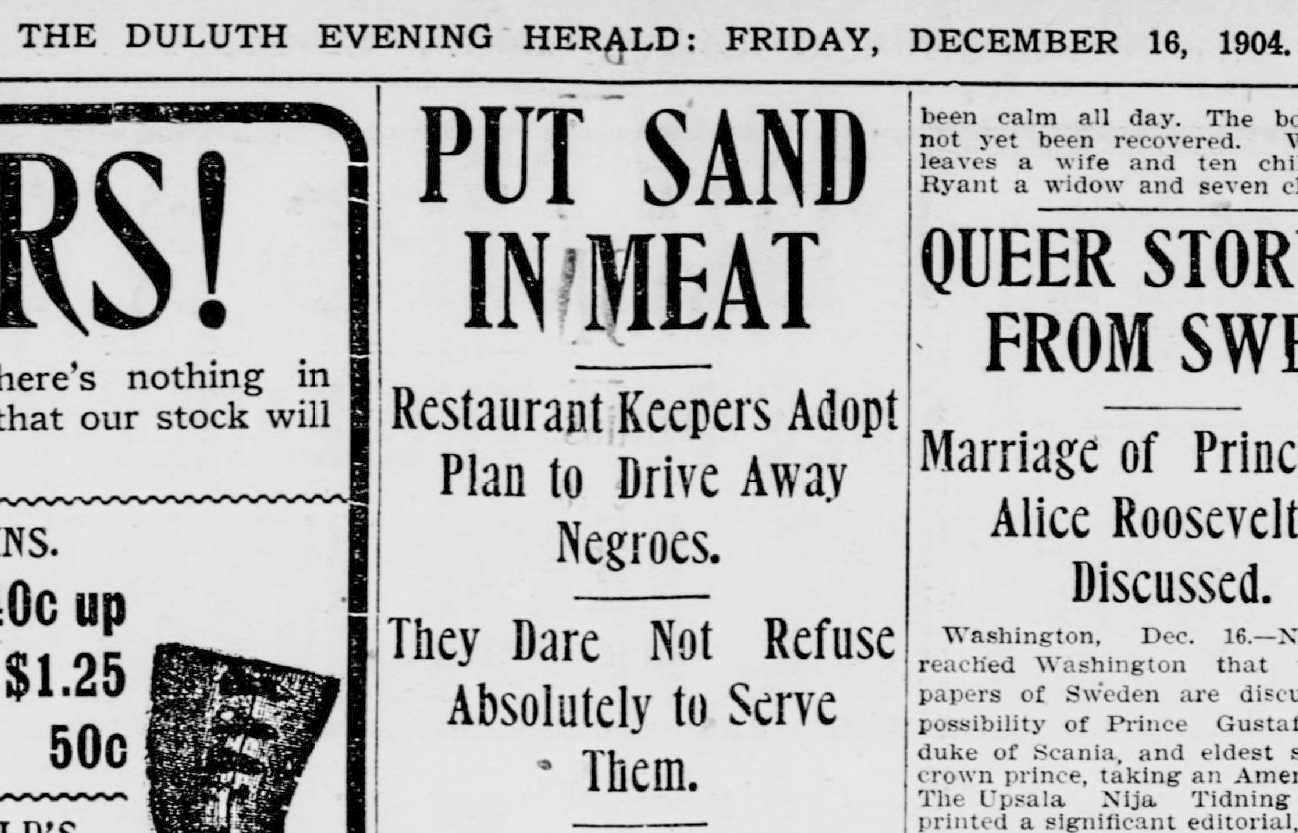
As a result of the damage suit instituted by Henry C. Richardson against M.B. Cook [the brother of B.J. Cook and co-owner of the restaurant] for refusal to serve him, some of the local restaurant proprietors have hit upon a new method for keeping negroes from frequenting their establishments.
Yesterday at the noon hour, two negroes recently arrived in the city from Minneapolis, entered one of the Superior Street restaurants and, ordered roast beef. The waitress took the order and after waiting for from fifteen to twenty minutes brought the negros their dinner. When they attempted to eat it, however, they discovered that the plate had been sprinkled with sand before the meat was placed upon it, and they were unable to eat a mouthful.
They registered a kick with the proprietor. who told them that they need not pay for the meat, but would give them no further satisfaction. They left without their dinner, and when last seen were headed for one of the Bowery restaurants.
“We are not responsible for the conditions that exist,” said a well known saloon proprietor in telling of the incident. Saloon men are confronted by the same problem. I have watched it closely for fifteen years or more, and it is impossible to make a first-class restaurant or saloon pay if you allow negroes to frequent it. It is not the fault of the saloon or the restaurant keepers. They have to live like the rest of the people and they cannot afford to encourage negro patronage.
“Of course I see the reason for the law. A negro might starve to death or freeze to death if he were not protected by the law, but you can count on the restaurant keepers trying every dodge they can think of to keep the negroes out or their places of business.”
The Richardson case has been appealed by Attorney J. H. Whitely and will be tried in the district court.
“I intend to carry it to the supreme in court in St. Paul if the district court does not reverse Judge Windom,” said Mr. Whitely today. “The law in the matter seems to me to be very plain and I believe my client is entitled to a verdict for damages under the statutes.”
Until the matter is finally settled, sand is likely to be in heavy demand by the restaurant keepers.
While Richardson’s lawsuit may not have ended racist practices in Duluth, it did bring considerable attention to the existing Minnesota law. While the filing of the suit and its setbacks were only reported in the Duluth Evening Herald, Richardson’s ultimate victory, while limited, made state news. In the days following the verdict, twelve newspapers across the state covered the story,19 making businesses owners across Minnesota aware of potential consequences for not following the law.
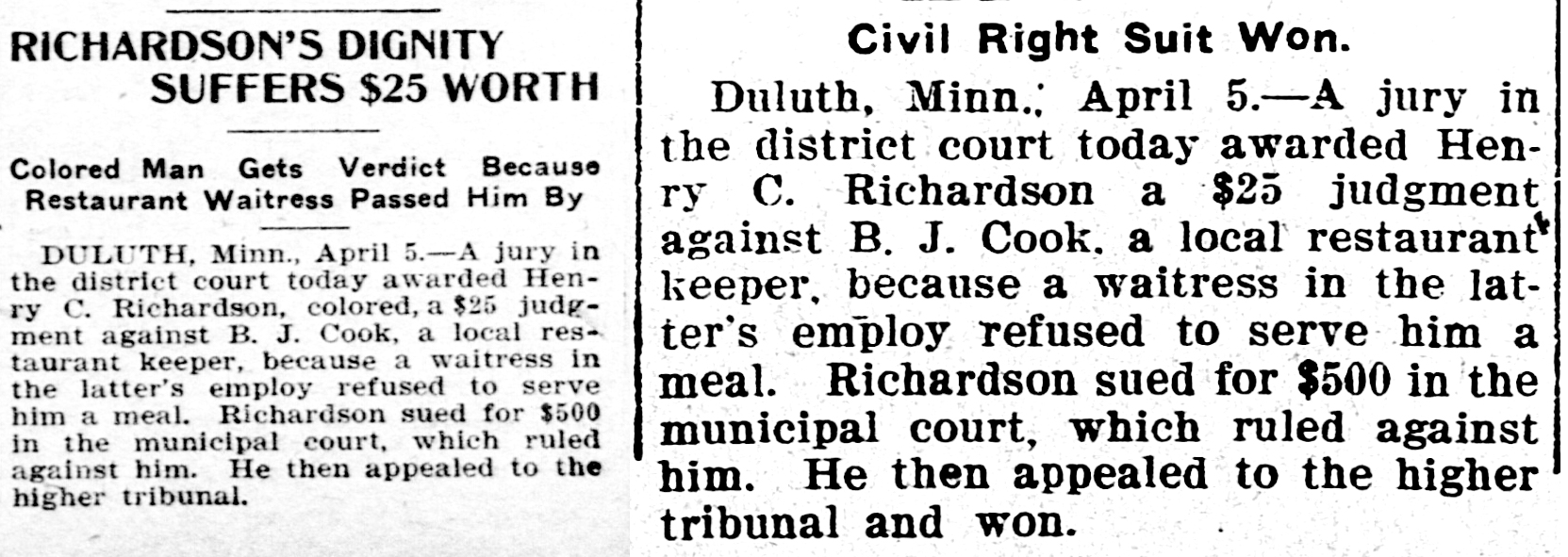
Results of the verdict as reported on April 6, 1905 in the St. Paul Globe, left, and on April 8, 1905 in The Appeal, a national Black newspaper also based in St. Paul.
It’s not clear if Cook specifically changed his practices. He sold the restaurant in the summer of 1905 and went into politics.20 He ran for city alderman of Duluth’s fourth ward,21 joining a Republican political coalition with Judge Windom, the same judge who originally ruled in Cook’s favor in the discrimination case.22 Cook only had one challenger in the primary, D.H. Saunders, a Black man working as a waiter in the Spalding Hotel who also belonged to Zenith City Lodge Number 14 of the colored Knights of Pythias, a membership he shared with Henry C. Richardson.23 Cook won the primary easily. The Duluth Evening Herald, under the assumption that only Black people would vote for a Black candidate, noted, “The picturesque contest in the Fourth ended as was expected and B.J. Cook had no trouble winning out. Saunders polled only seventy votes, which is about ten or fifteen less than the total colored vote in the ward.”24 It would take another 114 years, with the election of Janet Kennedy to the Duluth City Council in 2019, before Duluth would elect a Black person as a city council representative.
While Richardson’s lawsuit may not have changed Duluth restaurant practices or the city’s politics, it did not end Richardson’s fight for civil rights. While a significant portion Duluth’s Black population moved out of the city in the immediate aftermath of the 1920 Duluth lynchings, the Richardson family stayed. The 1922 Duluth City Directory lists him as still employed as an elevator operator at First National Bank and gives his home address as 729 E. Sixth St.
When the NAACP started a Duluth chapter in the aftermath of the lynchings, the Richardson family was actively involved. Henry’s wife Ethel and his daughter Myrtle sang and played the piano at Duluth NAACP meetings.25 In 1908, the United Brothers of Friendship and the Sisters of the Mysterious Ten, two related benevolent organizations that supported Black men and women, respectively, sought to establish chapters in Duluth. Their initial meeting was in the Richardson home.26
Henry Richardson retired from his position as elevator operator at First National Bank in 1937. He died on Nov. 13, 1953, two years before Rosa Parks sparked a sustained fight against racial inequality in the United States when she refused to give up her seat on a Montgomery, Alabama, bus. Annie St. Arnold, the woman who had refused to serve him, died five years later, on Oct. 14, 1958. When he died, Henry lived at 729 E. Sixth St., Annie at 824 E. Sixth St.. They lived 400 feet from each other for at least 34 years.27
At the time of his death, his daughter was living in Chicago and his wife had died some years earlier in 1928.28 His house went to his nephew Milton Richardson,29 the son of his brother William, who had worked alongside Henry as an elevator operator at the First National Bank from 1901.30
Milton Richardson, while still living in his uncle Henry’s home, made his own contribution to equity in Duluth restaurants. In the 1960s, the Gateway Urban Renewal project on West Superior Street resulted in the closure of multiple city bars. The owners had the opportunity to transfer their liquor licenses to other areas, but five business owners declined to do so, leaving the licenses open for new owners.31 In August 1965, Milton Richardson, who had started out his career working in Duluth as a restaurant porter in the 1930s,32 applied for one of those licenses. William Maupins, president of the Duluth NAACP, argued on Richardson’ behave in front of the city council with a speech that implied racial segregation in Duluth was still just as strong in 1965 as it had been when Milton’s uncle was refused a meal in 1904. The Duluth Herald gave the following report:
[Maupins] said the issue was whether a Negro had a right to own a bar and serve other people of his race. He noted that Richardson would be the first Negro ever to operate a bar in Duluth if he were granted a license. Harold B. Evans, chairman of the Alcoholic Beverage Board, lauded the council’s action. “Richardson’ place will serve a segment of the population of Duluth which has had no place to go in the past,” he said. “He will run a fine establishment.”33.
Richardson’s license request was granted34 and for four years he operated the Rendezvous Club at 21 W. Michigan St. On July 4, 1969, in the early morning hours while he was cleaning up after closing, he was murdered during a robbery by two of his patrons. Of the 500 people who attended his funeral, the paper noted that many were leaders of the Duluth business community.
In 1904, Henry Richardson challenged segregation in Duluth restaurants. In 1965, his nephew Milton became the first Black bar owner in Duluth. This essay told the historic account of two people from the same family who made Duluth a better place. The work of the Richardson family in Duluth, however, is not confined to the past. Before posting this Deep Dive, I reached out to Milton’s grandson and Henry’s great-grand nephew, William Richardson II, named after his father who was in turn likely named after his grandfather, Henry’s brother. In 2019 he graduated from the College of St. Scholastica with a degree in peace and justice studies and now works for a Duluth nonprofit serving homeless and at-risk youth. He recently volunteered with the Duluth Tenants organization to gather signatures and raise awareness for the Duluth Right to Repair ordinance, a measure created “to protect, repair, and maintain all of Duluth’s housing so all of us have safe, dignified places to call home.” Last November the measure passed by more than a two-to-one margin.
For Black History Month, the month’s Geoguessr challenge looks at places associated with Black history and civil rights.
Geoguessr Challenge: Minnesota Black History and Civil Rights
More information on how to play Geoguessr can be found here.
Notes
1Duluth Evening Herald, July 2, 1901
2Duluth News Tribune, Nov. 15, 1953
3Duluth Herald, Nov. 24, 1923; Duluth Evening Herald, Dec. 19. 1908
4 Duluth Herald, Aug. 4, 1930
5 Duluth Herald, May 5, 1932
6 Duluth Evening Herald, July 8, 1905
7 Duluth Evening Herald, July 8, 1905
8 Dultuh Evening Herald, Feb. 25, 1905
9 Duluth Evening Herald, Feb. 15, 1905
10Duluth Evening Herald, Feb. 15, 1905
11 Duluth Evening Herald, Dec. 2, 1904
12 Duluth Evening Herald, Nov. 28, 1904
13 Duluth Evening Herald, Dec. 2, 1904
14Duluth Evening Herald, Dec. 3, 1904
15Duluth Evening Herald, Feb. 25, 1905
16Duluth Evening Herald, March 1, 1905n
17 Duluth Evening Herald, April 5, 1905
18Stillwater Daily Gazette, April 6, 1905
19April 6, 1905: Stillwater Daily Gazette, The Minneapolis Journal, The Saint Paul Globe; April 7, 1905: Saint Cloud Daily Times, The Post and Record; April 8, 1905: The Appeal; April 12, 1905: Mower County Transcript; April 14, 1905: Little Falls Herald, Sleepy Eye Herald, The Plainview News, The Zumbrota News; April 15, 1905: The Northfield News
20 Duluth Evening Herald, July 8, 1905
21 Duluth Evening Herald, Dec. 18, 1905
22 Duluth Evening Herald, Jan. 11, 1906
23 Duluth Evening Herald, Dec. 1, 1905; Duluth Evening Herald, Feb. 11, 1896
24 Duluth Evening Herald, Dec. 20, 1905
25 Duluth Herald, April 25, 1922, Jan. 2, 1923, Jan. 22, 1923
26 Duluth Evening Herald, July 26, 1908
27 Duluth Herald, Nov. 15, 1953; Dec. 11, 1919; April 19, 1915; Oct. 14, 1958
28 Duluth Herald, June 5, 1928
29 Duluth Herald, Nov. 25, 1953
30 Duluth Evening Herald, July 2, 1901
31 Duluth Herald, Aug. 24, 1965
32 Duluth Herald, Oct. 30, 1934
33 Duluth Herald, Aug. 24, 1965
34 Duluth Herald, Sept. 16, 1965