

Duluth Deep Dive #14: The Last of the Transporter Bridges
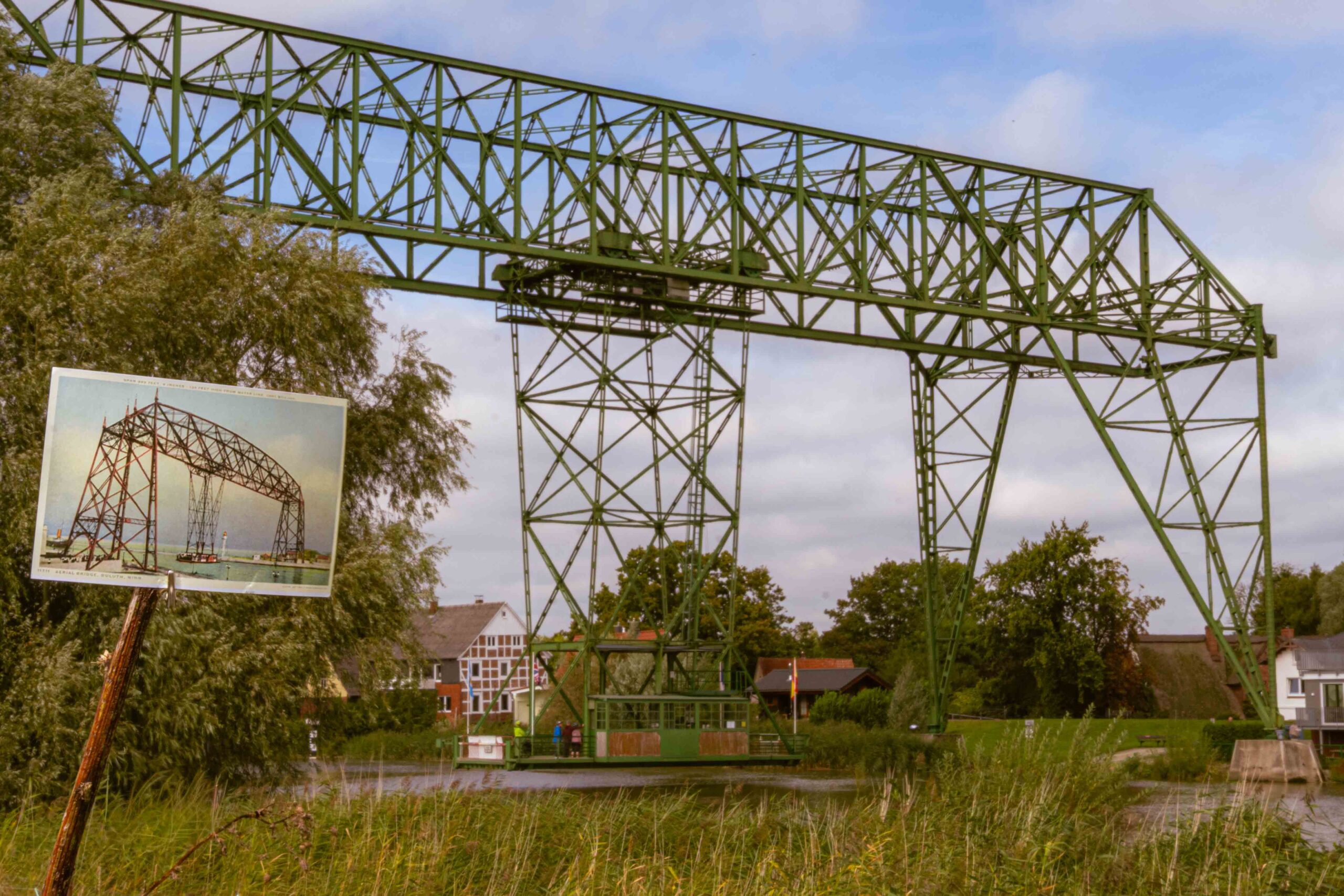
Germany’s Osten-Hemmoor Bridge with a postcard of Duluth’s transporter bridge in the foreground. (Photo by Matthew James; postcard from the University of Minnesota Duluth, Kathryn A. Martin Library, University Archives)
Growing up in Duluth, I often heard that the lift bridge was the only bridge of its type in the world. I later learned that the world is full of lift bridges. Wikipedia lists 137 of them. But that doesn’t mean the claim isn’t true. The lift bridge was once a transporter bridge, a far more rare type of bridge. Aside from various hand-cranked bridges that basically amount to art projects, fewer than two dozen transporter bridges have ever been built anywhere in the world. Only eight of those are still in use. And the world only has one converted transporter bridge in operation: Duluth’s Aerial Lift Bridge. This Duluth Deep Dive takes a closer look at what Duluth’s bridge was like before its conversion by recounting my visit to two of the world’s remaining transporter bridges. One is the closest surviving counterpart to Duluth’s original canal bridge. The other gives a sense what the Duluth bridge might have looked like if the city had modernized the gondola instead of making the conversion to a lift bridge.
Tony Diercken’s authoritative book Crossing the Canal describes how Duluth’s transporter bridge was the first of its kind in the United States when it went into service in 1905. Modeled on a transporter bridge in Rouen, France, that was destroyed at the start of World War II to slow the advance of German soldiers, Duluth’s bridge had a gondola that crossed the 135-foot span of the canal every 70 seconds. As the number of people living on Park Point grew, the neighborhood needed a bridge that could handle higher traffic volumes and in 1929 the transporter bridge was converted to a lift bridge by raising the height of the two towers while leaving the underlying structure intact. The steel structure connecting the two towers clearly reveals its history. A lift bridge built as a lift bridge doesn’t include a top as it constricts the height to which it can rise.

The old rail bridge in Rotterdam, a lift bridge built as a lift bridge, in raised position. (Photo by Matthew James)
The year that Duluth’s transporter bridge was converted to a lift bridge the Duluth Herald ran a story about a bridge in Osten, Germany, for those who were already feeling nostalgic for Duluth’s old transporter bridge. Under the headline “Copy, Not Ghost of Former Duluth Bridge,” a short article described a transporter bridge between Basebeck and Osten, Germany.
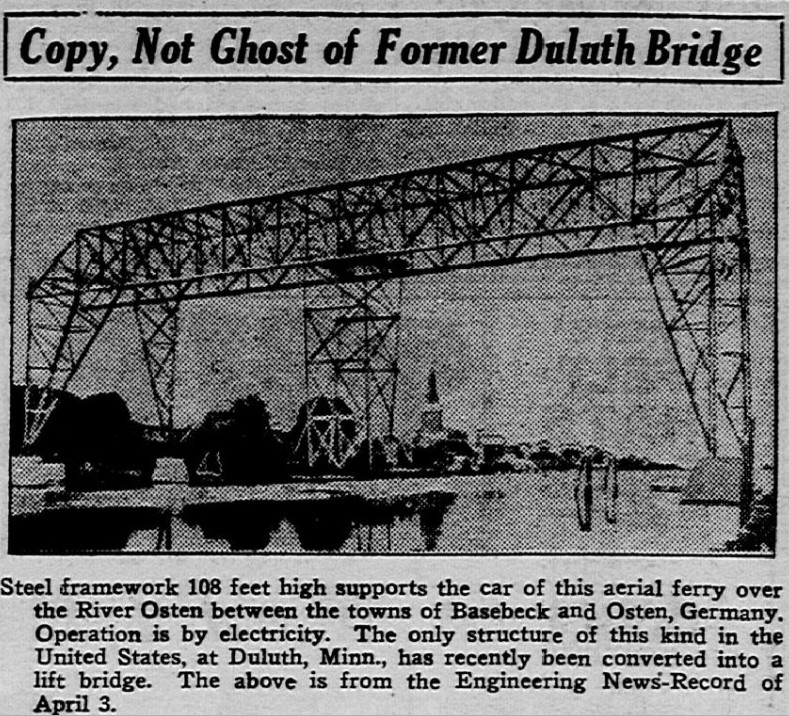
Newspaper story from the April 25, 1930 edition of the Duluth Herald, from the Minnesota Digital Newspaper Hub.
An independent local historian sent me a copy of the newspaper clipping. A quick Google search showed me that the Osten-Hemmoor Bridge still existed in Germany just outside of Hamburg. Opened in 1909, it is somewhat smaller than Duluth’s transporter bridge. The distance between the supports is 100 feet shorter than in Duluth. Its height of 125 feet is just 10 feet less than the original height of the Duluth bridge. While there are some differences in the shape of the supports, the basic design is the same, including a gondola with a space for cars and a small room for passengers to escape the elements. When a new bridge was constructed in Osten a few hundred meters away, the bridge lost its transport function but was spared from demolition by the local community and now serves as a tourist attraction run by volunteers.

The Osten-Hemmoor Transporter Bridge. (Photo by Matthew James)
I knew that I would be in the Hamburg area eventually, and when the opportunity arose I decided I would visit the bridge. The Duluth transporter bridge only exists as a structure to be imagined from old photographs. The Osten transporter bridge is still a functional object, something you can step onto and use to cross a body of water. I thought taking a ride on one would make the history of the Duluth bridge feel less abstract.
When I arrived in Hemmoor, I learned about more than just their transporter bridge. As you approach the bridge from the nearby town, a series of displays provide information on the world’s eight remaining transporter bridges. On my way back, I left behind my photo of Duluth’s transporter bridge on one of the displays.

Displays on the last of the transporter bridges. In the bottom right photo, the new bridge for car traffic is visible in the background. (Photos by Matthew James)
Despite being somewhat smaller than the Duluth bridge, its location in a more rural setting makes it just as imposing upon approach.

Approaching the bridge from Hemmoor. (Photo by Matthew James)
Perhaps because of the way the gondola is suspended over the water or the way it resembles a large Ferris Wheel car, some part of me expected to feel the gondola swaying as I crossed the river. But the steel beams connecting the gondola to the bridge, its relatively slow speed, and the placement of the motor on the top trestle meant the ride was both completely smooth and completely silent. I guess I expected a more dramatic crossing, but the lack of drama gave me just as much of a sense of what it would have been like to use the transporter bridge in Duluth.
I crossed back to the other side and waited to take some pictures of the bridge in operation from the banks of the river. It seemed the volunteer had gone to lunch, however. As I waited for her return, people approached the bridge by bicycle from both sides of the river and tried to figure out when the gondola would make its next crossing. And that’s when the fundamental flaw of the Duluth transporter bridge, and the unpopularity of transporter bridges in general, became apparent. A transporter bridge defaults to the ship traffic and needs the intervention of an operator for land-based traffic to cross. A lift bridge defaults to the land traffic and needs an operator to make the ship traffic possible. A transporter bridge only makes sense in situations with very heavy ship traffic and very limited land traffic. People on Park Point may complain now about getting bridged, but at least the crossing being inaccessible isn’t the default position.

A model of the bridge in a small museum on the Osten side. (Photo by Matthew James)
After giving the photo of the Osten-Hemmoor bridge from the Duluth Herald to the bridge volunteer (she found it quite funny because it referred to the town of Basebeck, which was a name she hadn’t seen in some time — it merged with Hemmoor in the 1960s), I made my way back to the train station as quickly as possible. I still had another trip to make before the end of the day. Of the eight remaining transporter bridges in the world, two of them happen to be about an hour outside of Hamburg, but along different train lines. If I wanted to visit them both in one day before the sun went down, I had to catch the hourly train back to Hamburg.

The main train station in Hamburg, the central hub connecting to both of Germany’s transporter bridges. (Photo by Matthew James with his new lens-ball)
The Rendsburg High Bridge is not a historical relic but an active form of transportation for the city. And it looks nothing like the transporter bridge that Duluth once had. It functions primarily as a railway viaduct across the Kiel Canal. My train rode across the top of it as I entered the city. The short distance between the elevated bridge and the ground level station requires the train to follow a 360-degree loop in the tracks as it approaches the station. At 8,156 feet, the viaduct itself is substantially longer than the Duluth bridge although it’s approximately the same height. A gondola hangs below the viaduct and allows people walking and biking to cross the 410-foot distance of the canal itself. The transporter element is the shortest route to a smaller town on the other side of the canal and often used by children on their way to school, so maintenance is scheduled around school holidays. The only other way across the canal within walking distance is a tunnel about a mile from the bridge. When the gondola collided with a ship in 2016, it totaled the gondola and it took six years to build a replacement and re-initiate service.
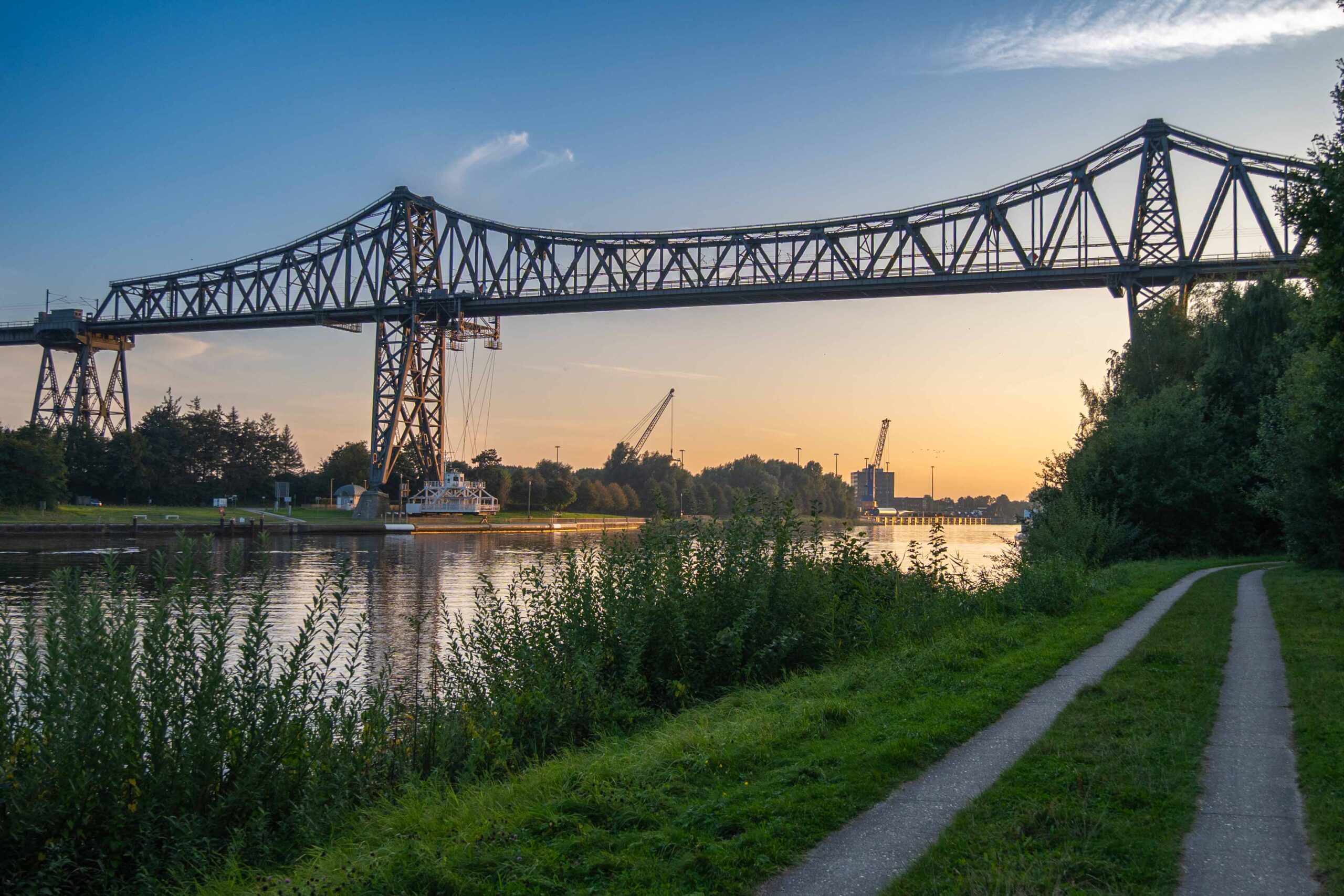
The Rendsburg High Bridge. (Photo by Matthew James)
While it doesn’t look like Duluth’s former bridge, it does give a sense of how Duluth’s bridge might have been updated if it hadn’t been converted. It shows how a transporter bridge can fit into a contemporary transportation system. Except on the day I visited, it was out of service. And the gondola was on the other side of the river. If I wanted a picture of it, I had to walk the mile to the tunnel and then walk another mile on the other side back to the bridge. I had already come so far; I figured I might as well go just a bit further. On the way to the tunnel, I walked by a closed outdoor café with a very odd looking metal frame surrounding it. Perhaps because it was surrounded by a fence that obscured it somewhat, it took me a moment to realize it was the old gondola from the bridge. I wanted a picture from a better angle and asked a man working near an entrance gate if I could enter the lot to take a picture. He replied, “Just pull on that second pole there and you can move the fence to the side. Then you can go in and take all the pictures you want. I’m the owner.”

The former gondola turned eatery, with the Rendsburg High Bridge in the background. (Photo by Matthew James)
After I took a few pictures, I talked to him for a bit. His name is Martin Sick and his relationship to the bridge makes up the last paragraph of the Wikipedia page. He explained that he purchased the old bridge gondola to preserve its history, making sure that in its conversion to a fish and chips stand the damage from the 2016 collision was still visible. He was also active in pressuring the city to get the gondola back in operation after damage to the cables was discovered in March 2025, which led to a discovery of a technical defect that had yet to be resolved to the satisfaction of the city. He talked for a bit about what the bridge meant to him and what it meant to the community, not just as a key transportation connection across the canal but as a part of the city’s history and identity. He also invited me to a poetry reading and musical event the next night that would use the old gondola as a stage, with the audience having a clear view of the bridge behind the make-shift podium.
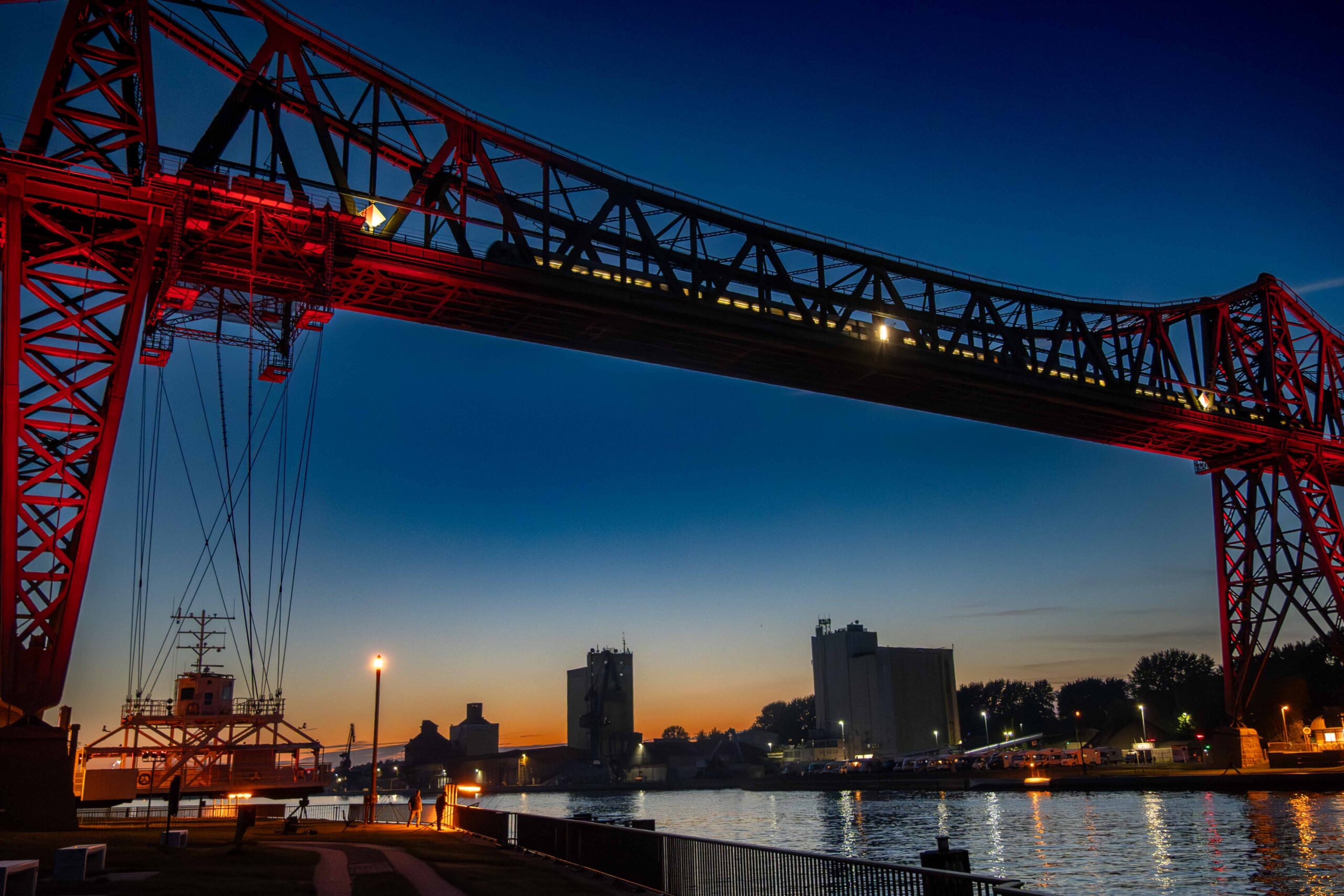
The Rendsburg High Bridge just after sunset, with a train crossing above and the out-of-service gondola below. (Photo by Matthew James)
When I finally made it over to the carriage on the other side of the bridge, the last of the day’s light was nearly gone. The few people fishing alongside the canal were packing up their gear and I had to adjust the light settings on my camera for my final transporter bridge pictures of the day. I was quite tired from my long walk to the other side, but seeing the more modern transporter bridge gondola coupled to the bridge did give me a better sense of how a transporter bridge would have worked in Duluth. Or maybe more specifically, how it would not have worked. Unlike the historic transporter bridge I visited earlier in the day, this one’s gondola was considerably larger and had space for about four cars. And that was still clearly not enough capacity for even a modest amount of car traffic.
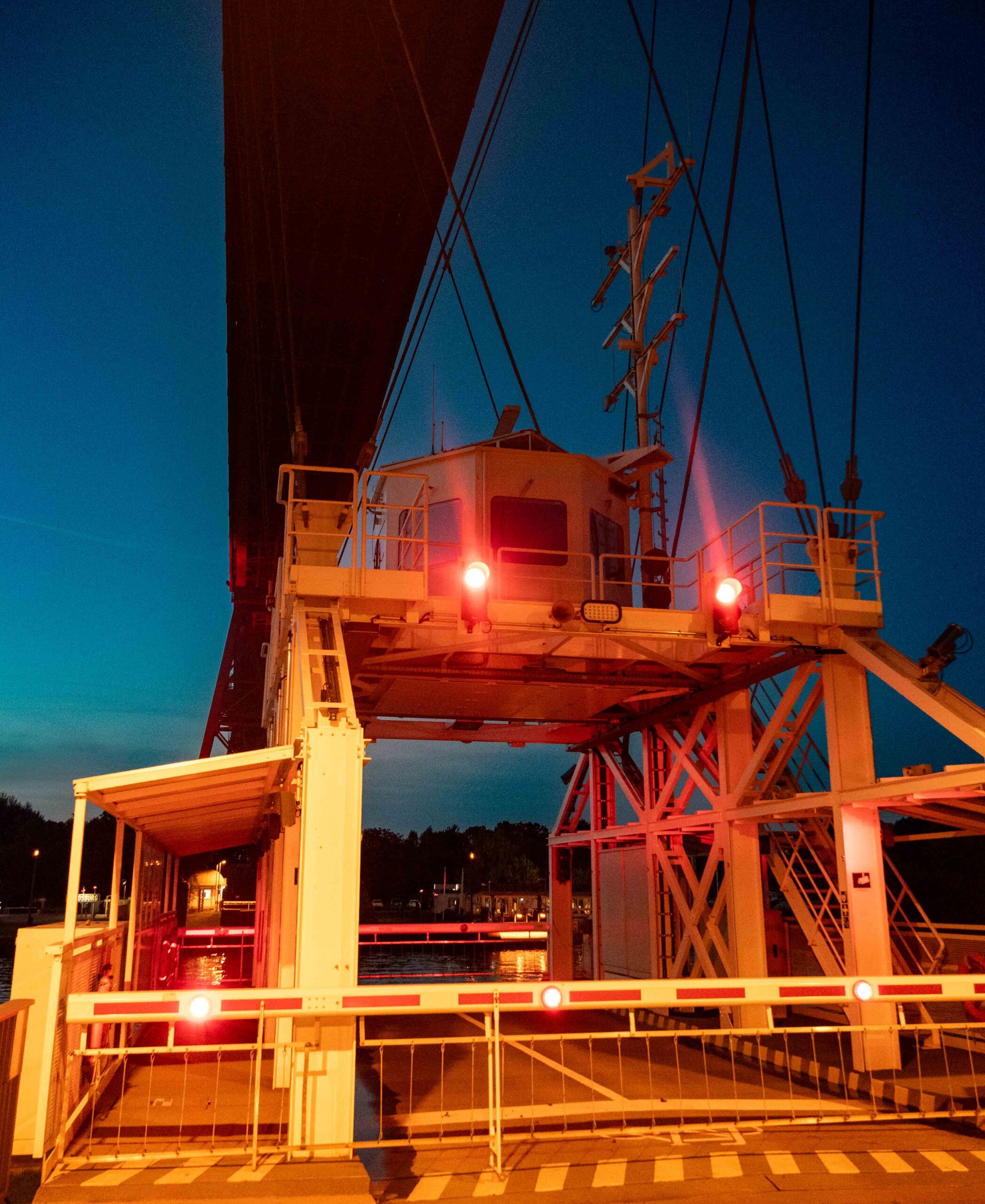
The current Rensburg High Bridge gondola. (Photo by Matthew James)
Given the backups that occur on both sides of the bridge when a ship comes into the Duluth harbor, I could immediately see why, even in the 1920s, the gondola was no longer a functional option for the connection to Park Point. Imagining what Canal Park would look like if the transporter bridge had been kept also means imagining an entirely different development history for Park Point, one in which Park Point might much more closely resemble Mackinac Island than a beach front residential neighborhood. The only way the gondola could function would be with severe limitations on car traffic, likely resulting in a Canal Park where tourists leave their cars behind and walk or take their bicycles to the gondola in order to reach summer cabins strung along a car-free Park Point. Just like before the conversion, some people may have year-round homes along the stretch of sand, but the limits on the gondola capacity would make transportation considerably less reliable, which is of course the reason the conversion was made in the first place.

The other way to cross the canal. (Photo by Matthew James)
As darkness fell and I walked back along the river to the tunnel, I thought about why the history of Duluth’s bridge seemed so abstract. I think most people, at least locally, are aware that it used to be a transporter bridge. But as far as I am aware, there are no interpretive signs with photos along the harbor entrance, no miniature models in the Lake Superior Maritime Visitor Center, and certainly no original transporter bridge gondolas serving as a canal park snack shop. And its name, the Aerial Lift Bridge, only refers to the more recent part of its history. If it were called the Converted Transporter Bridge, I think people might see it a bit differently. It might encourage visitors to shift their focus from the moving platform to the entirely redundant structure connecting the two towers at the top of the bridge. Of course both names are correct. It is a lift bridge but it is also the remnants of a transporter bridge. The lift bridge didn’t replace the transporter bridge, it exists within the frame of the transporter bridge. It’s not a complicated idea and yet it’s one that took me traveling to two transporter bridges on the other side of the world to fully process.
The Duluth transporter bridge isn’t just a part of Duluth history. It’s still there, all of its structure still present except the hanging gondola itself. That frame is a part of the first transporter bridge in the United States and a part of the only operational converted transporter bridge anywhere. Calling it the Aerial Lift Bridge does reflect its uniqueness as the only active bridge of its type in Minnesota. Calling it the Converted Transporter Bridge reveals its uniqueness as the only bridge of its type in the world.
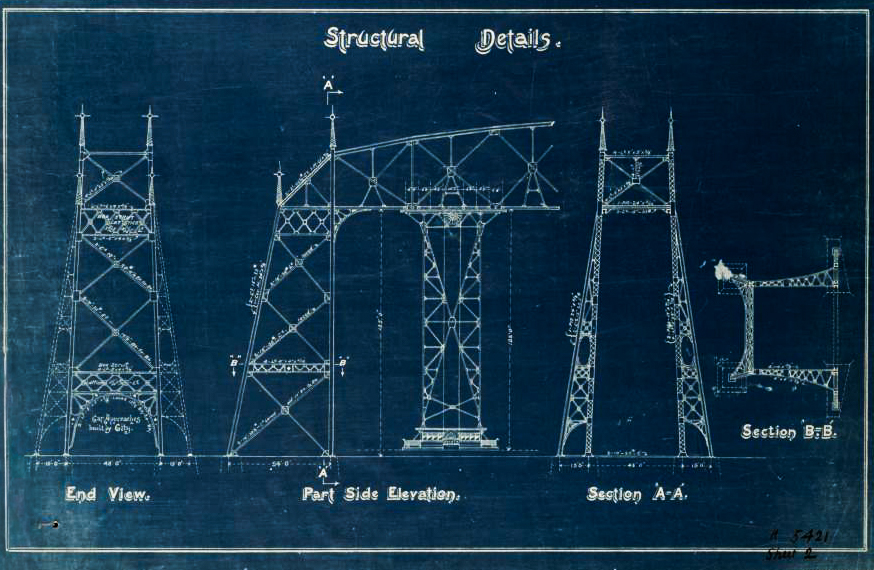
A structural drawing of Duluth’s transporter bridge from around 1903. (Drawing from the University of Minnesota Duluth, Kathryn A. Martin Library, University Archives)
This month’s Geoguessr Challenge looks at five of the other remaining transporter bridges in the world. Each round lasts five minutes.
Geoguessr Challenge: Transporter Bridges
A guide to playing Geoguessr can be found here.