

Mark Twain and Joseph Conrad Destroy a Duluth Hotel Suite
 Introduction
Historic hotels worldwide falsely claim the globe-spanning author Joseph Conrad was a former guest. However, it should come as no surprise that, while struggling with the untitled manuscript that would become Heart of Darkness, Conrad stayed the winter of 1898-1899 in a top-floor suite of Duluth’s Spalding Hotel. It was a suite he destroyed with Mark Twain after the two writers met in the gilt-muraled hotel bar and things got out of hand. The incident might have been forgotten but for the young Duluth Herald reporter on the scene who wrote an article about it.
Conrad, 41, the Polish exile living in England, was stranded in Duluth because he’d missed the departure of his cruise ship. He’d dashed into town to get a tooth pulled and it simply took too long. He was going to catch the next steamer out, but the freighter Marchande wrecked at the mouth of the canal. Then winter arrived and shut down the shipping season anyway — and he was only interested in traveling by ship. So although he missed his wife of two years back in England, he decided to winter in the Spalding, dreaming up ideas for his manuscript, and hopefully, a title.
Meanwhile Twain, 63, was in town one night for a private speaking engagement at the Kitchi Gammi Club. There, for a small fortune, he detailed his recent world travels, while inventing stand-up comedy wearing a white suit in winter. And he went directly from his lodgings at the Kitchi Gammi to the Spalding, and the world-famous writers had their one and only tête-à-tête. Conrad smoked gold-tipped Egyptian cigarettes he carried in an enameled tin. Invoices and receipts show he smoked Duluth’s entire inventory of these rare cigarettes for the 60 days he lived here. Twain smoked cigars of a Cuban-Sumatran hybrid shade-grown in Connecticut, of which he had several on his person.
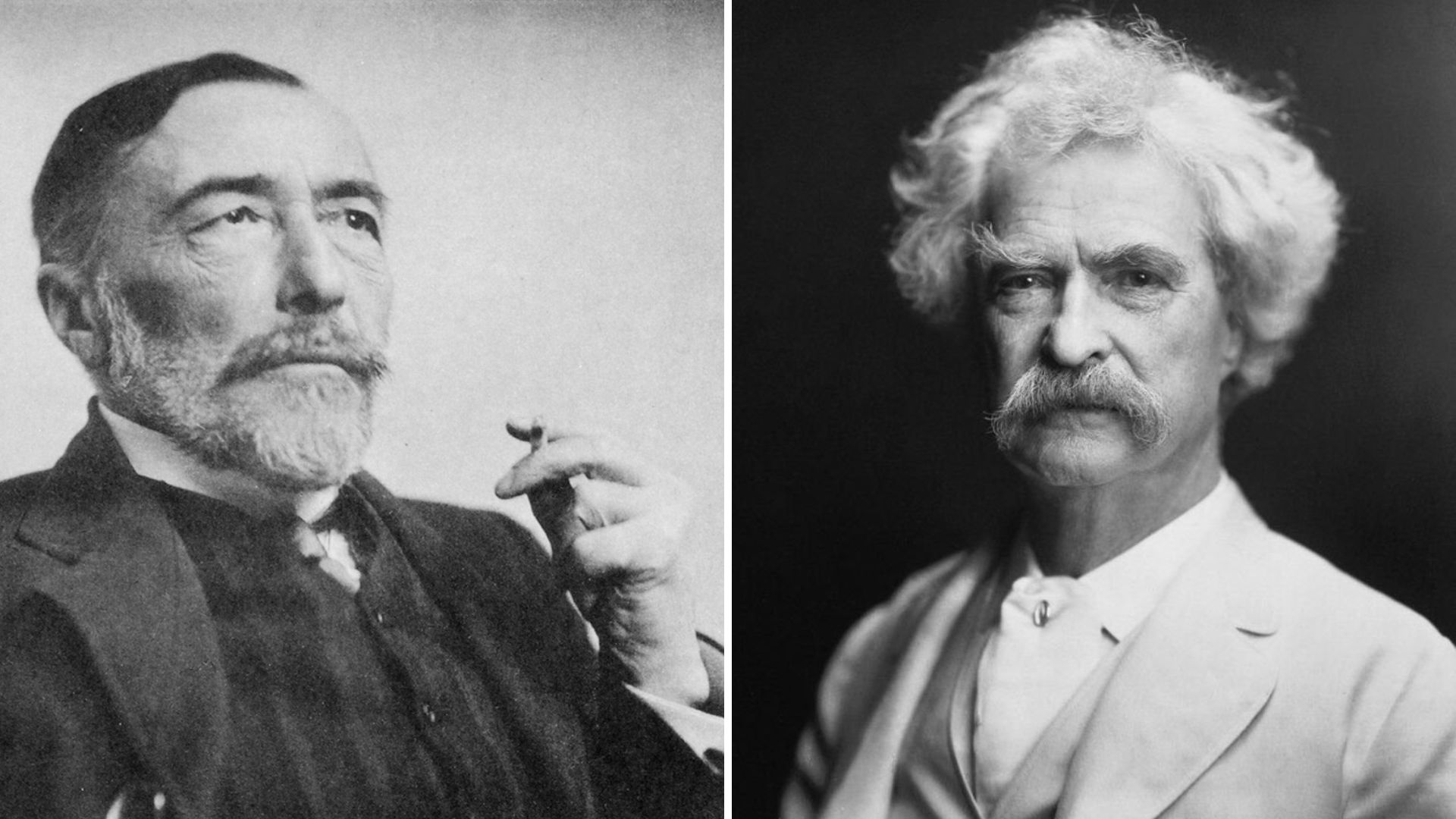
Twain wore Einstein hair before it was cool, showing all the signs of late-onset uncombable hair syndrome. Twain and his voluminous mustache had written most of his great works already. The salt-and-pepper Conrad, close-trimmed with a sharp-edged beard and pointy mustache, wore a black wool suit. He had yet to write most of his major works. Their meeting began in the bar, then adjourned to Conrad’s suite. During the night, they ventured onto the ice, exploring the seaman’s bar that had spontaneously arisen in the frozen wreck of the ill-fated Marchande. Returning to Conrad’s suite, they destroyed it like the rockstars they were:
Famous Writers Shipwrecked in the Spalding Hotel
Duluth Herald early-edition special report
Friday, Jan. 30, 1899
By Joe Crisp, Junior Shipping Reporter
Your trusty reporter received an assignment yesterday morning. It seems an author of popular yet literary sea adventures is stranded in the Spalding Hotel after missing the last cruise ship out. His name is Joseph Conrad, and he is the author of Almayer’s Folly, The Outcast of the Islands, and The Children of the Sea. Mr. Conrad is using his time here to work on his fourth novel, currently untitled. His cruise had been a sort of writer’s retreat anyway, and he still gets to see the water from his suite, so he doesn’t think missing his boat was a setback. I interviewed him in the hotel bar. But this below-the-fold article turned into the scoop of the century when in walked the most celebrated man in America, perhaps the world, Mr. Mark Twain. Nothing less than the father of modern American literature, he made a beeline for Mr. Conrad and introduced himself: “Someone told me, ‘Conrad is in town,’ and I wanted to pay my respects, as a lover of nautical fiction and river tales. Thank you, sir, for writing Almayer’s Folly.”
Conrad stood and gestured for him to sit, next to me at our bar table. “Nice to meet you, lad,” Twain said to me as if I mattered. I introduced myself and asked for his autograph. “We’ll get to that,” he deflected, more interested in Conrad. I didn’t even care that Twain was interrupting my interview, his entrance made this the most exciting thing since I joined the paper last year. I took shorthand notes throughout and committed the rest to memory.
I retain my notes but not my memory. The writers let me tag along and I stayed out of their way best as I could, but they handed me drinks even though I’d never tasted a lick. I took it slow on purpose but we drank all night. The barkeep came over. “Can I take your order?” Twain asked Conrad what he was drinking. Conrad replied, “Ever since I moved to England, I’ve explored the gin cocktail, and I continue those explorations marooned here.”
“Gin and tonics it is,” Twain said, “You want one, lad? Sure you do. A round of gin and tonics please — top shelf.” The barkeep walked away swelling with pride that he had spoken with Mark Twain.
“I’m writing another riverboat novel,” Conrad began, “untitled so far — it’s my Life on the Mississippi you might say — about when I went up the Congo River in a tin-pot steamboat. Many a time I thought of you scanning the water for obstructions and shoals; I thought of The Mississippi Pilot while I strained in the night looking for snags. You understand all that sort of job. It’s a craft.”
“Yes. Navigating the spurious menace of wind and sea.”
“The Congo is the deepest river in the world, more than 100 fathoms. Life on the Mississippi came closest to my own life. I read Innocents Abroad to my wife.”
Twain said, “I’ve piloted riverboats but never captained. The pilot is more important anyway, more prestigious.” Conrad agreed, saying, “I’ve worked all positions but only Captained twice, and it didn’t go well. So I left the sea to write. You never really leave it, of course.”
“You do not … How’s the weather treating you?”
“I don’t mind. Polish winters are not too removed from this. Yourself?”
“Well, I’ve lived in Buffalo, which fortifies a person. Where did I read you speak French with a French accent? But English with a Polish accent?”
“English is my fifth language. Not only do I speak it with an accent, but I am prone to write it using Polish grammar.”
“The effect on the page is liminal, extraordinary,” Twain said, “I’m also trying to put English words into English grammar.”
They shared their first laugh of the night. Our drinks arrived, they toasted, and I toasted with them.
They compared notes on foreign ports. Conrad was in Mauritius in 1888, Twain in 1895. They discussed the sugar oligarchy. They praised Herman Melville and denounced the evils of imperialism. Conrad told Twain about the atrocities in the Congo, finding him informed on the topic. Twain has become an ardent anti-imperialist, and that’s when the conversation and the additional rounds of drinks really started flowing. Both men are conservative but imperialism and racism drive them to distraction.
Conrad convinced Twain he had been an ass to the Indians. “I shouldn’t have said all that stuff,” Twain admitted, “There’s no native American criminal class except the Congress.”
This remark got a laugh and some light applause from the gathering crowd. Twain’s presence had drawn people together off the street to loiter and listen, while others gawked through the windows. So, Twain ordered bottles of gin to be sent to Conrad’s suite and we excused ourselves. Twain shook hands and signed autographs the whole way. His persona was even larger than his stories.
“You’re a great American,” the bellhop told him.
“I’m not a great American,” Twain shot back, “I’m THE American!”
Conrad’s Suite
We got to the 7th floor, walked the carpeted hall to Conrad’s door. He opened it and ushered us into the nautical-themed-wallpaper space, furnished with Victorian wooden furniture, brass fixtures, and lace curtains.
Conrad praised the writing of James Fenimore Cooper and Henry James, to which Twain responded, “Forget those guys,” using ruder language. Conrad furrowed his brow, perhaps a sign that, like Henry James, he considered Twain “a coarse, vain buffoon.” But the mood lightened when Twain mentioned Shakespeare and Cervantes in a single breath. Then the writers spent 30 minutes comparing and contrasting positivism and nihilism, and other words I do not understand. Conrad played bartender. He handed me a Tom Collins and veered the conversation back to imperialism. He’s seen colonialism up close, the chopping off of hands and so forth which seems universally to accompany such endeavors.
Looking toward the lake, we shared a strange and terrible vision of the darkness. From the spread of double windows we fell into endless night, a form of diffuse red light. The city’s Midwest housing stock and cute downtown ambiently underlit the low cloud cover, but any trace of luminance from Wisconsin was smothered. White ice lay barely visible against black open water, a pristine dark beneath the faintest illumination.
“And under the ice a sunless sea,” I said. The writers looked at each other and commenced to teasing me. Conrad, suppressing a smile, deliberately spoke the words, “A sunless sea — is that Coleridge?” “Looks like we got us a poet here,” said Twain, and they practically fell over laughing. They did in fact fall over.
We smoked and drank liquor and gazed at the mansion of night.
Conrad said, “It’s like the universe is going dark as the stars die. Man is a bad animal.” He handed me a gimlet.
Twain replied: “Worse than the animals. Man knows he does wrong. In 1866, I put a gun to my head, but I couldn’t pull the trigger.”
Conrad: “I was 21 when I put a gun to my chest, and I DID pull the trigger. Shot myself clean through, missing everything important. I know I have a heart in here, somewhere. Why did you want to end it?”
“The horror,” Twain replied, “the horror. Why did you do it?”
“Love, money, despair …”
“The classics.”
Conrad brooded archly, “The universe is a machine which spits us out, nothing matters, but I admit to look at the remorseless process is sometimes amusing.”
“The secret source of humor is sorrow,” Twain noted, fussing with his cigar.
We spied a set of illuminated portholes on the ice in front of the canal.
“The SS Marchande — the frozen wreck has become a drinking destination,” I volunteered, “or so it is said among my contacts — sailors and life savers. I bet that’s them out there. We should go.” The idea struck my dual interviewees as so exotic and deranged, they announced we simply must brave the ice and go like it was their own idea.
“And we’re bringing this gin,” Twain said, grasping an empty bottle.
As a local I was already dressed for such a wintry hike, a mile or so but arctic. My red flannel hunting jacket and canvas pants might not make me the best-dressed reporter in town, but I know I’ll be warm anywhere with my layers. You have to be prepared; I wear three pairs of socks in case I ever lock myself out of my apartment or something. But for these dapper out-of-towners — Conrad’s luggage probably in London by now — we leased some more-or-less color-matching garments from the hotel’s in-house haberdashery. Boots, caps, gloves, heavy coats, and a pair of lustrous wool cloaks with fur collars, one black and one white, supposedly left behind by Scandinavian royalty years ago and become prizes of the hotel collection. Twain donned the black one and Conrad wore the white one. Twain looked like a first among equals. Conrad looked like a nobleman, his family’s legacy shattered by the Russians. But he wore it well with the ramrod spine that is his only inheritance.
The Wreck of the Marchande
We absconded to the Marchande until the wee hours.
To get there we left the hotel, wended our way four blocks to Lake Avenue, and crossed the train tracks. We scrabbled down a rim of snow and ice to step onto the lake. Thin snow lay on the surface like an even application of powdered sugar. We treaded carefully and as the shore fell behind and the leaning tower of the Marchande’s forward pilot house rose up, we felt the presence of the water waiting under the ice; it had claimed this 300-foot ship and would happily claim us as well. Until then, it waited.
The Marchande’s cargo had shifted, so her ass slipped beneath the waves near the end of the shipping season as previously reported in this paper. She limped toward the canal hoping to make it through, but failed. Luckily no lives were lost even though the boiler exploded in the flood of cold water; the explosion blasted the chief engineer up through the deck, but he survived and was pulled to safety. The way she sank, the bow retained air and buoyancy long enough for winter ice to lock her in place, sticking out of the water at an angle. The whole lake isn’t frozen but the western tip of it is, from the canal to beyond Leif Erikson Park, all the way to Wisconsin a foot thick. During the day people play hockey around the wreck. The ice prevents the Park Point ferries from running. They say there will finally be a bridge in a few years, but for now the Park Pointers are skating the width of the canal pulling sleds of groceries, grumbling about the bridge delays.
The pilot house is bisected by the frozen waterline that partially fills the off-center space. Walking in on the flat ice, you duck through a diagonal door into a disorienting room, spiral staircase likewise tilted leading to the cockeyed wing deck. You have to climb the floor to get to the ship’s wheel, and when you look out the windows, you see the Marchande is pointed at the featureless sky.
The Life-Saving Service, in going out to the wreck and planning how to salvage it come spring, set up shop in there where everything’s off from true. The furnishings are bolted to the floor, but the floor is more like the wall. The real floor is the ice, and you walk on it with the ship’s interior suspended around and above you, lit by whale oil. The life savers have been there every night, this is their clubhouse and play-fort. It has a limited lifespan equal to the life of the ice sheet socking us in, probably early-mid March. But the life savers plan to float a crane as conditions allow, and move the Marchande out of the shipping lane for salvage. Meanwhile, they’ve axed through an iced-up doorway and, with the aid of a diving suit, excavated a few cases of vodka from within the frigid belly of the wreck. The vodka now belongs to them by the law of the sea.
We approached the wreck and the glow of the portholes showed it was not a scrim of snow we had walked across, but a field of uniform frost flowers. I pointed this out to the writers and we bent down, as much as we were able, inspecting the crystal rosettes on the inside of the light curve. Each was framed by black water under clear ice.
Conrad uttered, “It’s like walking over your own death.”
The ice sheet made a flexing sound which echoed within the core of the ship.
“I’ve only heard weirder noises in Tesla’s lab,” Twain said. “And, as then, I expect to die any minute.”
The watermen in and around the wreck were salt of the earth: eight or nine life savers and sailors, plus wives and girlfriends. They gathered by the wood stove they’d sledged in here, piping the smoke out a porthole, and using an assemblage of ice blocks as a bar to serve frozen vodka shots. Conrad’s eyes lit up at the prospect of vodka; for him, it was nostalgia for Eastern Europe in liquid form.
No one could believe Mark Twain walked in but there you have it. He shook everybody’s hand and regaled all with tall tales and even a couple investment opportunities. Most present had not heard of Conrad who Twain generously introduced. Conrad was eager to discuss seamanship and maritime law, asking detailed questions that made each person feel understood. Both writers held court discussing faraway cities and marine adventures.
We saw cigars drying on the woodstove. Mr. Joshua Nettleton Jr., the keeper of the Park Point Life-Saving Station, explained, “We recovered these from the wreck. Here, this one’s dry now.” Twain muttered, “Drowned cigars … How deep is it here?” Nettleton lit the cigar for him, saying, “Just so deep and deep enough. We are standing over 12 fathoms. This is not only the head of the lake, but the mouth of the St. Louis River. It’s frozen to a trickle now, but when it thaws, its force will concentrate through the canal and sweep the ice sheet out to sea. Then we can move this wreck and Mr. Conrad can sail for home.”
I was getting cross-eyed taking notes under these conditions, but I persevered in my journalistic ambition. There is a taint of death in lies, therefore I must tell the truth. My elation was so pleasurable that whenever it flagged, I hastened to order another shot.
Wobbling back to the hotel, Duluth’s panoply of lights rose above us, the homes and downtown cheering the dreams of Edison.
The Wreck of the Spalding Hotel
After stumbling back to Conrad’s suite like drunk penguins, the writers discovered they had each been eleven years old when their fathers passed away.
Conrad said, “My greatest regret is that my father died when I was eleven.” He handed me a martini.
Twain countered, “My greatest regret is that my father lived until I was eleven.” I did a spit take.
They grew sullen as the memories crowded upon them. Conrad’s aristocratic veneer dropped. He said he felt guilty for choosing exile over resisting the occupation of his homeland. That brought out Twain’s guilt for getting his brother a job on a steamboat that subsequently, fatally exploded.
Conrad wept for the hopelessness of his fractured nation. Twain wept for America’s failed reconstruction. I wept to see them weeping.
They started yelling, “Forget imperialism!” and “I’ll turn this place into a God-damned warehouse!” They took shots. “For the disgraced muskets!” They hurled the glasses, smashing picture frames and electric lamps. “For the wounded flags!” They tossed a victrola out the window; it played “Hello Ma Baby” all the way down until it smashed on the sidewalk. “You could have killed someone!” A mutual stunned silence collapsed into giggles, then howls of laughter.
After a few noise warnings, Sherriff Buzzcock himself cop-knocked on the door. Mr. Twain answered — miraculously standing, hair particularly uncombable. The Sherriff let him off with yet another warning — how could you not be awestruck by Twain, even in a depraved condition? The Sherriff implored us to respect the other guests and the citizenry at large: “It’s nearly four in the morning, sirs.”
Conrad turned to Twain at that moment and said, “I read your masterpieces in the cheapest, unauthorized editions, with cardboard covers.” There was a long pause, then a mutual, uncontrollable laughter between the writers and myself. The Sherriff left shaking his head.
Postscript
Conrad gave Twain the bed while he took the couch. I curled up on the rug in front of the fire like a dog.
Twain sat up before first light and began dressing. He had to meet the motorcar he’d hired to drive him to his next engagement in St. Paul. He complained of having a nightmare about being poor. Otherwise, he appeared to suffer no ill effects from the night’s excesses, which had ended not a couple hours ago.
He put money and a check on the coffee table. “That’s a generous tip for housekeeping, and a blank check for damages.”
Conrad, so hungover he could barely see, mumbled from the couch, “I am skint and so can’t leave anything toward damages. This layover has not been cheap.”
Twain: “Maybe you should cut costs, smoke cheaper tobacco.”
Conrad: “You must be joking.”
Twain: “Don’t stand, I’ll see myself out — gentlemen.” And he was gone.
Groaning, Conrad turned on his side to reach his manuscript on the coffee table, from under a stack of bottles that fell. The clattering pained us both.
“Quick man, something to write with!” he barked. My notepad was close at hand by a cigar burn in the Persian carpet. I tossed him my pencil but it landed in an empty glass. He fished it out, and on his blank manuscript cover, he scrawled the words “Heart of Darkness.”
By the time Conrad shooed me back into the world, I was despondent at having forgotten to get Twain’s autograph. But later in the day while writing this article, I found a handwritten verse in my breast pocket. It was a parody of Coleridge’s “Kubla Khan”:
“In far Duluth did one Joe Crisp
A stately pleasure-drift decree:
Where St. Louis, the sacred river, ran
Through taverns measureless to man
Down to a sunless sea.
Weave a circle round him thrice
For he hath drunk the booze of paradise.
— Your friend, Mark Twain.”
An index of Jim Richardson’s essays may be found here.