

The Fine China
 My maternal grandmother purchased a nice set of porcelain dinnerware in 1953. That was back when ladies got all giddy over fine china. One of my grandmother’s sisters had the same set of dishes. Perhaps they were thinking they could lend each other matching teacups if either hosted a large gathering.
I’m certain my mother told me all the details related to the fine china numerous times over the years, but I didn’t really pay attention because she was talking about fine china and no one cares about fine china anymore.
Ten days before I was born, in 1972, my grandmother died. It’s a strange kind of grief for me to carry, because it comes with a sense that it began in utero. The idea of my mother’s sadness transferring to the fetal version of me is a little silly, of course, and probably manufactured entirely in my imagination, but still, my grandmother holds a heavy emotional sway with me for someone I never met. It is at least true that I entered the world into a family in mourning. Learning about it later is enough to make it a memory. When I see a photo of my grandmother or hear a story about her, it punches me in the gut because we came so close to meeting but never did. If a story about my grandmother involves fine china, however, my mind will wander because there are few things less interesting than fine china.
After my grandmother died, I’m not sure what happened to her dishware set. It might have been boxed up by my mother and stored away, or it might have been combined with my grandmother’s sister’s set. What I do know is that after my grandmother’s sister died in the mid-1980s, all the fine china was at my childhood home.
We didn’t use or display the fine china, of course, we kept it in the deep recesses of the basement. New technologies had brought changes to the kitchen. Porcelain with decorative paint and metallic trim could be damaged by microwave ovens and high-temperature dishwashers that use strong detergents. Also, I was a teenager in the 1980s. There is no greater threat to fragile things than adolescent males. Grandma’s china needed to be protected from me.
By the time I moved out of my parents’ house, it was still an unsafe place for breakable stuff. Grandchildren were stomping around. And again, because of dishwashers and microwaves, fancy tableware has basically been rendered useless forever.
So my grandmother’s pride and joy remained in boxes. To my surprise, my mother had actually written “fine china” with a black marker on the outside of the boxes. This seemed rather highfalutin to me, because as modest Minnesotans we’re supposed to call them “the good dishes.” But apparently we aren’t hiding our status as West Duluth royalty. We have fine china and will not euphemize our generational wealth. No one has informed me yet whether it is “antique” or “vintage” fine china. I’m sure it’s one or the other.
Eventually my parents became elderly and needed to sell their house and move into a small apartment. There would be no space for storing things. It was time for someone of the next generation to inherit Grandma’s fine china.
I don’t know if being the youngest of four children made me first or last in line to inherit the ornate crockery, but my mother gifted it to my wife and me with great sentiment — as if we were the first to be offered it — and we seemingly had no choice but to accept.
We knew instantly there would be no space in our small home for a fancy 16-piece dinner set, so I appealed to my siblings to please claim it. They all laughed and waved it off.
So in the rush to get the last things cleared out of my parents’ house, I hustled the three boxes of formal tableware to a shelf in my garage, where it all sat for another seven years.
Shortly after my parents died, my wife and I found a house we were in love with and decided to move. It was time once again to consider the fate of the fine china. Our new house would have a little more living space, but a lot less storage space. We needed to either find a way to display and/or use our inherited cups and saucers, or get rid of them once and for all.
About a month before the move, my wife went out to the garage to go through some things. She opened one of the boxes to have a look at the nuisance dinnerware. And suddenly she was sobbing.
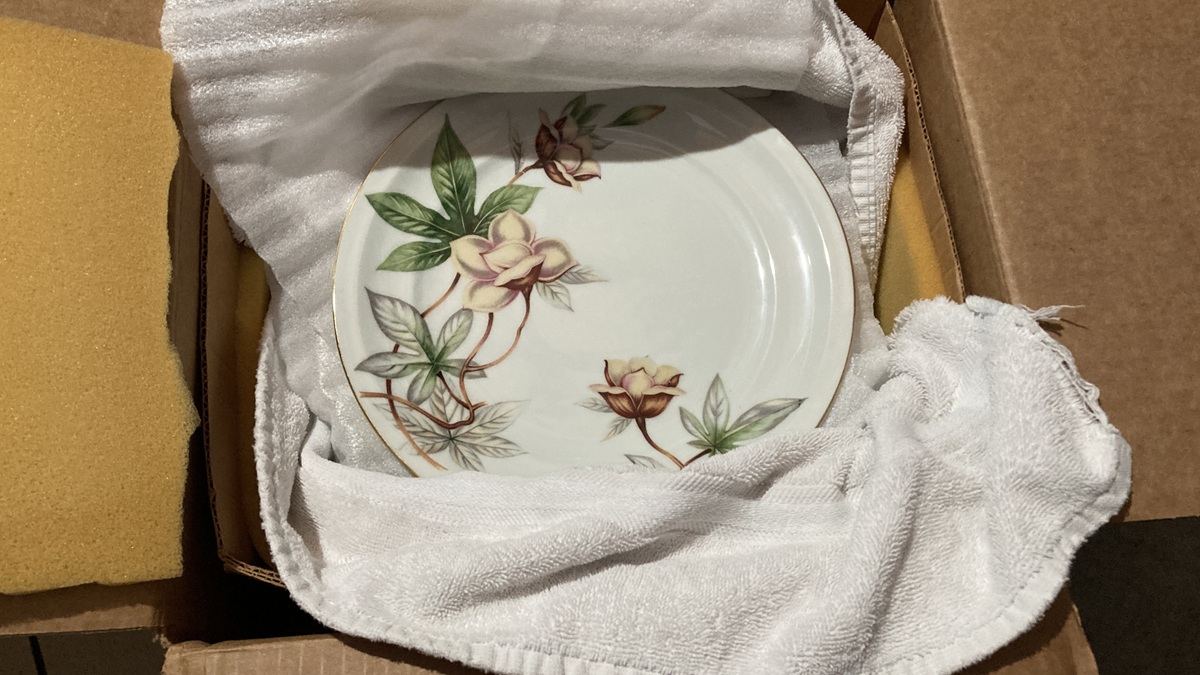
The fine china; stored with care since the mid-1980s.
I was in the house on the couch when she came in and told me, “We’re going to use your grandmother’s china at the new house. It’s beautiful.”
I reflexively began my monologue of reasons why reality will soon set in and we will not use the china set, but my wife interrupted.
“It’s really nice,” she said. “And the way your mother packed it up with such care. It obviously meant a lot to her. She even left a note with it.”
I was instantly persuaded. Suddenly I couldn’t believe we had been so eager to get rid of the fine china. What kind of heartless animal considers it a burden to hold on to something precious from his granny? It’s not just a duty to maintain family heirlooms like this, it’s an honor and a blessing.
When we moved into our new home, however, it became clear there was no room for china in the kitchen unless we used it exclusively and got rid of our more practical dishware. So we wedged the boxes of china on the lower level of a large shelf in the garage, where it will remain until it becomes someone else’s blessing.