

Superior Street, Sept. 11, 1907, Part 4: The 400 West Block
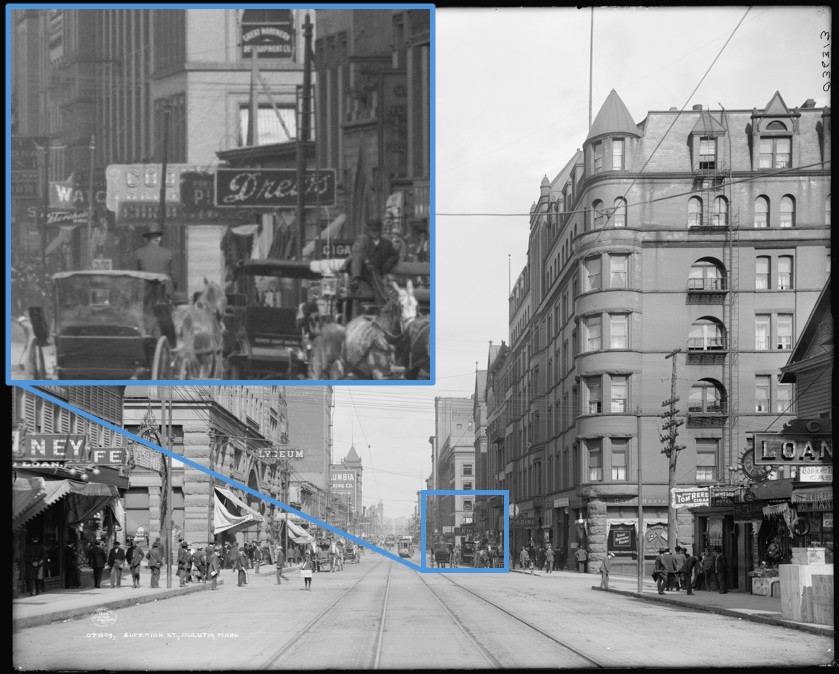
This series takes a detailed look at life on Superior Street on the afternoon of Wednesday, Sept. 11, 1907. The first part of the series provided background details on a photograph shot that day where the street intersects Fifth Avenue West. Part three looked at the businesses around the Spalding Hotel. Part four looks at the people who occupied the remainder of the Spalding block, including “old Nick Drew, erstwhile gambler, rounder and saloon-keeper.”
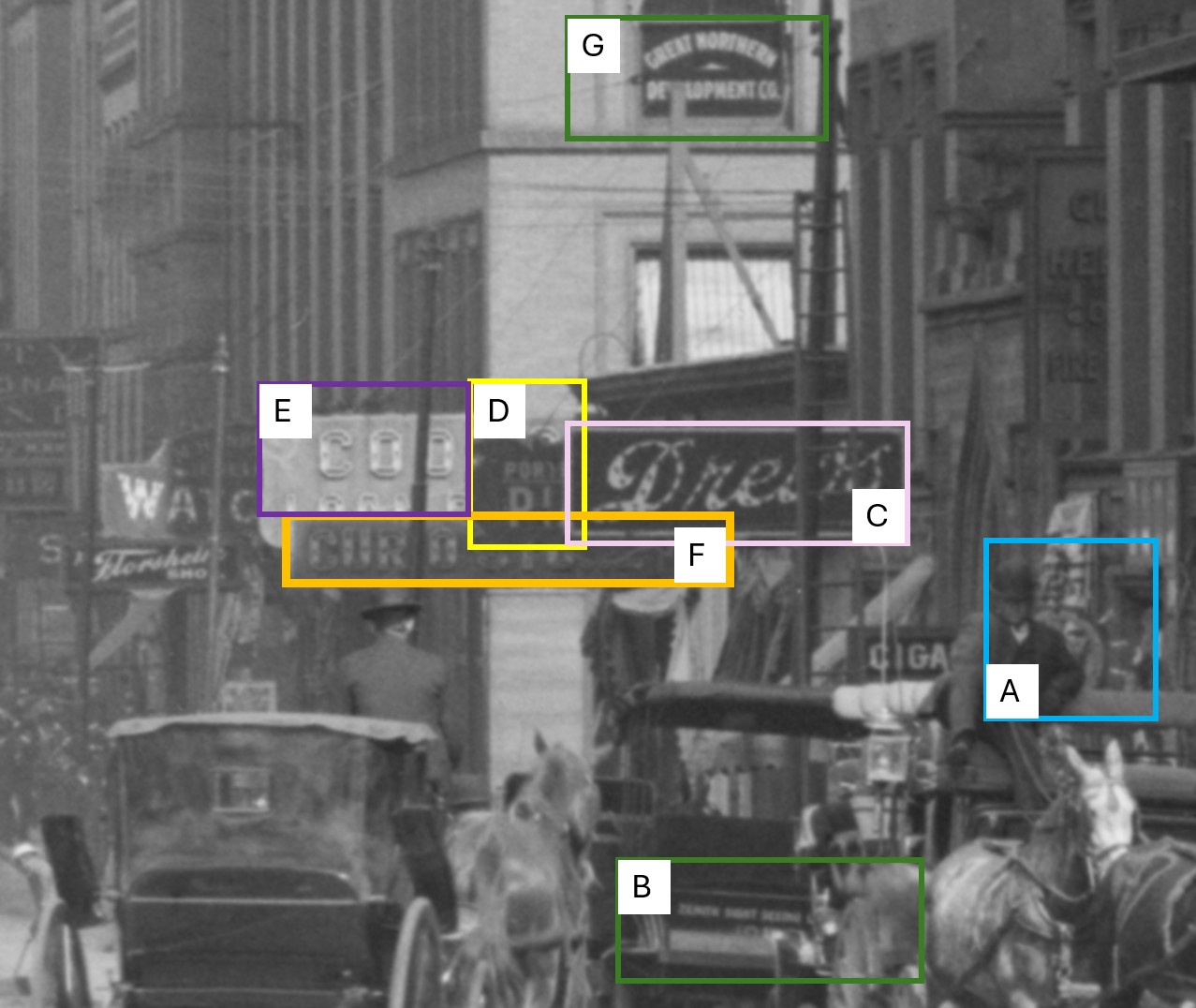
A. Louis Oreck’s Curio Store, 416 W. Superior St.
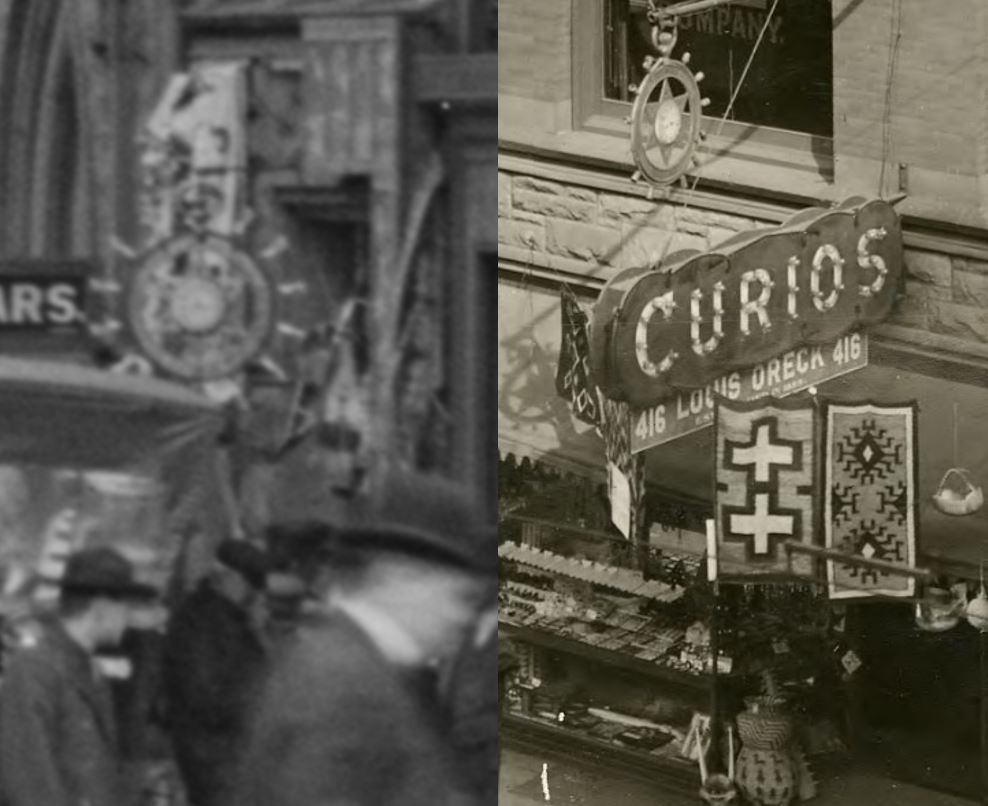
Left: A star in circle hanging from a store business in the 1907 photo. Right: Louis Oreck’s business with the same hanging ornament in a later photo. (Source: Library of Congress)
While his business sign may be obscured by the carriage driver, a part of the star-in-wheel sign of Louis Oreck’s curio business is clearly visible. Nothing of the prominent CURIOS sign itself can be seen, suggesting the photo was taken while Oreck was transitioning the business brand from a jewelry store to a shop specializing in novelty items, as seen in the series of ads below.
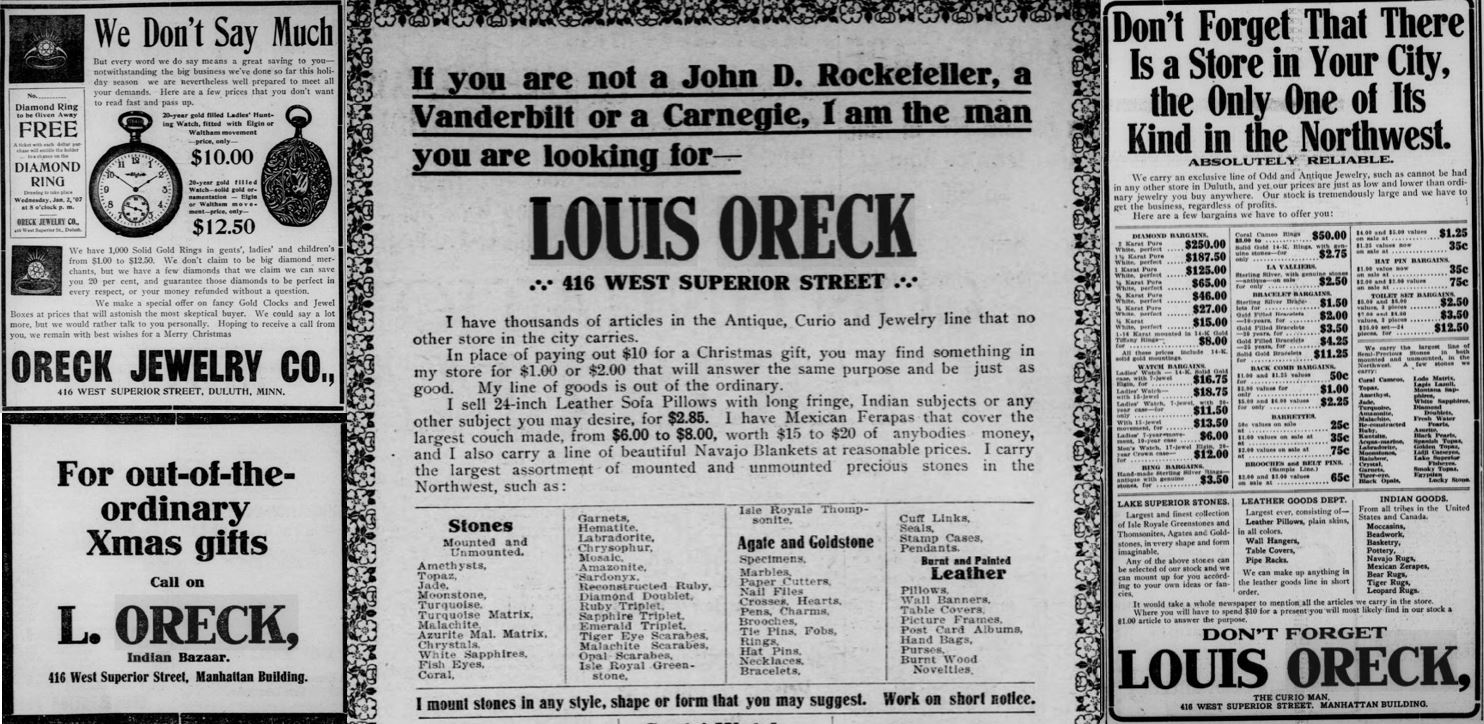
Ads for Louis Oreck’s store. (Sources, from left to right, top to bottom: Duluth Evening Herald, Dec. 19, 1906; Dec. 20, 1906; Dec. 18, 1908; Dec. 16, 1910)
B. Zenith Sight Seeing Company
A vehicle with an open cabin, canopy roof, and no windows is parked just outside of Drew’s. The back reads “Zenith Sight Seeing.” While no records of this company exist in the newspaper archives or online, this appears to be an early sightseeing bus that likely gave tours of the city and was parked near the Spalding Hotel to attract tourists. The small rubber tires and chassis structure show that it is not a horse-drawn carriage.
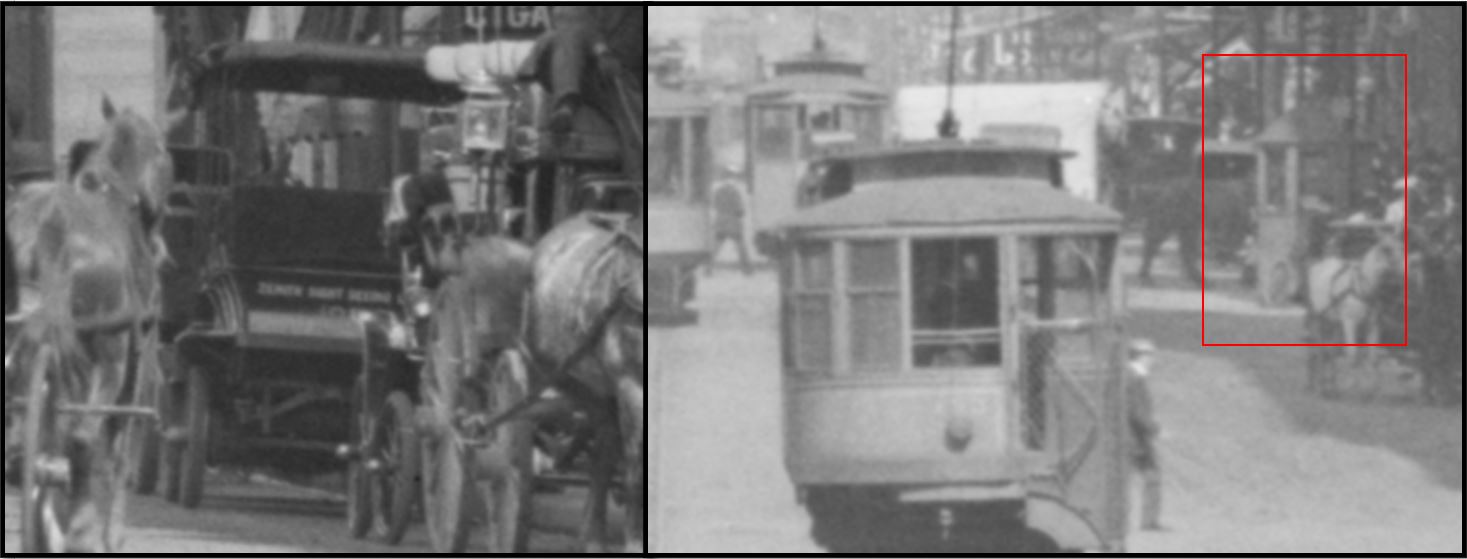
Left: The Zenith Sight Seeing Company Van. Right: A Traffic Control Kiosk.
It is one of the few motor vehicles visible in the photo. The wheels of another early car can also be seen in front of the touring bus. A sports car is parked across the street. As of May 24, 1908, about eight months after the photo was taken, Duluth had only 176 registered motor vehicles, which were a mixture of gas, electric and steam powered cars. The first electric traffic light wasn’t installed in the United States until 1914, and farther down the street at the intersection of Third Avenue West, the photo shows a traffic officer kiosk used by the police to monitor the chaotic mixture of private cars, horse-drawn carriages and streetcars.
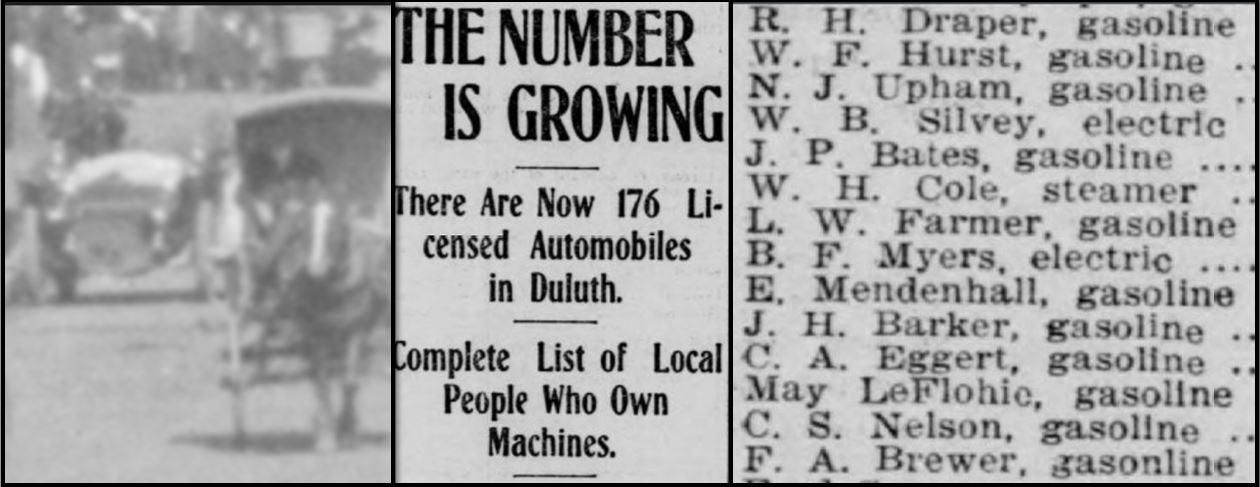
Left: What appears to be sports car on the north side of Superior Street in the photo. Right: An article listing all of Duluth’s car owners. (Source: Duluth Herald, May 24, 1908)
C. Drew’s Saloon, 410 W. Superior St.
Nick Drew, the owner of Drew’s Saloon, got his start in Superior. In 1895, he operated a saloon with a gambling hall above it.[33] He later owned several bars and restaurants in Duluth, including a saloon in West Duluth[34] and the Manhattan Buffet in the same building as his downtown Superior Street saloon.[35]
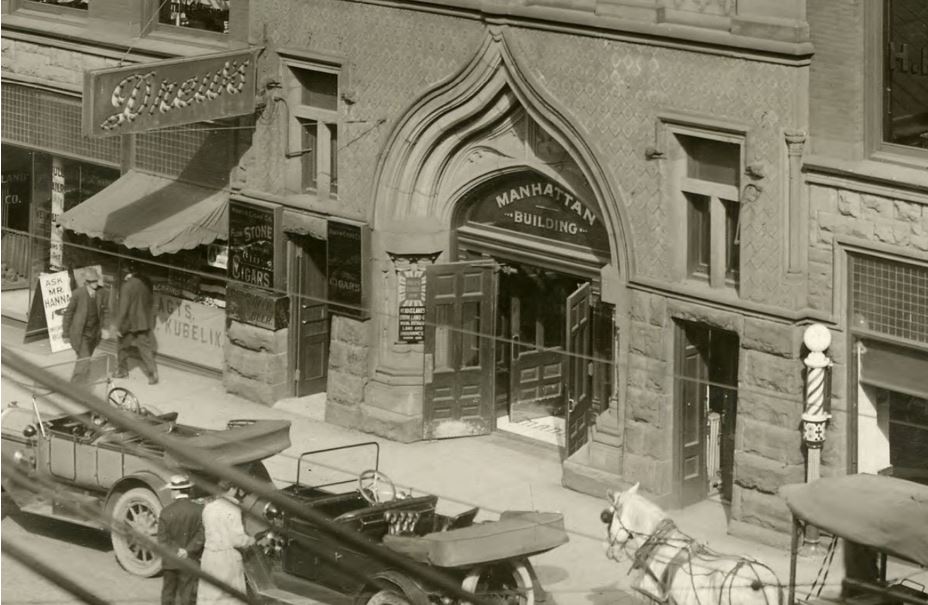
The sign for Drew’s in the Manhattan Building. (Source: Minnesota Digital Library)
In 1902, Drew’s brother Thomas visited from Toronto and the Duluth Evening Herald noted that Drew’s brother “bears a wonderful resemblance to him,” because that is the sort of thing newspapers reported on at the time.[36]
Drew found himself in occasional conflict with the law when running his saloon. In 1906, he was arrested for lid tilting,[37] a phrase for selling alcohol outside of the legally established hours.
He was well known and liked around town[38] and in 1907 one of his friends recounted how they went to New Orleans together to see the 1892 championship boxing match between Billy Meyers and Jack McAuliffe, “the Napoleon of the Ring,” one of only 15 world boxing champions to retire without a loss. After the match, Drew and his friends ran into McAuliffe at a casino in town, seemingly uninjured, and watched him walk away with $500 in winnings.[39]
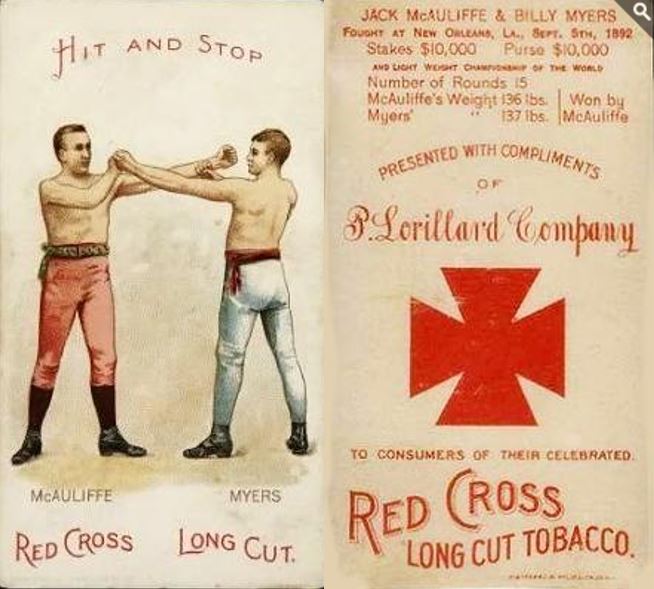
Trading card for the championship boxing match that Nick Drew went to see in New Orleans in 1892. (Source: Trading Card Database)
Not everyone was so taken with the stories of Drew’s escapades. In 1924, long after the close of Drew’s saloons, the Duluth Rip-saw used the friendship between Nick Drew and congressional candidate Victor Power as one of the many reasons not to support Power. The paper noted in its diatribe that, “Mr. Power’s social cronies are such men as old Nick Drew, erstwhile gambler, rounded and saloon-keeper; also D.D. McEachin, notorious deadbeat, human rattlesnake and booze-tank.”[40]
Drew died in 1949 at the age of 90 while spending the winter in Fort Lauderdale, Florida. His obituary noted he had no children but that he kept a summer cabin at Beaver Bay and “enjoyed wide acquaintance among elderly Twin Ports residents.”[41]
D. Porter Music Company, 406 W. Superior St.
The very edge of the Porter Music Company’s sign can be seen poking out behind the sign for Drew’s. Located at 406 W. Superior St., the company was owned by two brothers, Frank and Alexander Porter, and their mother, Amanda.[42] Frank narrowly escaped death in 1901 when a streetcar hit his horse-drawn buggy.[43] When Alexander died unexpectedly of heart failure in 1907,[44] two years after his mother passed away from pneumonia,[45] the shop closed down and its stock was sold off by other local music stores.[46]
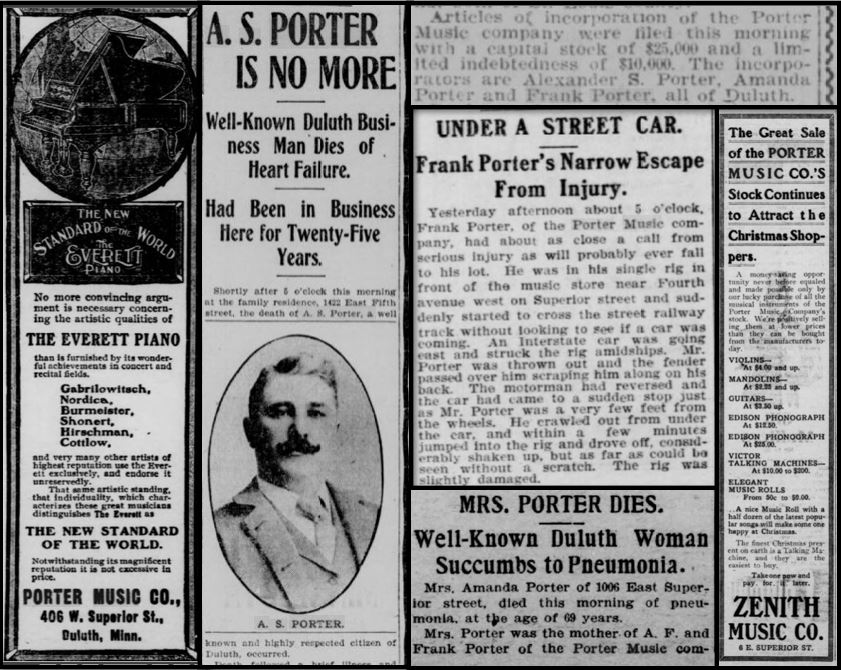
The Porter family’s music company and the tragedies that befell them. (Sources, from left to right, top to bottom: Duluth Evening Herald, March 8, 1902; Nov. 19, 1907; Sept. 15, 1900; April 15, 1901; March 27, 1905)
E. Cook’s Loan Bank, 400 W. Superior St.
Behind Porter’s half of the sign for Cook’s Loan Bank is visible. Located at 400 W. Superior St. and operating roughly between 1903 and 1907 (based on when ads were placed in the paper), the bank served as a pawn shop, offering cash in exchange for valuables.
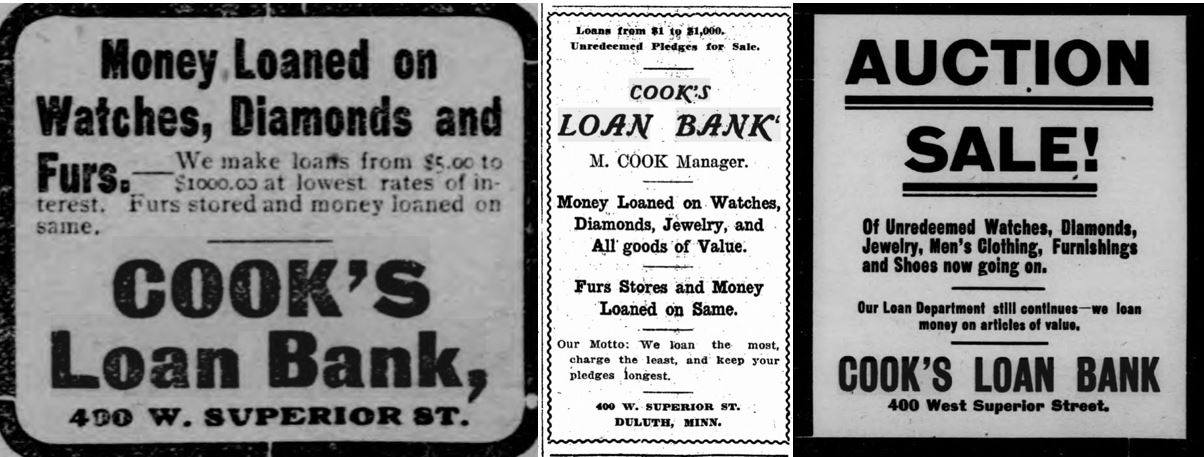
Ads from the beginning, middle and end of Cook’s Loan Bank. (Source: Duluth Evening Herald, June 24, 1903; Jan. 2, 1904; March 26, 1907)
The pawn shop was operated by Moses B. Cook. In 1907, he was arrested and convicted for selling watches and jewelry at an auction and had his license for conducting any type of auction revoked.[47] While the city normally did not enforce the auction laws, an exception was made in Cook’s case because of the type of auctions he was running. According to the complaint of one participant, he would auction off a product at a low price, only to have someone inform the winning bidder that the product was defective and encourage the winner to try again.
[Side note: When looking into the records Moses left behind, I discovered the role of his brother B.J. in discriminatory practices in Duluth.]
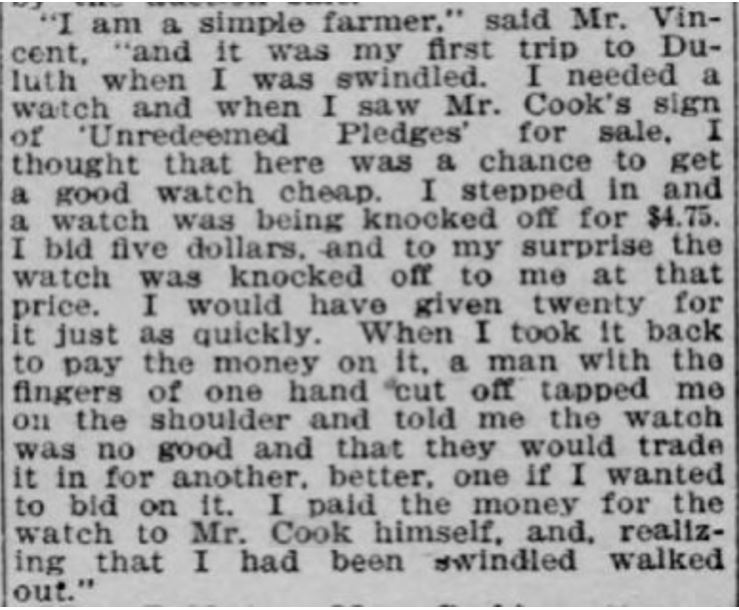
The story of a simple farmer at Cook’s Bank and Loan. (Source: Duluth Evening Herald, April 16, 1907)
F. City Gun and Curio Store, 402 W. Superior St.
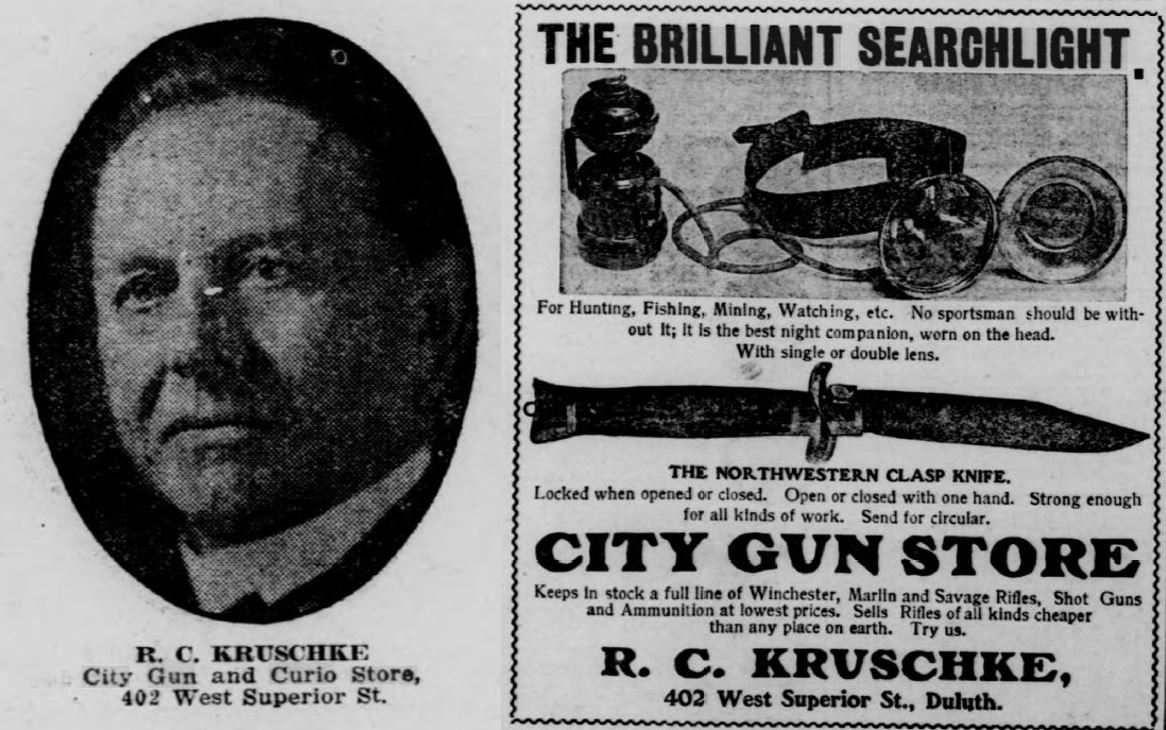
Left: R.C. Kruschke. Right: An ad for products he invented. (Sources: Duluth Herald, May 14, 1914; Duluth Evening Herald, Oct. 23, 1902)
Directly in front of the sign for Cook’s Loan Bank is a sign for another curio store. Its full name was the City Gun and Curio Store, owned by Rudolph C. Kruschke. According to his obituary in the Duluth Herald on May 11, 1918, Kruschke first moved to Duluth with his family at age 11 in 1869. The family later moved to Wisconsin but he returned to the city as an adult in 1881 and lived in Duluth the rest of his life.
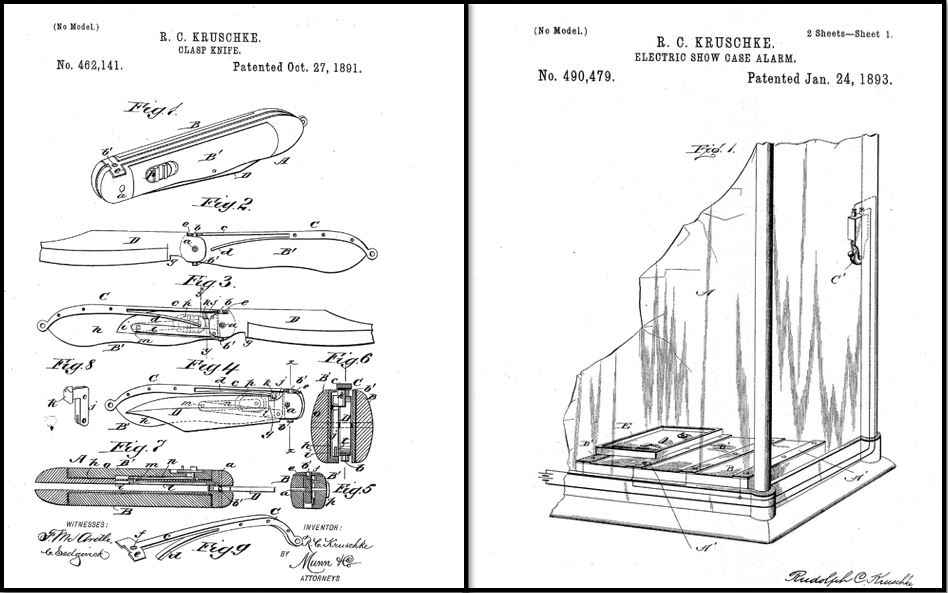
Left: R.C. Kruschke’s clasp knife patent. Right: His electric showcase alarm patent. (Source: U.S Patent Office located using the historical patent dataset [Petralia, Sergio; Balland, Pierre-Alexandre; Rigby, David, 2016, “HistPat Dataset,” Harvard Dataverse, V8])
Kruschke was not only an avid hunter but also a prolific inventor, including many inventions for the outdoors.[48] One of those, the Brilliant Searchlight, he manufactured on a large scale, calling it “a Duluth product sold throughout the world.”[49] He patented a foldable hunting knife that could sharpen fish hooks.[50] His patents, however, were not limited to outdoor goods. He also created inventions for his own store. His electric showcase alarm contained weight-sensitive trays “rendering it absolutely impossible to remove any article from its retaining or supporting means without sounding an alarm.”[51]
G. Great Northern Development Company
Charles Colt Cokefair, an East Coast businessman, moved to Duluth in 1899, where he organized and then served as president of the Great Northern Development Company, an enterprise focused on developing a power plant on the St. Louis River rapids.[52] Opening on Oct. 1, 1907, the Thomson Hydro Station is still the largest hydroelectric power plant in the state of Minnesota.
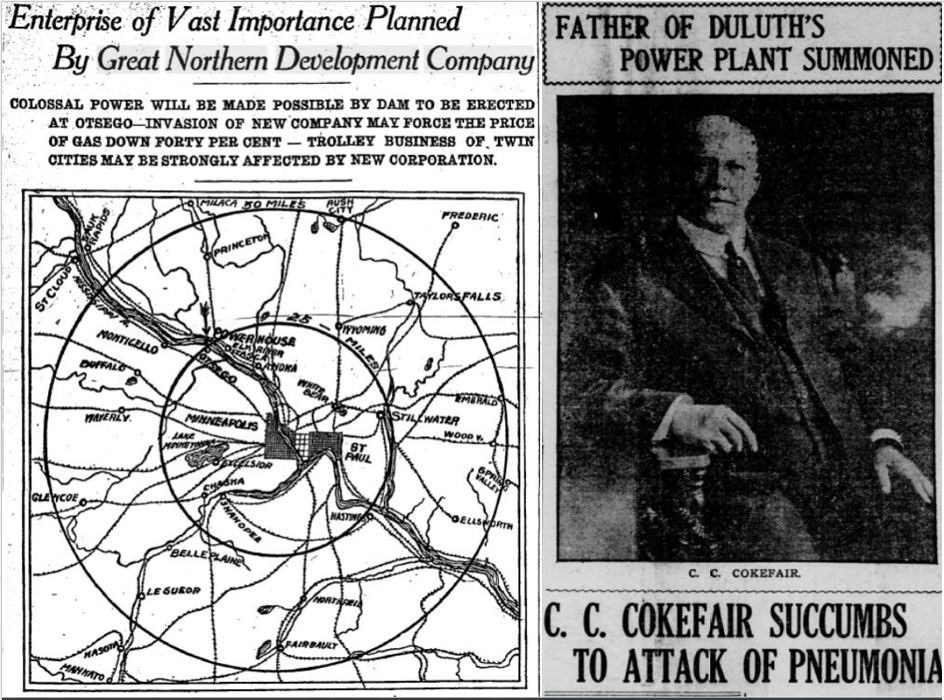
Left: Announcement of a dam to be built at Otsego. Right: Obituary of C.C. Cokefair. (Sources: The Minneapolis Tribune, Feb. 25, 1906; Duluth Herald, Dec. 13, 1911)
Cokefair then began working on developing several different power plants on the Mississippi River.[53] When his company acquired the land and approval to build a dam at Coon Creek, eight miles above Minneapolis,[54] the War Department reserved the right to include a lock in the dam. The Great Northern Development Company, however, successfully argued that the Mississippi was not navigable above St. Anthony falls, even as representatives of Sherburne, Stearns, Wright and Anoka counties strongly objected to these claims.[55] Cokefair died unexpectedly before construction could begin and the dam was completed by H. M. Byllesby & Company in 1914. It closed in 1966 and is now a recreational facility. As the southernmost dam on the Mississippi with no lock, it marks the northern end of navigable portion of the Mississippi River.
Next month, the journey through downtown in 1907 continues to the next two blocks on Superior Street.
Coming next month: Superior Street, Wednesday, Sept. 11, 1907, Part 5: The 300 and 200 Blocks of South Superior Street
Notes
[33] Duluth Evening Herald, July 19, 1895
[34] Duluth Evening Herald, July 19, 1895
[35] Duluth Evening Herald, Dec. 20, 1906
[36] Duluth Evening Herald, April 21, 1902
[37] Duluth Evening Herarld, Dec. 28, 1906
[38] Our Side, April 20, 1916
[39] The Labor World, March 16, 1907
[40] Duluth Rip-saw, Oct. 25, 1924
[41] The Duluth Herald, Dec. 14, 1949
[42] Duluth Evening Herarld, Sept. 15, 1900
[43] Duluth Evening Herald, April 25, 1901
[44] Duluth Evening Herald, Nov. 19, 1907
[45] Duluth Evening Herald, March 27, 1905
[46] Duluth Evening Hearld, Dec. 1, 1907 Dec. 19, 1907
[47] Duluth Evening Herlad, April 16, 1907
[48] Duluth Evening Herald, July 28, 1894
[49] The Duluth Herald, Nov. 2, 1918
[50] Duluth Evening Herald, July 28, 1894
[51] U.S. Patent Application, Jan. 24, 1893
[52] Duluth Herald, Dec. 13, 1911