

Superior Street, Sept. 11, 1907, Part 3: Spalding Hotel and Surrounding Businesses
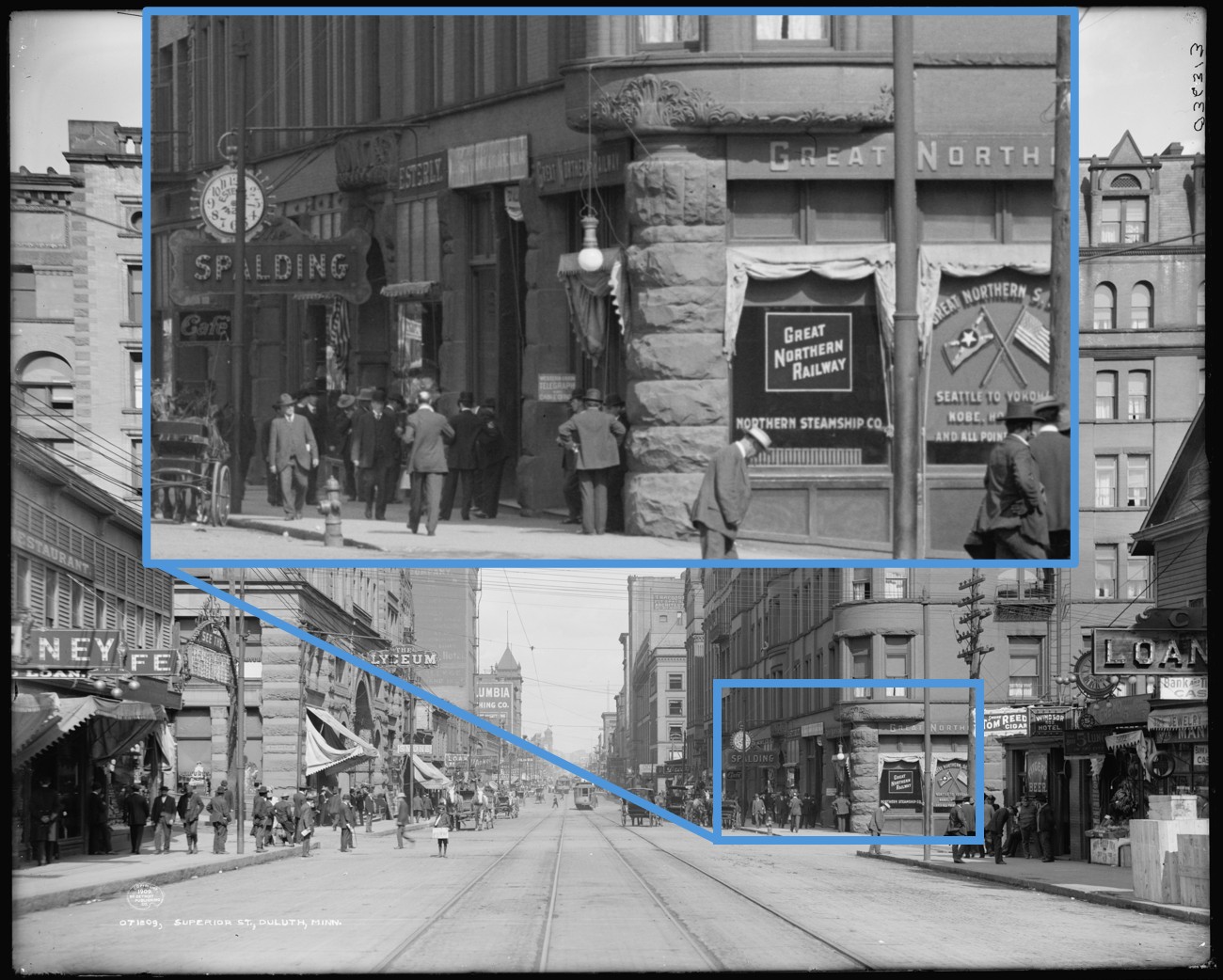
This series takes a detailed look at life on Superior Street on the afternoon of Wednesday, Sept. 11, 1907. The first part of the series provided background details on a photograph shot that day where the street intersects Fifth Avenue West. Part three focuses on the businesses around the Spalding Hotel, including a fight with the city over on-street parking policies by a watchmaker whose pocket watches are still prized by collectors today.
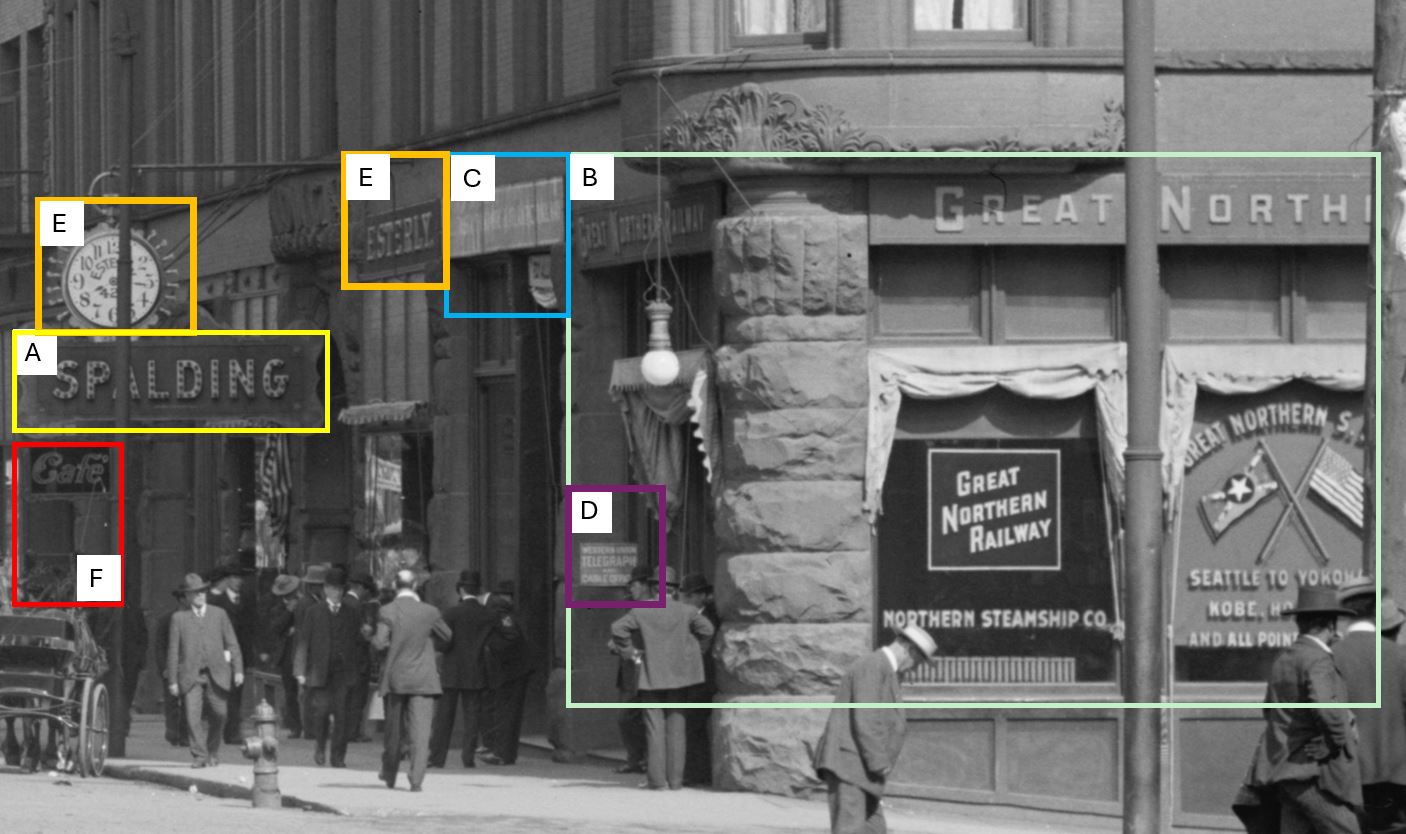
A. The Spalding Hotel
When the Spalding went up in 1889, it became the first grand building of Fifth Avenue West, finished three years before the Union Depot. The Spalding opened as the most luxurious hotel in the city and served not only tourists but also the business and social life of the city. With its grand lobby, the largest barroom in the city, a rooftop pavilion, and several dining rooms, it hosted Duluth events for decades before being demolished as part of the Gateway Renewal Project in 1963. All of this summary information came from articles connected to the Spalding Hotel hashtag on Perfect Duluth Day, containing stories of the hotel throughout its 74-year existence. This section takes a closer look at the businesses with signs on the outside of the Spalding building in the 1907 photo.
B. Great Northern Railway and Great Northern Steamship Company

Left: A 1909 Great Northern Railway ad; Top: System map in 1920; Bottom: Postcard of the Empire Builder in (Sources: Wikipedia, including Elkman at English Wikipedia, CC BY-S)
Both the Great Northern Railway and the Great Northern Steamship company were enterprises of James J. Hill. The Great Northern Railway was created in September 1889. The headquarters were in St. Paul but Duluth was the start of one of the main lines that connected the Twin Ports with Seattle. The line’s leading train was known as the Empire Builder, the same nickname given to James J. Hill for his vision in creating an entire rail network.
The rail lines did not just allow travel between northern cities in the west. They were also instrumental in bringing settlers into the area as the U.S. government took over land from indigenous groups. Through a series of mergers, the Great Northern Railway is now a part of the Burlington Northern Santa Fe Railway.
Hill’s steamship company never achieved the same level of success. The Great Northern Steamship Company and its offshoots operated between 1900 and 1918, when the government commandeered the remaining two ships for use in World War I. Hill wanted to use steamship’s to extend his rail network globally but while he had an unsurpassed understanding of train systems, Hill’s knowledge of sea trade proved far more limited, forcing him to close down the business at a considerable loss.
A photo of the Spalding Hotel from around the same period gives a clearer view of the window sign, which reads
GREAT NORTHERN S.S. CO.
SEATTLE TO YOKOHAMA,
KOBE, HONG KONG
ALL POINTS IN ORIENT

Left: Playing cards with company flag; Right: 1908 Great Northern Steamship ad/ (Sources: Railroad Memories and Period Paper)
C. Duluth South Shore & Atlantic Railway
Next to the Office for the Great Northern Railway is a sign for the Duluth South Shore & Atlantic Railway. A photo from another angle provides a better view of the banner underneath the sign: “To All Points East.”

A 1916 route map of the DSS&A. (Source: Interstate Commerce Commission. Bureau of Valuation, Engineering Section, public domain)
The DSS&A connected Duluth with Sault Ste, Marie, Michigan, extending across the south shore of Lake Superior, with train connections to East Coast operators from the end of the line. Heavy snowfall created maintenance issues and the thinly populated service area created financial challenges to resolve those maintenance issues, resulting in a poor reputation for the service. Passenger nicknames for the DSS&A included Dead Slow Service & Agony and Damn Slow, Shabby Affair, while the workers said the initials stood for Damn Small Salary & Abuse. A Herald article from April 12, 1913 about improvements to the line, including replacing the wooden bridges with steel structures and repairing the roadbed, noted “The roadbed no more will be likened to a corduroy road and the old joke about the cow beating the train will be placed in the scrapheap.”
In 1961, the DSS&A became a part of the Soo Line. Some sections still have operational tracks. Others, like the St. Ignace-Trout Lake Trail have become part of hiking and biking trails. John Gaetner published an extensive history of the DSS&A in 2008. In 2022, Archive Dive, the podcast of the Superior Telegram, produced an episode on the vanished settlements that once existed across the length of the route.
D. Western Union Telegraph and Cable Offices

An ad using the format of a Western Union Telegram in the Duluth Evening Herald, Dec. 29, 1908.
A sign next to the entrance of the Great Northern Railway also lists it as a Western Union office. Western Union was founded in 1851 and by 1900 operated a million miles of telegraph lines and had two undersea cables for international messages. In 2006, the company stopped offering telegram services.
E. E. E. Esterly, Spalding Hotel Jeweler, 428 W. Superior St.

An Esterly pocket watch from the collection of Paul Sullivan.
E.E Esterly started cleaning and repairing watches in Duluth in 1892.[22] As his business grew, he started sending representatives to sell his products at logging camps, although not always with successful results, as noted in the newspaper accounts below. By 1908, his store in the Spalding Hotel was the largest dealer in luxury watches in the Northwest.[23] The pocket watches from his store are still prized by collectors.

References to Esterly’s sales at logging camps. (Sources: Duluth Evening Herald, Jan. 17, 1908, Two Harbors Iron News, Jan. 15, 1909, Jan. 2, 1908)
On Aug. 10, 1909, Esterly parked his car in the space in front of his building. The police said he was obstructing the entrance to the Spalding Hotel and told him to move it. He refused and demanded to be arrested. The police declined to arrest him, at which point he went to city hall and had a formal complaint made out against himself in order to challenge in court his right to park in front of his own business.[24] Two days later, he refused to remove his horse from in front of his business, and this time he was arrested. He was ready to pay bail, but the police refused to release him until he agreed to stop blocking traffic in front of the hotel. Esterly refused for an hour, at which point he agreed to stop parking either car or carriage in front of the hotel, and was then released without bail. He pleaded not guilty in court the next morning and the judge scheduled a trial for later in the week.[25] The day after his court appearance, he put his horse and his car up for sale in an ad in the Evening Herald, providing a full explanation for the sale.[26] Two days after listing his car and horse for sale, he was found guilty of obstructing the street.[27]

An ad for Esterly’s car and buggy with very little information about the car and buggy. (Source: Duluth Evening Herald, Aug. 14, 1909)
F. Berry’s Saloon, 420 W. Superior St.
Just a few facts about Frank Berry and his saloon at 420 W. Superior St. have survived.[28] His infant daughter died of a diphtheria outbreak on Park Point in 1902.[29] In 1905, he killed a 1,200 pound moose outside of Grand Marais and mounted it in his saloon.[30] In 1909, he applied for his deer hunting license with T.J. Storey,[31] whose father’s taxidermy business still stands on Sixth Avenue East. Berry’s Saloon stayed open until at least 1911, when defective wiring caused a small electrical fire.[32]

Left: Berry’s Saloon entrance from a photo around the same period; Right: An ad for G&W Special Canadian Whisky, sold locally by both Frank Berry and Nick Drew, whose saloon appears in part four of this series. (Sources: Library of Congress; Duluth Evening Herald, June 19, 1907)
Coming next month: Superior Street, Wednesday, Sept. 11, 1907, Part 4: The 400 Block of South Superior Street

Notes
[22] Duluth Herald, Feb. 7, 1921
[23] Duluth Evening Herald, Jan. 3, 1908
[24] Duluth Evening Herald, Aug. 11, 1909).
[25] Duluth Evening Herald, Aug. 13, 1909
[26] Duluth Evening Herald, Aug. 14, 1909
[27] Duluth Evening Herald, Aug. 17, 1909
[28] Duluth Evening Herald, 1911
[29] Duluth Evening Herald, 1911
[30] Duluth Evening Herard, Nov. 16, 1905
[31] Duluth Evening Herald, Oct. 27, 1909
[32] Duluth Herarld, April 3, 1911