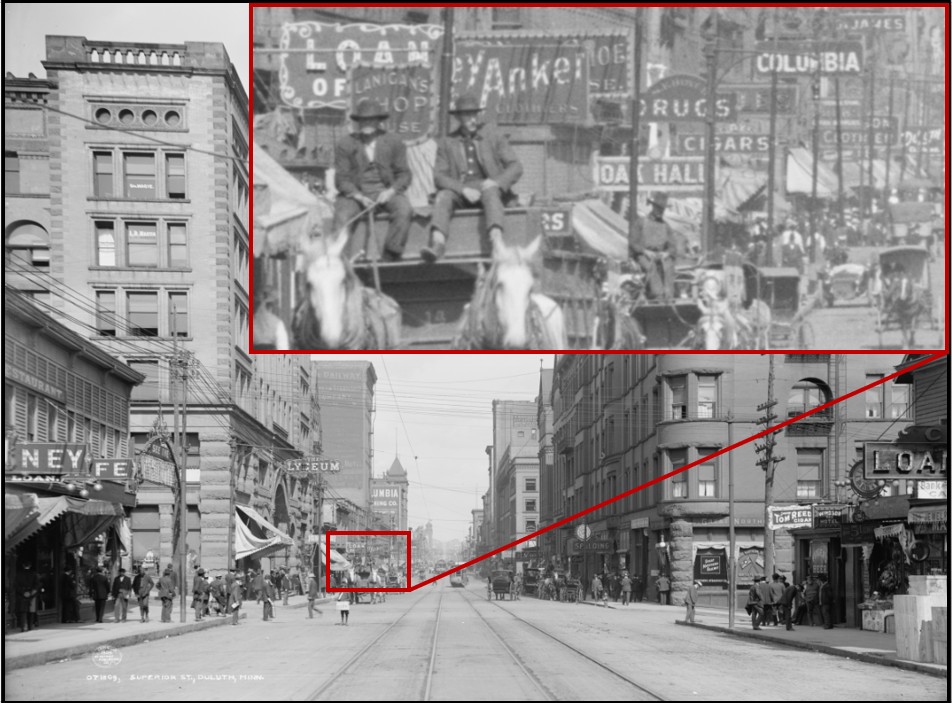
Superior Street, Sept. 11, 1907, Part 8: The West Side of the Lyceum Building
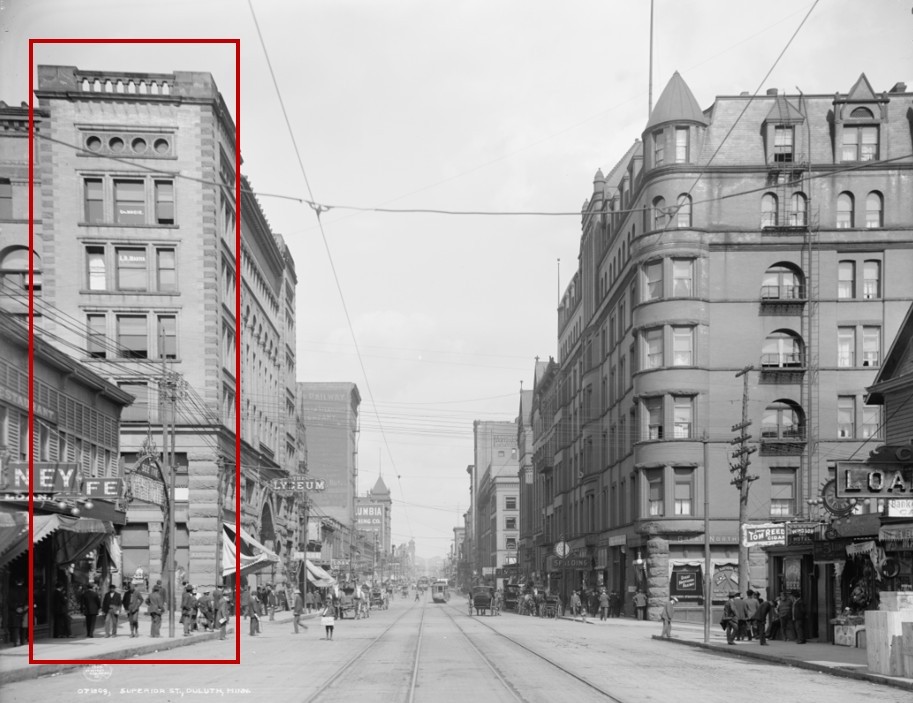
This eighth part of the extremely detailed exploration of a single photograph looks at the people who decided to put their names on their office windows on the side of the Lyceum Building. It describes the lives of two doctors whose stories connect to the present day and a lumber baron who supplied the timber that built many of the region’s early railroads.
Dr. Samuel H. Boyer
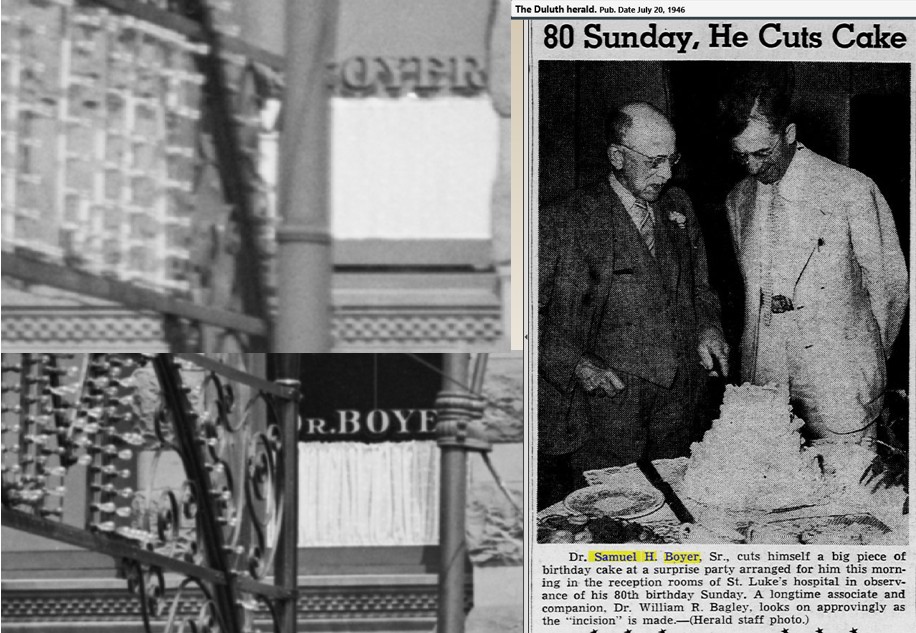
Top: Dr. Boyer’s office in the 1907 photo. Bottom: His name more clearly visible in a photo from 1904. Right: Dr. Boyer cuts his 80th birthday cake with Dr. William R. Bagley.
In the side window of the Lyceum building next to the Fifth Avenue West “White City”/”Welcome” sign, the name Dr. Boyer can be seen on the glass (only “oyer” is visible in the 1907 photo, but the full name is readable in other photos from the same period). The office belonged to Dr. Samuel H. Boyer. A biographical sketch from the book Minnesota and Its People from 1924 states that Dr. Boyer “enjoys the distinction of being considered one of the progressive, public spirited men of Duluth, as well as one of the most successful physicians in the state.” Born in Oil City, Pennsylvania, on July 1, 1866, Dr. Boyer gained his medical training from the University of Pennsylvania, graduating in 1890 and then moving to Duluth in 1891. He had his own private practice alongside being on the staff at both St. Luke’s and St. Mary’s hospitals. The book Little Sketches of Big Folks in Minnesota notes that he served as St. Louis County Coroner from 1901 to 1905.
He and his wife raised their family in a home that still stands at 219 Second Ave. E. A classified ad from the Duluth Evening Herald on March 6, 1906, gives some indication of his personality: “WANTED – COMPETENT SERVANT who can cook. If experienced will pay wages asked. If inexperienced, don’t apply. Dr. Boyer, 219 Second Avenue East.”
Several reports in the Duluth Herald, including one from Sept. 6, 1913, note that the family often spent summers at the Elmoro Farm on Breezy Point in Cedar Lake, Minnesota (now a suburban residential area west of Minneapolis).
Dr. Boyer’s mother-in-law, Johanna Meining, was living with the family when she passed away. Her obituary in the Duluth Herald on Oct. 25, 1922, noted that she came to the United States from Germany at the age of 22 and “was one of the best-known women of the early period of the city’s development,” arriving in Duluth in 1870.
On July 20, 1946, the Duluth Herald published a profile of Dr. Boyer in connection with the celebration of his 80th birthday. The photo above shows him at a surprise party at St. Luke’s with friend and fellow doctor William R. Bagely, namesake of the Bagely Recreation Area adjacent to the University of Minnesota Duluth. The profile talked about his work in the horse and buggy days of Duluth, when nearly all births took place at home and his carriage coming down the street was a sign that a woman in the neighborhood was about to give birth. The profile closes with the following tribute:
In every emergency he has demonstrated an unruffled calm that is the envy of young men, his closest friends recall. Together with understanding, sincerity, conscientiousness and kindness, he has maintained a sense of humor that has contributed perhaps more than all other his traits to the reputation he has attained in 55 years of practice in Duluth. ‘There hasn’t been anything yet that I haven’t been able to find a bright side to,’ he told his admirers this morning. And the wit that adorns almost every one of this remarks attests to that statement.
The Herald reported Dr. Boyer’s passing nine years later, on Nov. 16, 1955.
Dr. Boyer’s brother was Dr. Clarence Valetine Boyer, but his doctor title came not from the study of medicine but from a PhD in English from Princeton University. Clarence Boyer served as the president of the University of Oregon during the Great Depression and was later credited with successfully managing the university during an extremely challenging financial period.
While his brother was a university professor, Dr. Samuel Boyer’s son was also a Duluth doctor. The Duluth Herald on April 22, 1968, noted that Samuel Huntington Boyer Jr. was actively working to bring a medical school to UMD as the chair of the Northern Minnesota Council for Medical Education and later news reports track the successful results of his efforts.
A report in the Duluth Herald from Aug. 9, 1962, notes that Samuel Huntington Boyer III graduated from East High School and Carleton College before joining the military.
Samuel Hunting Boyer IV was also a prominent physician. His papers can be found in the Chesney Archives at John Hopkins University. He is not the son of Samuel Huntington Boyer III. He was born in 1924, in Duluth, around 15 years before Samuel Huntington Boyer III. Unraveling the mystery of how Samuel Boyer the Fourth could be older than Samuel Boyer the Third took some work and required going backward a few generations. Samuel Huntington Boyer Sr.’s daughter, Jeanette Boyer, left Duluth to attend the University of Wisconsin in Madison on Sept. 14, 1920, according to the Duluth Herald of that date. The Herald notes on July 6, 1923 that she married Edmund P. Strothman of Milwaukee, Wisconsin. On Aug. 16, 1924, the Herald announced the birth of their son, Edmund P. Strothman Jr. Five years later, the Herald announced the second marriage of Jeanette Boyer Strothman to Walter Canby Heston of San Francisco on Sept. 14, 1929. Throughout the 1930s, the Herald provides reports of Jeanette returning to Duluth with her son Ned (a common nickname for Edmond), the last of which appears on July 20, 1940, just after the birth of Samuel Huntington Boyer III. A marriage license shows Ned’s father remarrying in 1928 in Littleton, Colorado. It seems that with his father out of his life and with a new step-father, Strothman Jr. took on the name of his grandfather and either added or altered the IV after the birth of another grandson with the same name. Familysearch.org confirms this with its listing of Samuel Huntington Boyer IV’s parents as Edmund Pennell Strothman and Jeanette Rella Boyer.
Samuel Huntington Boyer IV’s nickname is also given in his obituary as Ned. His obituary noted the following:
“He was a person who was interested in everything,” said Dr. George Dover, chairman of the Hopkins department of pediatrics, and Dr. Boyer’s former student. “He enjoyed learning the most he could about any subject, to excruciating detail.” His studies served as the basis for the development of a new therapy for sickle cell disease. In later years, a drug was developed to treat the condition. The drug was based, in part, on his earlier work, colleagues said. He has two sons, Donald and Thomas.
The son of Samuel Huntington Boyer III, Sam H. Boyer, lives in Malibu. At the age of 21, he directed the first extreme sports show, Board TV. He currently is the founder of an AI company along with being the owner of a cannabis dispensary. Whether he considers himself Samuel Huntington Boyer the IV or V is not clear.
Dr. William H. Magie
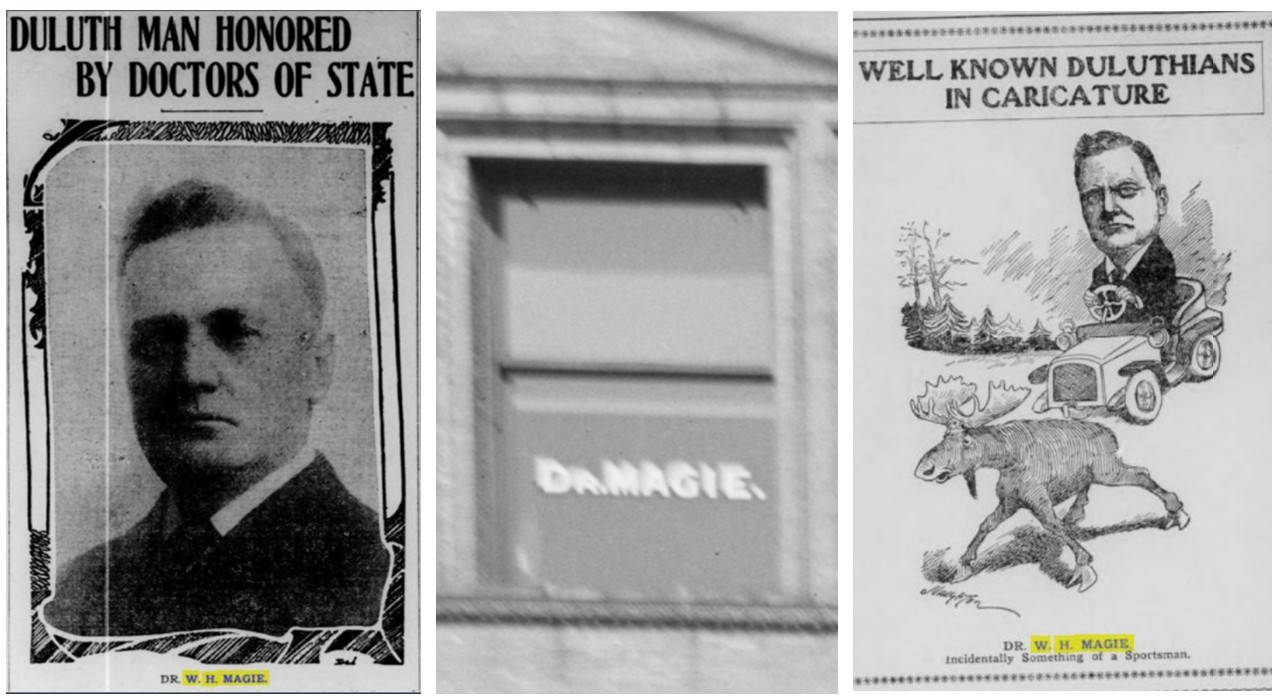
Left: A photo of Dr. Magie in the Duluth Evening Herald on Aug. 16, 1907, one month before the photo showing his office at the top of the Lyceum building (center) was taken. Right: Dr. Magie in caricature in the Duluth Evening Herald from May 7, 1909
The name of Dr. William H. Magie appears on the window of his offices on the top floor the Lyceum Building, two stories up from Dr. Boyer, but their relationship dates back considerably further. Dr. Magie’s obituary in the Duluth Herald on Dec. 12, 1932, notes that he started his medical practice in the West End with Doctor Boyer when he moved to Duluth from Pittsburgh, Kansas, in 1881. His obituary describes the following accomplishments:
For many years he was surgeon for all railroads, lumber and mining companies in this district … Dr. Magie was one of the first staff physicians of St. Mary’s hospital and remained a member of the staff until his death. He made medical history in the early days of Duluth and … performed the operation of the first properly diagnosed case of appendicitis in Duluth … He gained a wide reputation as a surgeon.
When he moved into the Lyceum building, he employed a young Dr. William Bagley, as noted in Bagley’s obituary in the Duluth Herald on July 29, 1965. As a doctor, Magie saw a number of notable cases throughout his career. The Duluth Herald notes that on May 17, 1904, he attended to Frank White as he gave a detailed account of his own soon to be fatal shooting. The man shot White, a saloon keeper, after he refused to serve alcohol to the man’s companion who appeared to be both already severely intoxicated and a minor.
A report from the Duluth Evening Herald on March 16, 1901 describes how Magie saved the life of Duluth’s deputy sheriff after he was shot in the head by an angry defendant in the Duluth courthouse. The paper said of Dr. Magie that “even during the least hopeful moments he showed a degree of calmness and splendid nerve that won the admiration of those in the operating room.” The deputy sheriff whose life he saved was Frank Magie, Dr. Magie’s brother.
The Duluth Herald of Dec. 22, 1913 notes that millionaire dredge and vessel owner James Whelan of Port Arthur, Ontario (present day Thunder Bay), was recovering after Dr. Magie was brought up from Duluth by a special train to perform his appendicitis. Showing the range of his patient’s backgrounds, a report from the Duluth Evening Herald on May 21, 1888, states the following:
A Bohemian fell into the hold of one of the ships at the Ohio coal dock on Saturday night. He was taken to St. Mary’s hospital, where he is being attended to by Dr. W. H. Magie.
While Dr. Magie was an accomplished physician, he also had a number of hobbies. The June 24, 1904 Duluth Evening Herald reported that he had purchased more than 300 acres of land next to the Jean Duluth stock farm in order to raise both sheep and driving horses in a country home. It’s not clear how long he stayed in the business of raising driving horses, as four years later, in the Herald of May 6, 1908, he is noted as one of the first Duluth physician’s to trade in his horse for a car in order to make house calls.
Even more notable is a story from just a year later, in the Herald of Dec. 24, 1909, announcing him as Duluth’s first aeronaut. Just six years after Orville and Wilbur Wright began the aviation era with their successful powered flight at Kitty Hawk, Dr. Magie was elected as the first member from Duluth to a prominent aviator’s club. Orville and Wilbur Wright themselves were present at his induction ceremony in Detroit. Dr. Magie stated his plans to use an airplane for moose hunting.
This statement would not have been a surprise to anyone who knew Dr. Magie. He was a prominent hunter and, as noted in the Herald on Sept. 29, 1903, a founding member of the Bow String Club, whose purpose was “the creation, development, and preservation of game preserves, breeding and propagation of brook trout and other fish, and instruction and mutual improvement in the art of angling, shooting and hunting large and small game.” Alexander McDougall, inventor of the whaleback ship was also a founding member of the Bow String Club.
Alexander McDougall wasn’t the only famous Duluth contemporary Dr. Magie crossed paths with during his lifetime. The Herald on June 17, 1940, noted that Duluth photographer L. P. Gallagher had become an honorary member of the Arrowhead X-ray Technicians’ Society. In 1896, just a few months after its invention, Gallagher made the first X-ray in Duluth using a device of his own construction. The photo helped with the removal of a needle embedded in the hand of a patient treated by Dr. Magie.
Dr. Magie lived in the same home from when it was built in 1892 until 1931, when its sale was announced in the Herald on Oct. 10 during the illness that proceeded his death a year later. You can take a moment to honor his life and legacy when exiting Chester Creek Books on 14th Avenue East. The home, with his name still etched into the wall of the entry stairs, is at 1401 E. Superior St.
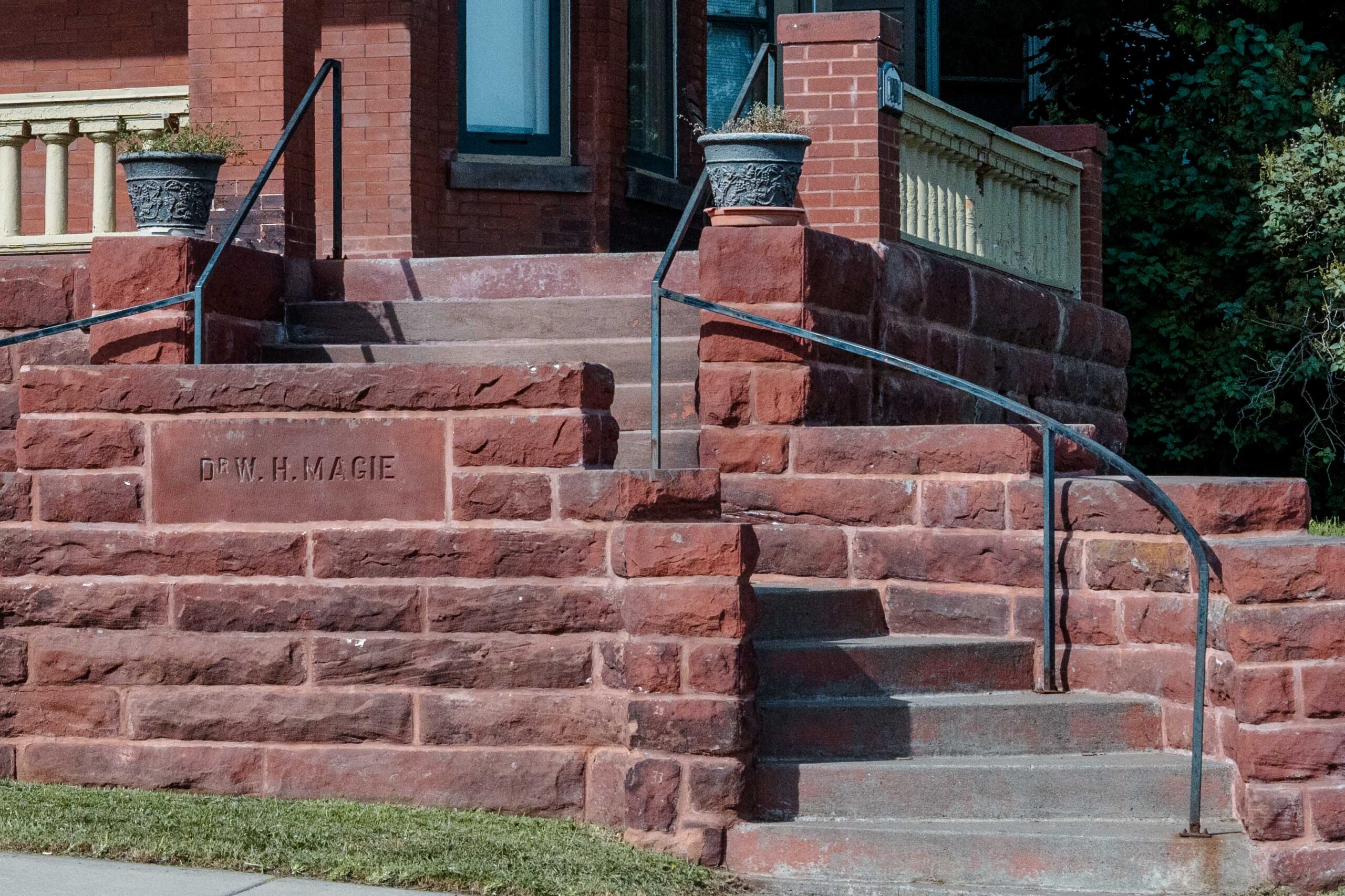
Dr. Magie’s former home at 1401 E. Superior St.
L.R. Martin
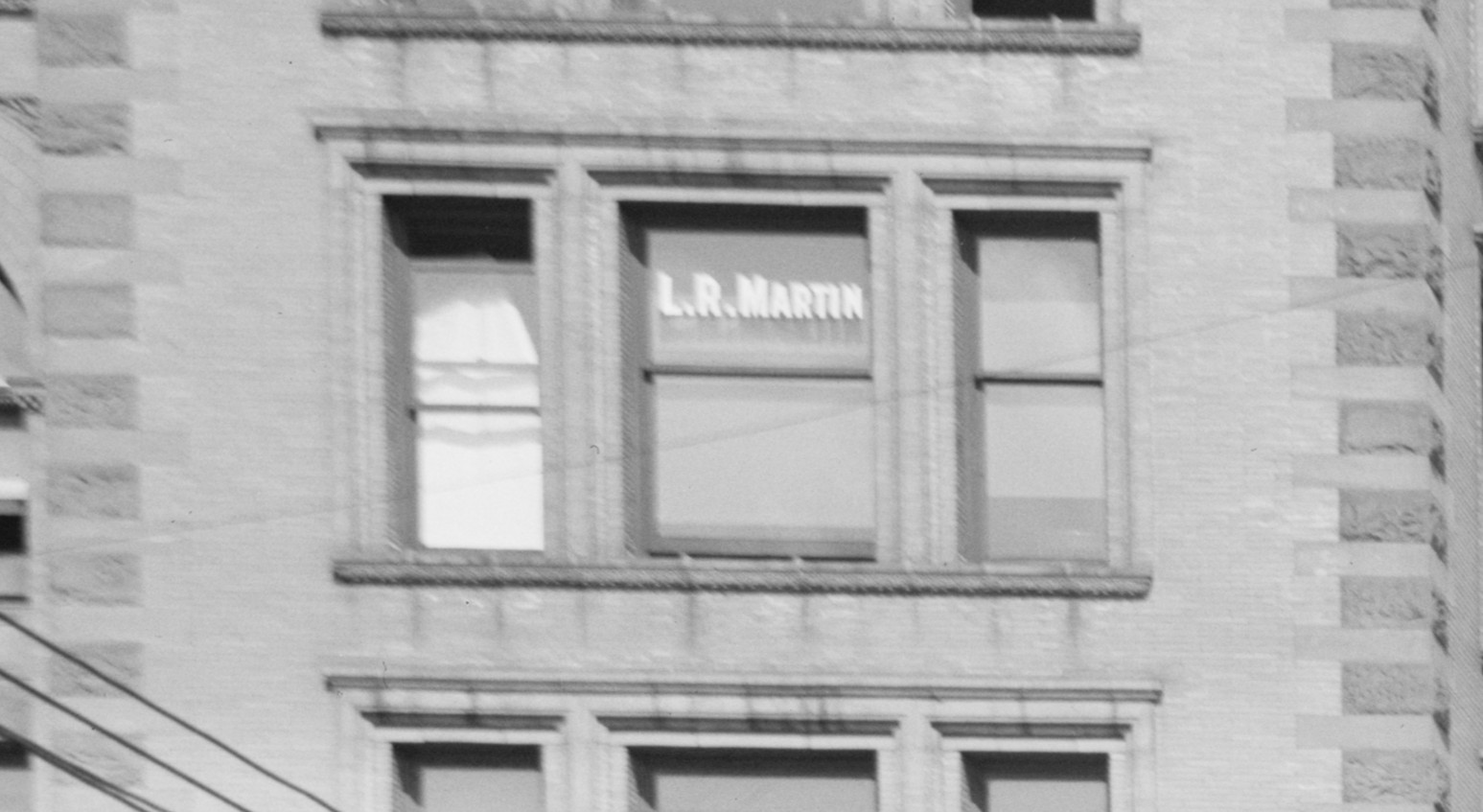
L. R. Martin’s office in the Lyceum Building.
Directly below Dr. Magie in the Lyceum Building, the window shows the name L.R. Martin. Unlike his companions on the side of the building, Louis R. Martin was not a doctor but a businessman. His name appears numerous times in the Herald archives in the early 19th century but this section of the 1907 Superior Street series will close with a single article from the Duluth Evening Herald on June 28, 1900, as it best summarizes what he and his company was doing on Superior Street.
RAILWAY SUPPLIES.
L. R. Martin.
One of the most important of the factors of the building up of the Northwest has been the construction of railways, and as many of the most important lines of the Northwest find their terminal in Duluth, this city is a favorable center for extensive operations in the handling of all kinds of railway supplies. A leader in this business is L. R. Martin, manufacturer of and dealer in railway supplies, having his office at 11 Fifth avenue west. Mr. Martin, who is a native of Ontario, came to Duluth five years ago and established his present business, in which he has ever since been successfully and actively engaged.He keeps in close touch with the best sources of supply, and carries on a large and active business as manufacturer of and dealer in railway ties, piling, posts, shingles, etc., and in connection with this business he operates a small mill in Duluth at the foot of Fourth Avenue East. Mr. Martin controls an extensive trade in all Western markets, and he is a very large handler of cross ties, bridge ties, switch ties, piling, telegraph poles and cedar posts, which he supplies very largely to railways throughout the West and Northwest, and he also has a specialty in cedar shingles, of which he is an extensive handler.
Mr. Martin gives a personal and careful supervision to the business upon methods which have brought him success and have constantly increased his trade with each succeeding year. He is a member of the chamber of commerce, and enjoys the best and most influential business connections and controls the patronage of many leading dealers and railway companies throughout the Western and Northwestern country.
Next month, part 9 of the series will look at the 12 businesses lining the odd side of Superior Street, all of which are long gone … except for one.