

Superior Street, Sept. 11, 1907, Part 7: The Odd-numbered Side of Superior Street and Fifth Avenue West
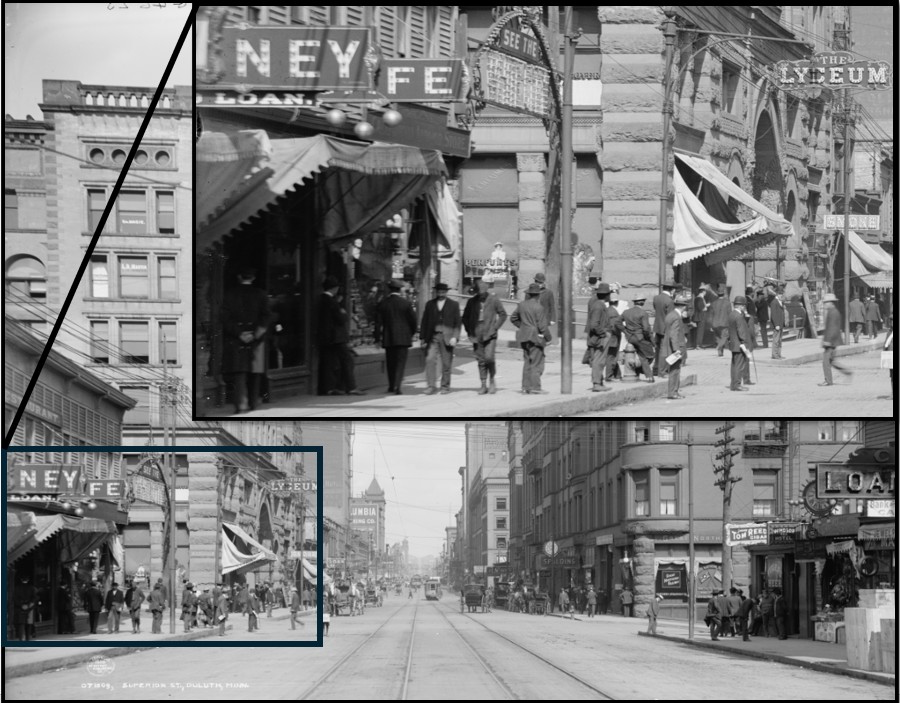
Superior Street in 1907 (Photo from the Library of Congress)
Part seven of this ten part series examining a single photo in depth looks at the businesses on the odd numbered side of Fifth Avenue West and Superior Street. It looks at the group of stores that were replaced by the Holland Hotel and reveals their direct connection to that hotel. It also looks at the stores occupying the ground floor of the Lyceum Theater and explains why the lit up sign across Fifth Avenue appears to say “See the Welcome.”
The businesses that occupied the northeast corner of Fifth Avenue West across from the Lyceum are a bit trickier to pin down precisely than the businesses directly across the street. A fire across the street shortly after the photo was taken resulted in newspaper articles describing which businesses were damaged and who owned them, creating a snapshot of that section of the street at the time of the photograph. No such record exists for the opposite side of the street. A photo from a few years earlier shows the same types of businesses but the signs and names have changed, suggesting shifting ownership.
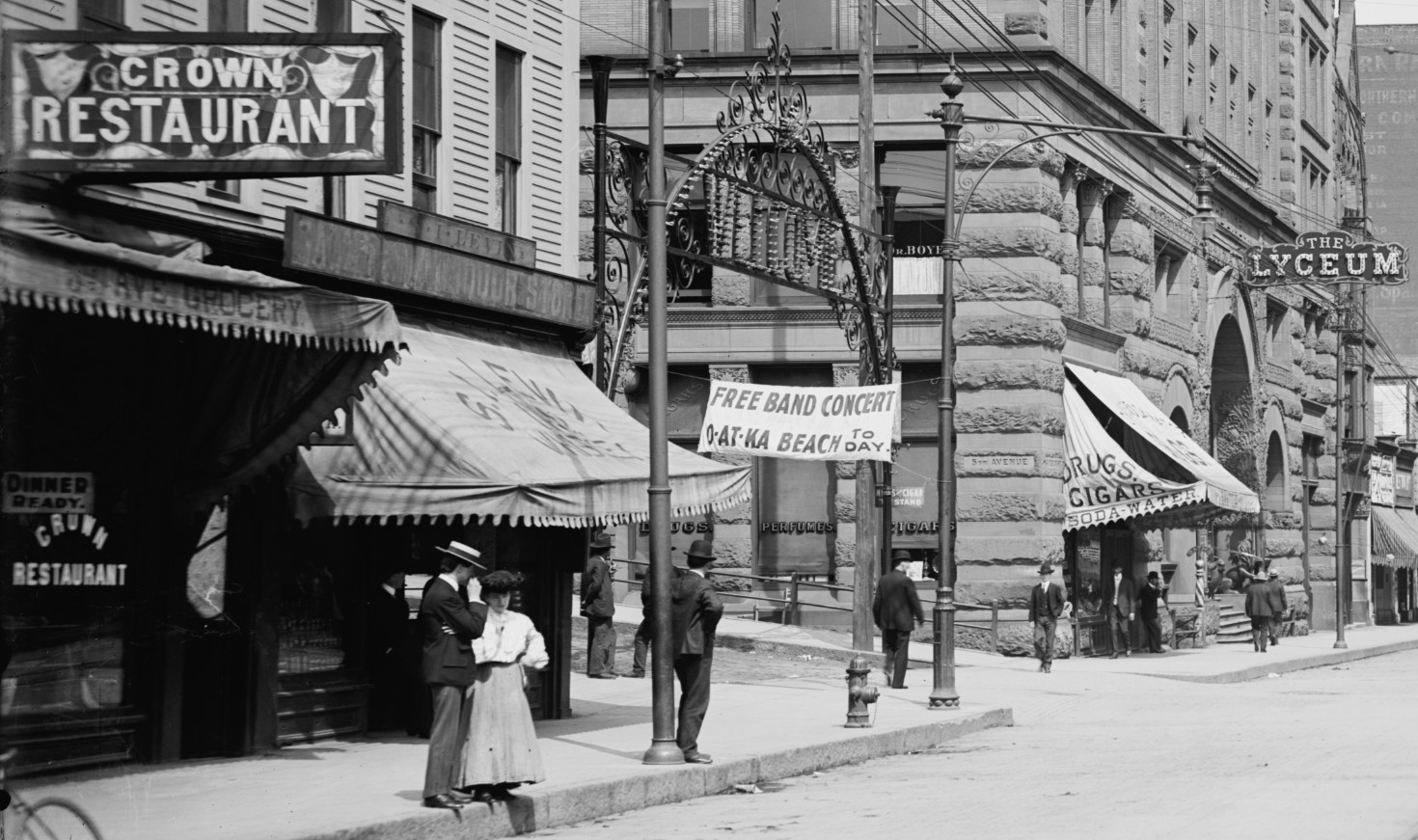
The same section of Superior Street around 1904. (Photo from the Library of Congress)
Newspaper records seem to confirm this. The older photo shows S. I. Levin’s California Liquor Store on the corner. The 1907 photo shows a new sign that still reads California Liquor Store on the bottom but the top name, while not legible, is clearly no longer S. I. Levin. An ad from June 13, 1908 lists all of the liquor deals to be found at Goldberg’s, located at 501 W. Superior St.
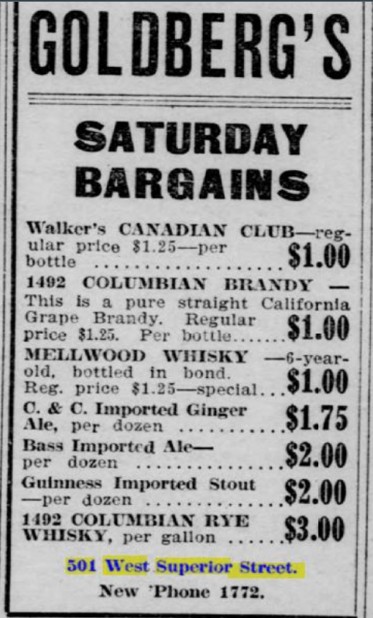
An ad for Goldberg’s from the Duluth Evening Herald, June 13, 1908.
At the time of the photo, the liquor store and all of the neighboring businesses seemed to have been owned by Isodore Goldberg. A want ad from Feb. 19, 1907, states that an I. Goldberg is looking for an experienced watchmaker and requests anyone interested to stop by between 11 and 12 at 501 W. Superior St., suggesting that he also operated the pawn shop marked by the three balls hanging near the liquor store. Between the pawn shop and the liquor store, an electric sign with the end letters ‘FE’ is clearly visible. A 1908 want ad shows that this sign belonged to the Crown Cafe. Either Isadore Levin also owned the café or the liquor store served drinks, as a 1908 want ad placed by Goldberg shows he was looking for a married man to work as a saloon porter.

Saloon porter wanted. (The Duluth Evening Herald, Aug. 29, 1906)
There is another less speculative reason to believe that Isadore Goldberg owned all of the businesses along this corner. They were torn down just a few years later for the construction of the Holland Hotel in 1910. A notice of incorporation of the Hotel Holland Company in the Duluth Herald from Dec. 16, 1910 lists Saul and Isadore Goldberg as president and secretary of the company, respectively.
The Fifth Avenue West Welcome Sign
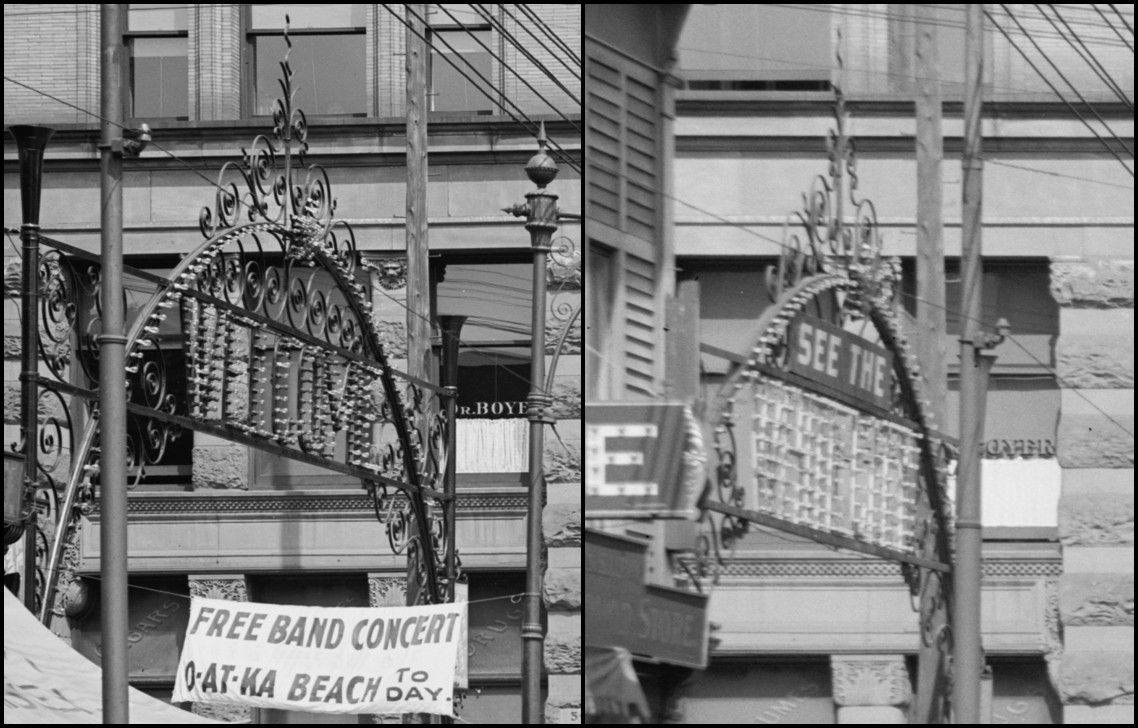
Left: The Welcome Sign around 1904. Right: The Welcome Sign in 1907.
In many photos of Superior Street from around this period, the Welcome sign on Fifth Avenue West is clearly visible. In the 1907 photo that is the subject of this series, there is something a bit odd about it. The letters seem more cramped and the text, “See the Welcome,” makes no sense. An article from the Duluth Evening Herald on August 15, 1906, provides an explanation:
The Duluth Amusement company was given permission to take off the “Welcome” sign from the city arch at Fifth Avenue West and Superior Street and replace the same with the illuminated words “See the White City,” on condition that after the amusement company is through with this advertisement it will put the word “Welcome” back on the arch again. This company was also directed to take its advertisements off the rocks of the city.
Whether the word Welcome was ever returned is unclear. A letter to the editor in the Duluth Evening Herald on June 17, 1909 references a city council decision to remove the sign in order to provide an unobstructed view from Superior Street of the new county courthouse.
When Philadelphia commissioner Albert Kelsey visited Duluth in 1903, he praised the welcome sign but thought that what the city really needed was some improvements around the canal area. His speech on the city was published in the Duluth Evening Herald on Nov. 14, 1903. Here is an excerpt:
The first impression of a city is important. If a good impression is made upon visitors it will attract capital. The ‘Welcome’ sign which Duluth shows to visitors is the correct idea, but you must go further. There must be something else. I was escorted this morning to the canal which serves as an entrance for your shipping interests. The breakwater is a work of art. But one glance was sufficient to tell where the government work stopped and the municipal work began.
If the same idea which is shown in the government work could have been carried right up to the business section of the city how much more attractive it would be to the visitor. It would make him stay longer and spend more money.
Care should be taken not to litter the waterfront with numberless unsightly buildings.
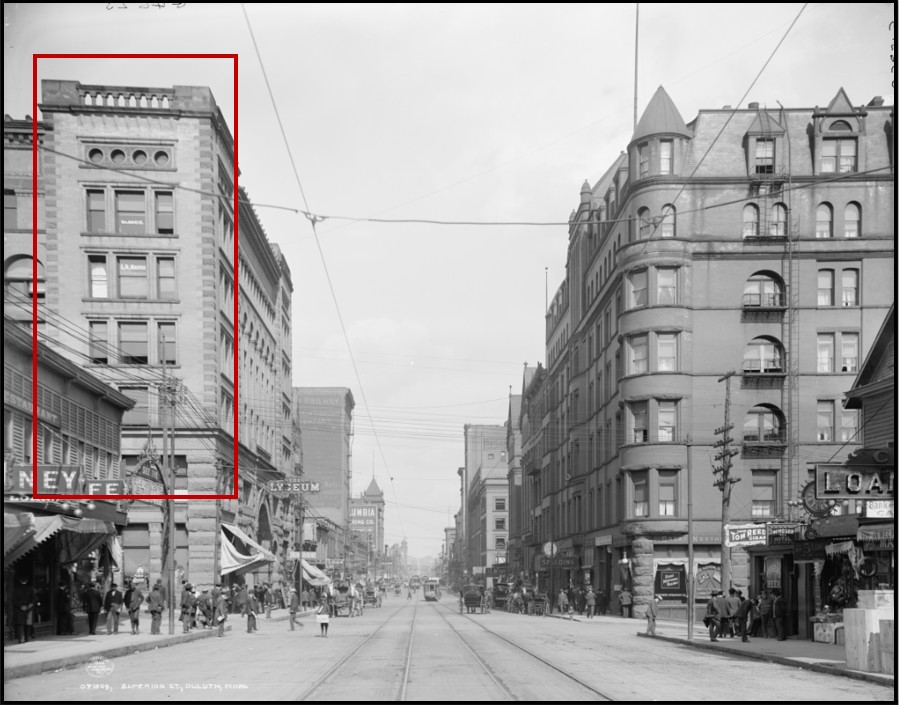
The Lyceum
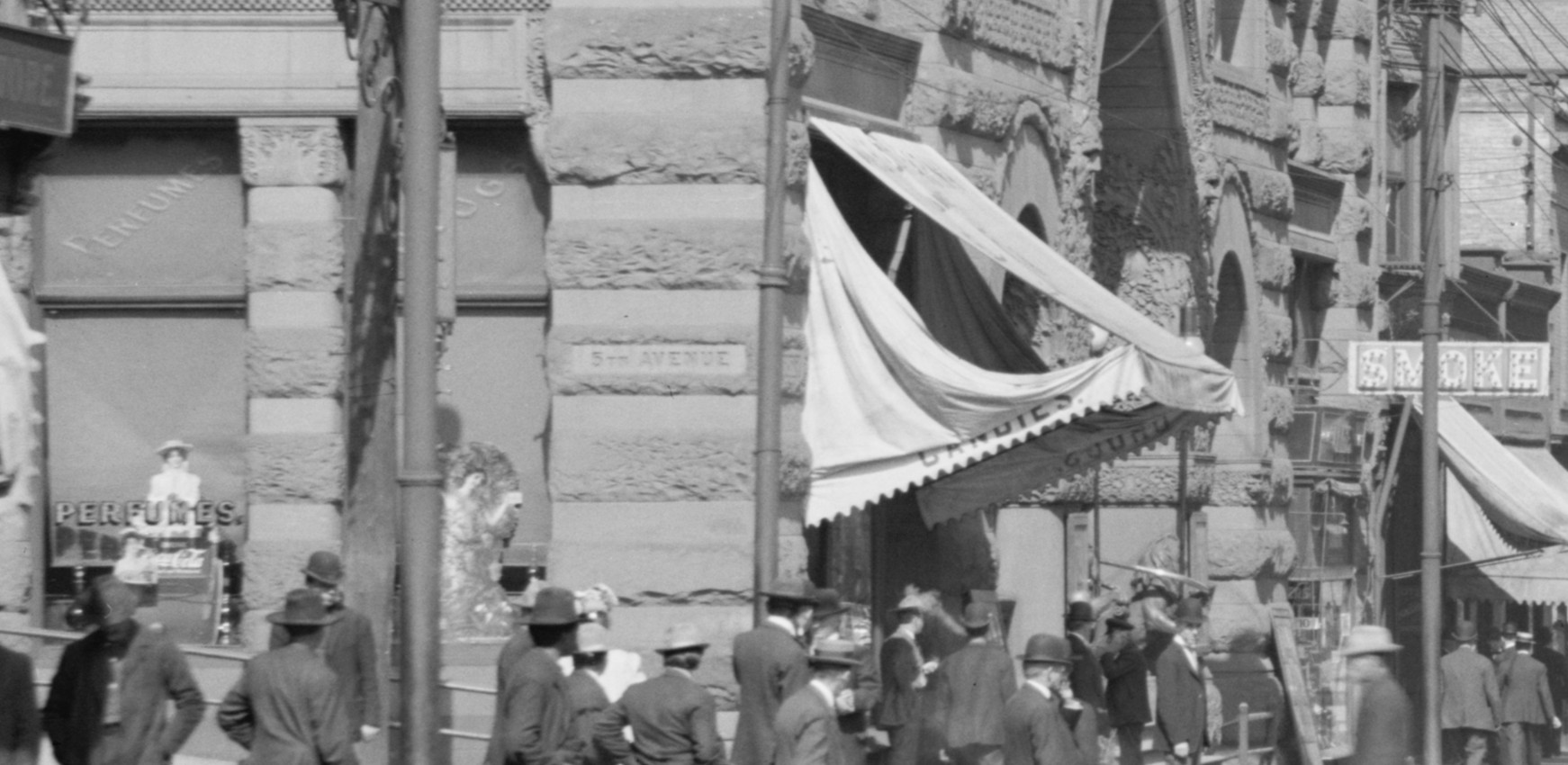
The Lyceum in the 1907 photograph.
The building on the other side of the welcome sign is quite well known. The Lyceum Theater opened in 1891 and stood at the present location of Maurices Headquarters until it was demolished in 1966. All that remains of it now are the comedy and tragedy masks from the façade that can be found at the Duluth Depot and the bronze lions that have moved from the front entrance of the Lyceum to the front entrance of the Lake Superior Zoo.
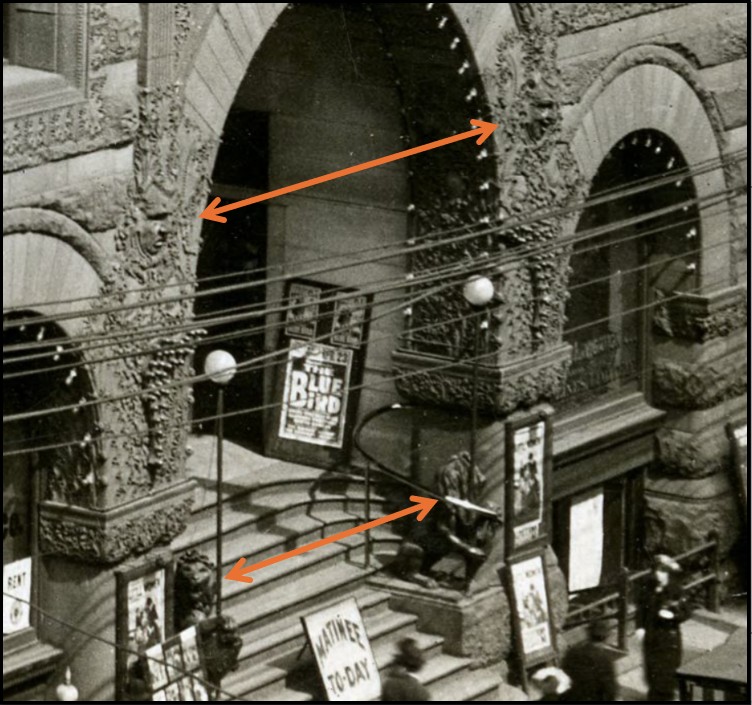
The masks and lions that spent decades just a few feet apart are now some miles apart. (Photo from the Minnesota Digital Library)
The awning of the Lyceum Drug Store is prominently visible on the corner. A search for the name in the Minnesota Digital Newspaper Hub shows that it operated from the opening of the Lyceum Building into the early 1940s. Most of the results are ads for cures of various ailments, with more information to be found by visiting the Lyceum Drug Store.
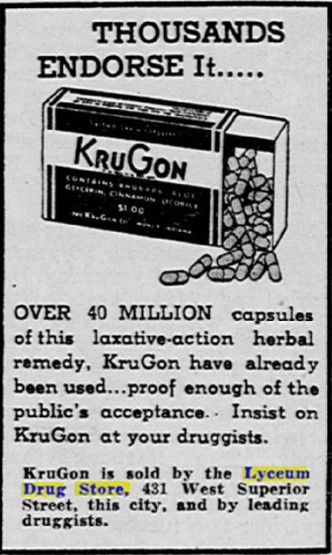
A laxative action herbal remedy sold by the Lyceum Drug Store. (The Duluth Herald, Dec. 1, 1941)
A story in the Duluth Evening Herald of April 5, 1907, just a few months before the photo was likely taken, ends at the Lyceum Drug Store and gives some indication of how people experienced Superior Street at the time.
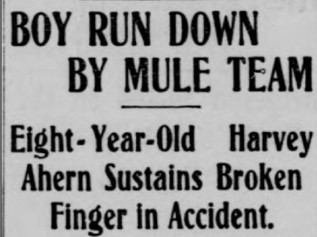
Harvey Ahern, an 8-year-old boy, was run down shortly after 5 o’clock, last evening, by a team of mules from the Board of Trade livery, and sustained a broken finger and sundry other bruises. The driver of the team drew upon himself the ire of those who witnessed the accident by attempting to drive off and leave the injured boy where he lay in the mud, stunned by the accident. One of them stopped the team, and the driver then helped carry the boy to the Lyceum Drug Store.
Young Ahern soon recovered, being only temporarily stunned, and a little deft treatment at the hands of a physician patching up his bruises.
The accident happened just after the liveryman had turned a sharp corner on to Superior street, so the driver could not have seen the boy, and was not to blame for the accident, except for the heartless manner in which he threatened to leave the boy at the mercy of the bystanders.
While it almost certainly changed over time, the Minnesota Digital Library has a few pictures of the interior of the drug store from its first decade, about 8 years before the photo of this series was taken. The cropped images below highlight some of the details from those photographs.
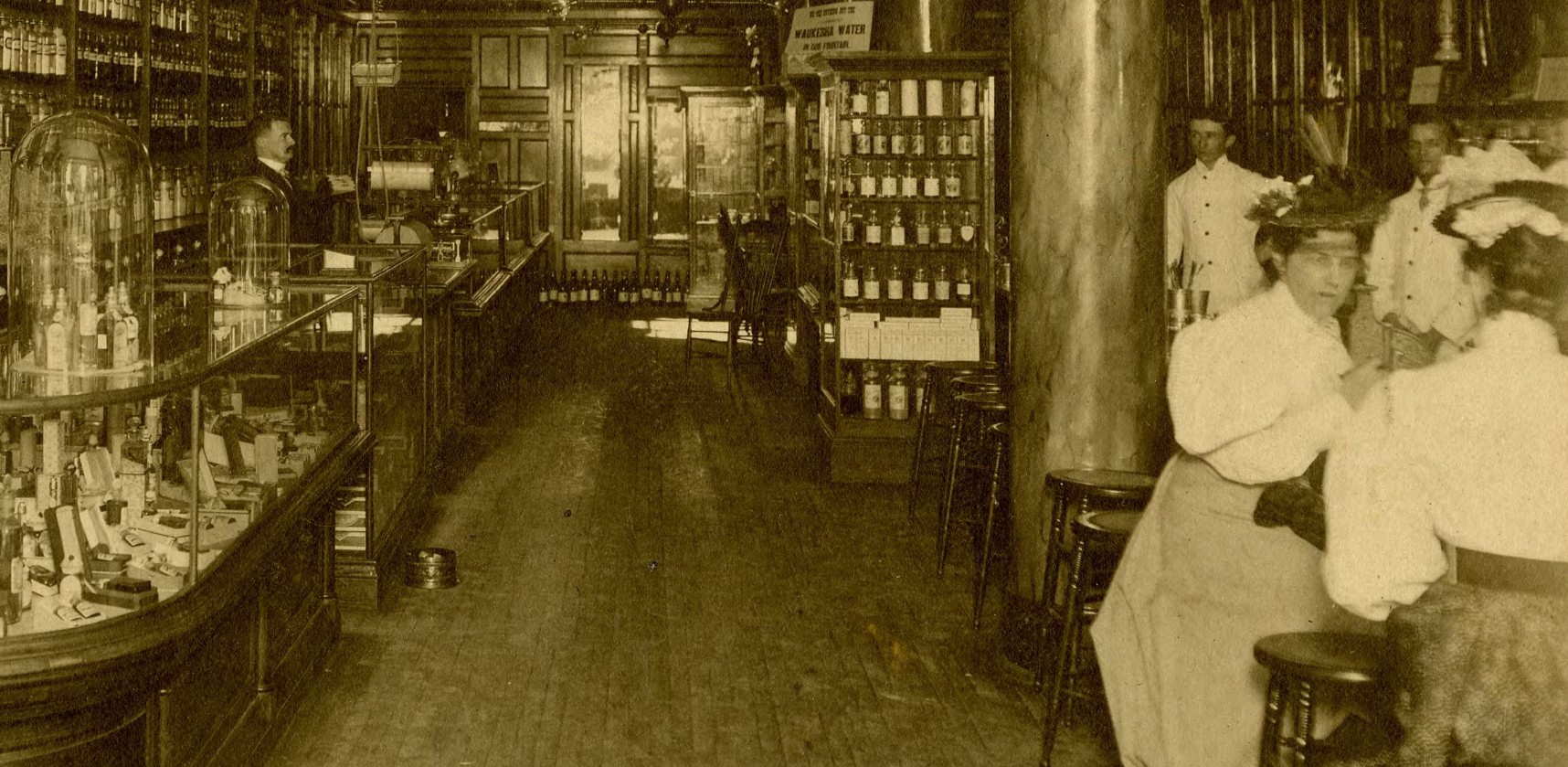
Lyceum Drug Store circa 1899. (Source: University of Minnesota Duluth Kathryn A. Martin Library Archives & Special Collections, via the Minnesota Digital Library)
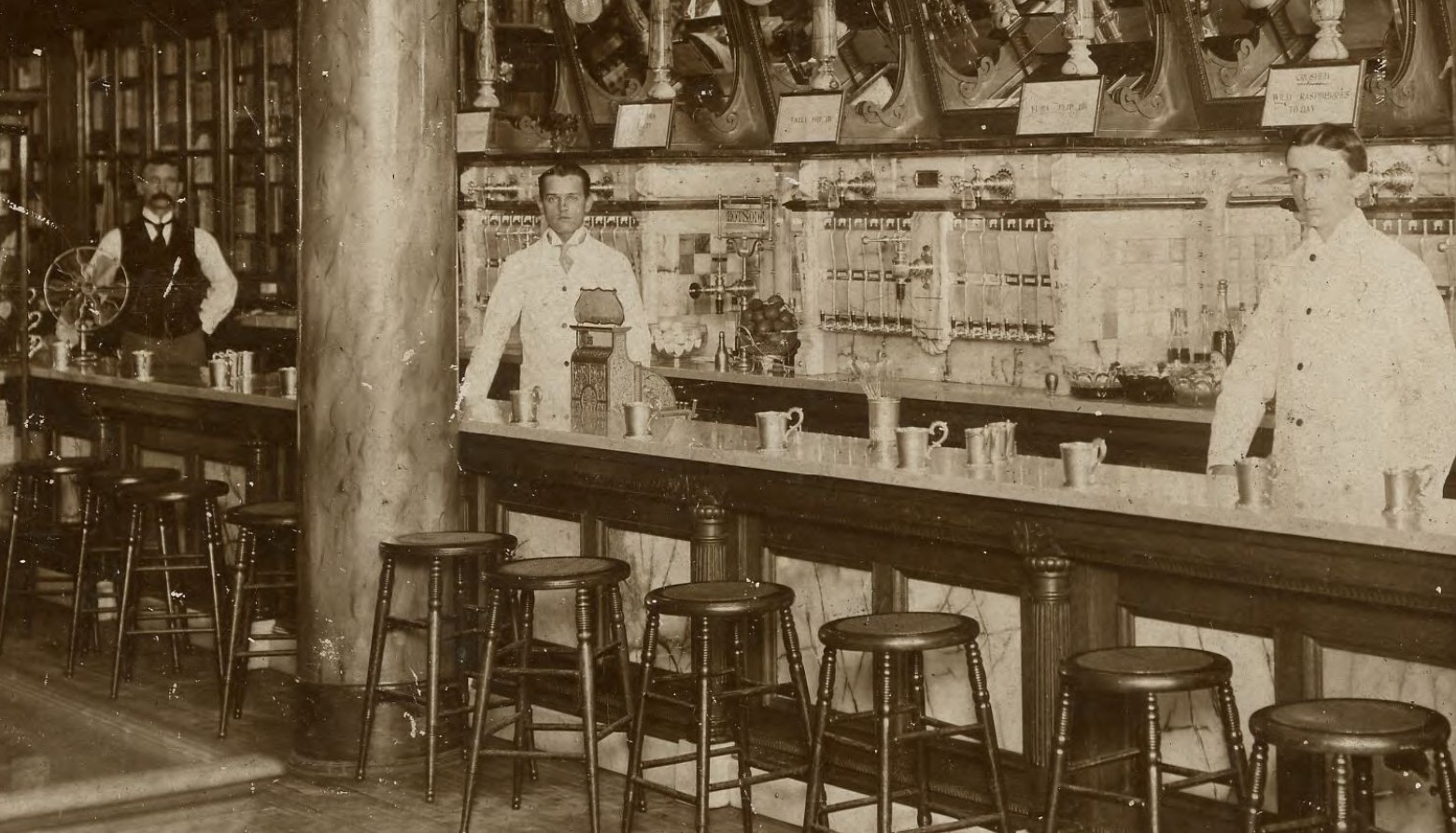
Lyceum Drug Store in 1899. (Source: University of Minnesota Duluth Kathryn A. Martin Library Archives & Special Collections, via the Minnesota Digital Library)
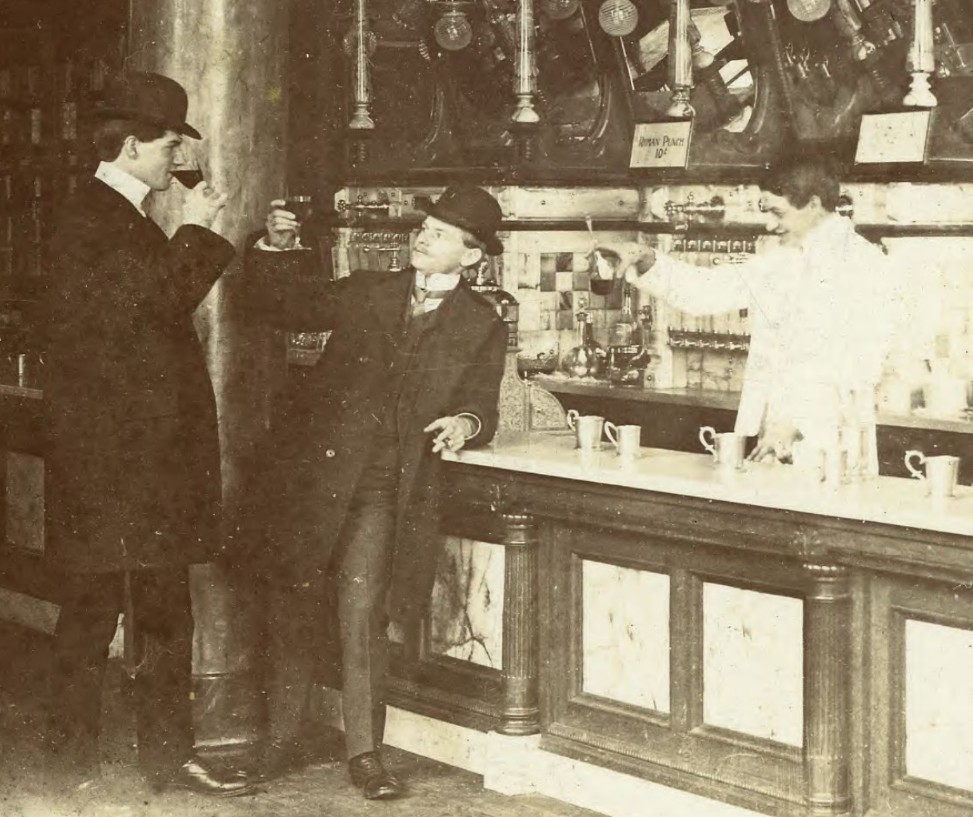
Lyceum Drug Store, circa 1890. (Source: University of Minnesota Duluth Kathryn A. Martin Library Archives & Special Collections, via the Minnesota Digital Library)
On the far side of the Lyceum Building, a sign sticks out that reads simply, “Smoke.” This business, apparently a cigar store, seems to have a somewhat less storied history than the Lyceum Drug Store. The only mention I could find of it in the newspaper archives involved a sale of some displays and a roll top desk.

For Sale – Counter Show Cases. (The Duluth Evening Herald, April 26, 1902)
Next month, part eight of this series will focus specifically on the side of the Lyceum Building, taking a closer look at the three people with visible names on upper office windows, one of whom still has his name carved into stone at the entrance to his former home.
Fascinating to look back in time. I see the people and wonder who they were, am I related? Also, beer was freaking expensive back then, over $71 for a 12-pack in today’s price. The whisky is more reasonable.
Love the story, and the images!
Where can I get all images, and the stories from this series?
Let me know!
Thanks! If you missed any of the previous six parts, just click on the “Detroit Publishing Company” tag at the bottom of the post just above this comments section. All of the most recent posts with that tag belonged to this series.
Just chiming in to say that this has been a super interesting and well-researched deep dive into one photograph. Kudos for all the work and thanks for sharing what you’ve discovered. Really cool.
Thank you!
Can you do one on the Anderson Furniture building in the craft district? There is so much history we’d like to learn!
I could at least add it to my rather lengthy project list – I did take a rather dramatic photo of the building a few years ago!
My great uncle James M. Milne was projectionist at the Lyceum for at least 20 years from the 1930s through the ’50s, also the Doric Theater in West Duluth.
From the Minnesota Digital Newspaper Hub…
Yes, That’s him!! I do know he also worked at the Lyceum according to my deceased grandmother, Mrs. Harry E. Howe. His wife, Claire in the pic above could have been a professional whistler she was that good!