

Superior Street, Sept. 11, 1907, Part 2: The Windsor Hotel and Surrounding Businesses
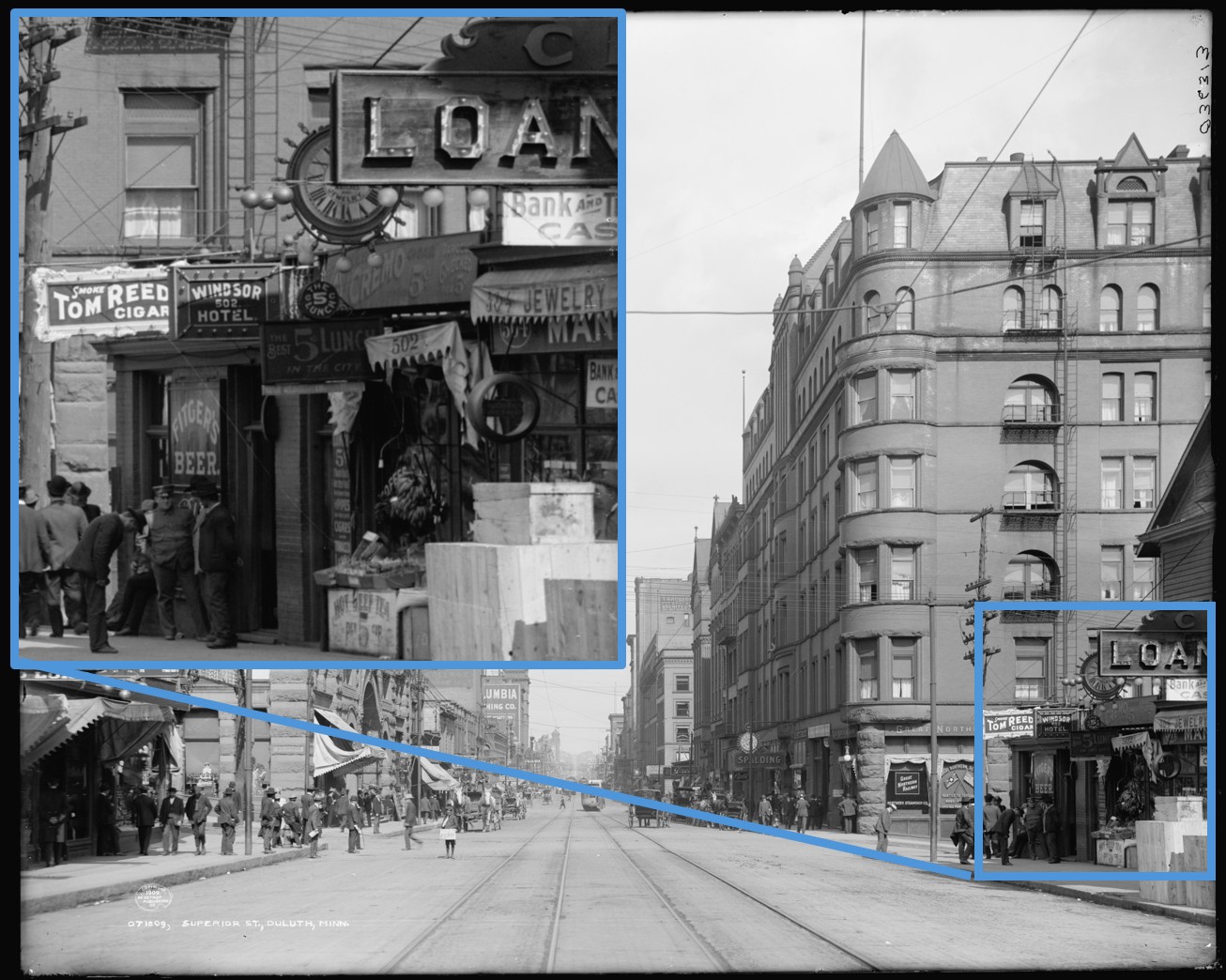
This ten part series takes a detailed look at life on Superior Street on the afternoon of Wednesday, Sept. 11, 1907 based on a single photograph. The first part of the series provided background details on a photograph shot that day where the street intersects Fifth Avenue West. Part two focuses on the bottom right corner of the photograph, relating to the contentious history between the city and the owner of the Windsor Hotel and telling the stories of the surrounding businesses.
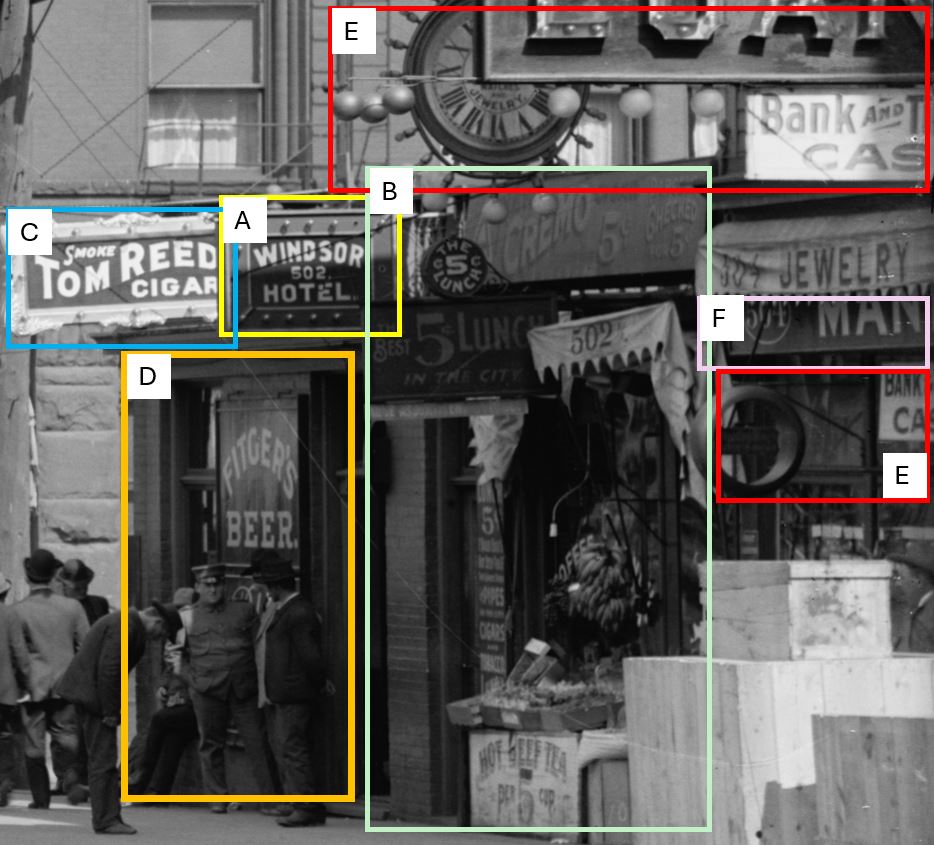
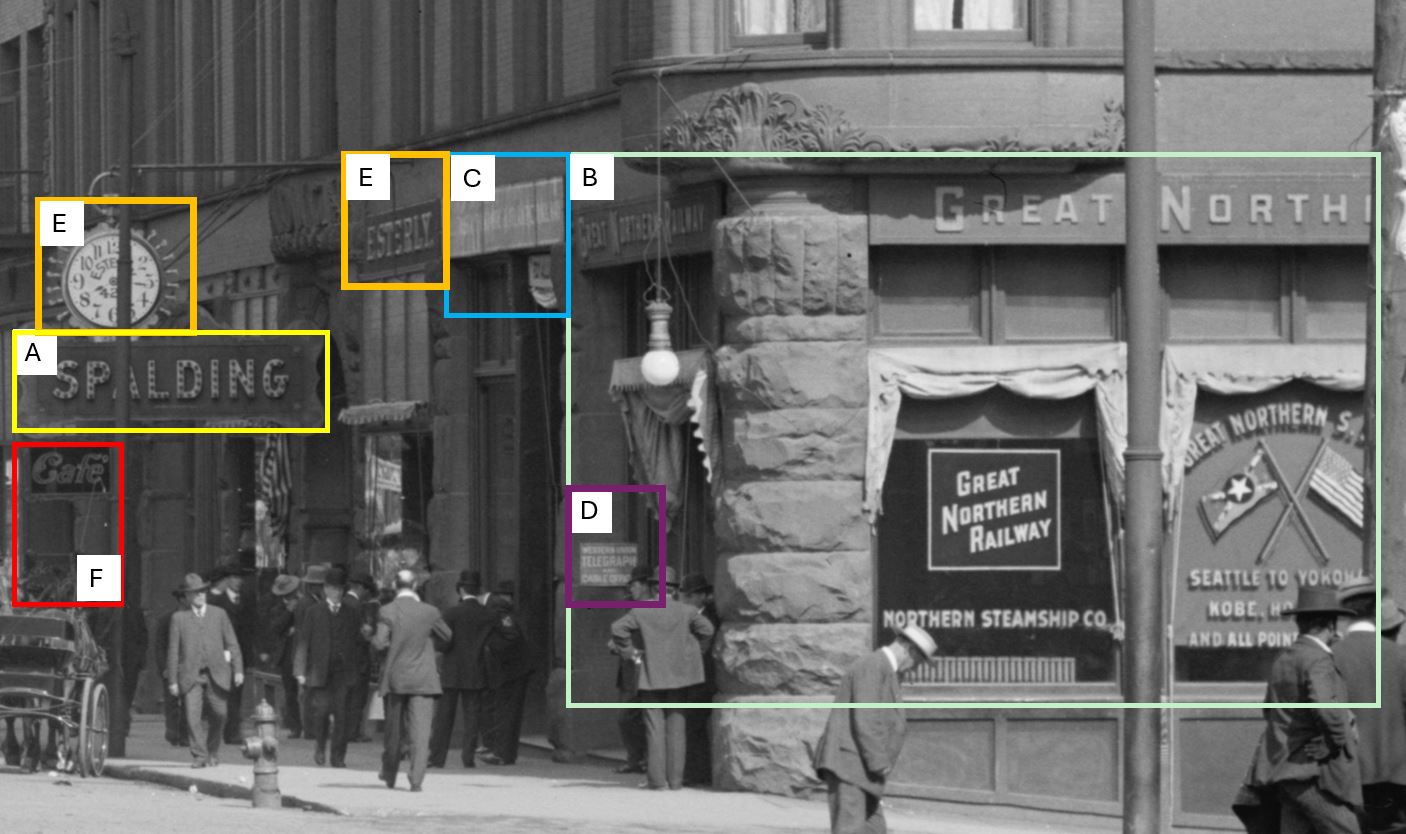
A. The Windsor Hotel, 502 W. Superior St.
The bottom right section of the main photo shows the storefronts along the front façade of the Windsor Hotel at 502 W. Superior St. The Windsor was one of the oldest buildings on Superior Street at the time of the photo. An 1883 ad describes it not only as the nearest hotel to the Union Depot but also as being “first class in every respect” with “good stables connected to the house.”[6] By the time of the photo, it was serving as a boarding home for laborers.[7] The transition from first class hotel to flophouse is a familiar one for this particular corner of Superior Street but the transition made by the Windsor Hotel was a bit different.

The Windsor Hotel and Stables around 1888 and a report on one of its residents from 1911 (Sources: Northeast Minnesota Historical Collections; Duluth Evening Herald, May 26, 1911)
In the 1907 photo this series details, the wooden frame of the Windsor is just visible on the far right of the image. This suggests that the picture was taken during a period of transition for Superior Street, when cheaply constructed timber structures began to be replaced by massive buildings of brick and stone. This is not the case. That transition had been completed, or nearly completed, some years earlier. The Windsor Hotel was a deliberate hold-out, much to the annoyance of many in the city.
In 1888, C.M. Henderson, a banker from Indianapolis, purchased the Windsor Hotel.[8] In 1889, he hired famed Duluth architect Oliver Traphagen, known for among other buildings the recently demolished Pastoret Terrace, to design a new stone, brick, iron and tile building for the corner[9] (a large wall billboard announcing the 9th floor offices of Traphagen and Fitzpatrick’s architectural firm can be seen in the photo on the top of the Torrey Building, designed by Traphagen and Fitzpatrick themselves). Traphagen’s building was never built. Just after construction started on the foundations next to the existing building, a tenant with a long-term lease filed a complaint and the city determined Henderson could only evict him if he provided the tenant with a considerable amount in compensation. In 1909, when reporting on a fire in the building, the Duluth Herald gave the following report of Henderson’s reaction to the ruling:
Mr. Henderson became so enraged at what he termed the unjustness of this proceeding that he vowed he would never complete the building and swore that as long as he lived, the corner should be an eyesore to Duluthians. Up to the present time he has kept his word, for there is not an uglier appearing corner in Duluth than the one in question. The combination of a brick and stone foundation with a dilapidated, unpainted ramshackle wooden structure sprouting out from its middle makes about as homely a picture as could be imagined.[10]
Duluth had an ordinance for downtown at the time stating that any wooden building receiving more than 40% of damage by fire could not be repaired and must be replaced with a stone or brick building. The 1909 fire was severe and many hoped it would mark the end of the Windsor, but it did not meet the 40% threshold.[11] The Herald wrote the following in covering the fire:
“Too bad the firemen got here so soon,” was an expression issuing from hundreds of throats in the crowd today.[12]
Henderson came out from the east coast to Duluth to examine the building and there was speculation that he would finally replace it.[13] He did not. He waited until 1912, when the lease of the renter finally expired.[14] On May 11, 1912, the Windsor Hotel finally went down to be replaced by “a handsome building of modern fireproof construction, steel frame, tile floors, brick exterior, trimmed with brown stone and terra cotta, which will greatly improve the appearance of Fifth avenue west where the bulk of the people visiting the city get their first impression.”[15]

Left: The demolition of the old Windsor, which was replaced by a new business block. Right: The new business block, which was replaced by the plaza of the Duluth Public Library. (Sources: The Duluth Herald, May 11, 1912; The Duluth Herald, Aug. 3, 1912)
While many of the city welcomed the fire that eventually led to the hotel’s replacement, some people working in the building felt differently. The hotel was home to an army recruiting station. The employees jokingly referred to the hotel as their fort with the hotel’s saloon owner, Gus Levine, as their general. After the fire, when those who frequented the hotel thought it could not be salvaged, one of the workers at the recruiting station wrote to another employee and his letter was published in the Herald the week after the fire:
Gen. Gus had a leave of absence for five days, with permission to visit the city of Chicago. He had only been in Chicago a few hours when he received word of the attack on the fort. He left immediately for the scene of action, but arrived too late to save the day. Arriving here Sunday morning the general at once saw the place that he once cherished and protected so long, was utterly destroyed.
The small fruit store that has contributed so bountiful to the soldiers of the fort, also the beautiful clothing and three ball store that helped these same brave soldiers out in the time of need, all being in close proximity of the fort, were unable to stand the heavy fire. They too have gone down in history only to be remembered by the insurance companies.[16]
These small stores in front the Windsor are all visible in the photo. The insurance records are likely long gone but the newspaper reports remain, allowing these businesses to be remembered here.
B. The Fruit Stand
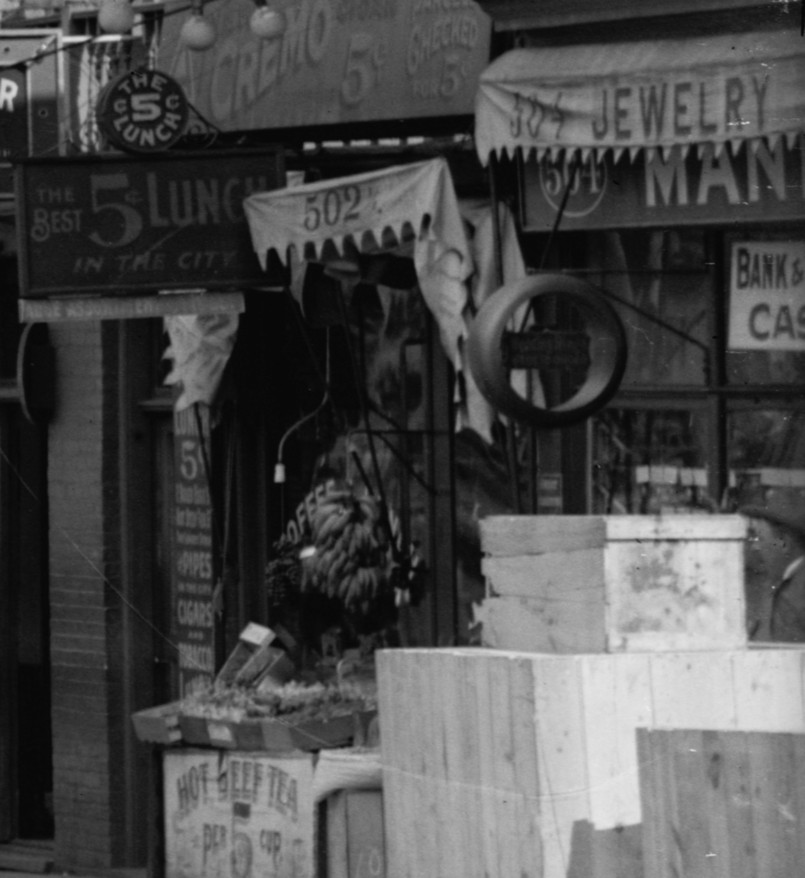
While bunches of bananas are visible outside the window, the fruit stand sold a lot more than fruit and all of it for five cents. They checked parcels for five cents, sold five cent cigars, made the best lunch in the city for five cents, and served hot beef tea for five cents.
In the Shorpy discussion of this photo, many made comments about the hot beef tea. A website describing its history gives its origins as a medicinal drink with its origins in 19th century hospitals. The website provides this recipe from 1851:
Cut a pound of solid beef into very small dice, which put into a stewpan, with a small pat of butter, a clove, two butter onions, and a salt-spoonful of salt, stir the meat round over the fire for a few minutes, until it produces a thin gravy, then add a quart of water, and let it simmer at the corner of the fire for half an hour, skimming off every particle of fat, when done pass through a sieve. I have always had a great objection to passing broth through a cloth, as it frequently quite spoils its flavor.
The drink became generally popular and Duluth was no exception. The fruit stand wasn’t the only place you could find hot beef tea. Freimuth’s Department Store down the street sometimes gave it out for free.
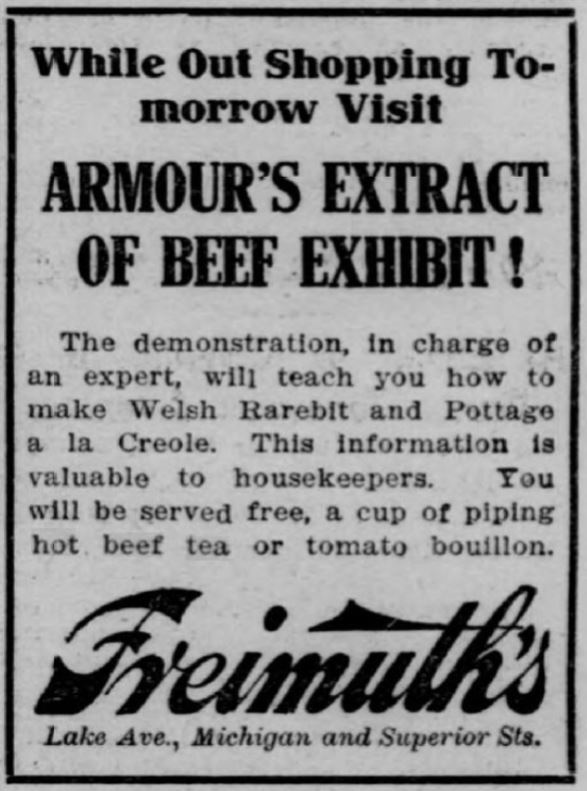
Hot beef tea served free at Freimuth’s (Source: Duluth Evening Herald, Jan. 11, 1907)
The name of the fruit stand appears to be Cremo, the name that appears in large font on the awning, but this is actually the name of their cigar brand. The “A” in a triangle on the far left of the awning is the logo of the American Cigar Company, producer of Cremo Cigars.

Ad for the American Cigar Company. (Source: Duluth Evening Herald, Aug. 7, 1906)
C. Tom Reed’s Cigars
Cremo isn’t the only cigar brand visible in the photo. Above the saloon is a prominent ad for Tom Reed’s Cigars. The saloon likely sold the cigars, which were made just a few blocks away in their factory at 214 W. Michigan St.[17] The Duluth company used local union workers to produce hand made cigars that were sold throughout Northern Minnesota and at least as far away as Iowa.

Ads for the Tom Reed Cigar Company, including a matchbook and cast iron cigar cutter with automatic match dispenser. (Sources, clockwise from upper left: The Ely Miner, Sept. 28, 1899; Morphy Auctions ; Duluth Evening Herald, Aug. 3, 1905; The Ely Miner, Sept. 1, 1897; eBay)
The company was named after the former Speaker of the U.S. House of Representatives from Maine, Thomas Brackett Reed.[18] Reed served as speaker from 1889 to 1891 and from 1895 to 1899. His photo was on the cigar box and an ad from 1897 shows the company existed while he was still speaker. As speaker, Reed was influential in passing the McKinley Tariff bill. He also presumably smoked cigars.
D. Gus Levine’s Saloon
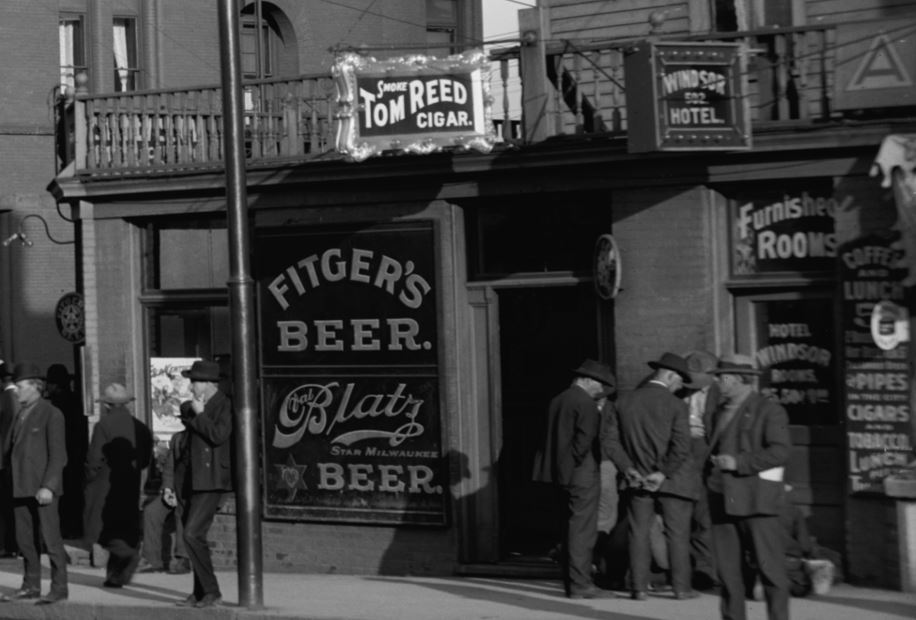
The saloon in front of the Windsor Hotel as shown in another Detroit Publishing Company photo from around the same time.
Gus Levine’s Saloon occupied the corner of the building,[19] made possible by eight foot extension to the front of the hotel in 1884.[20] Not much is known about the saloon although it is clear that it sold both Fitger’s and Blatz Beer.
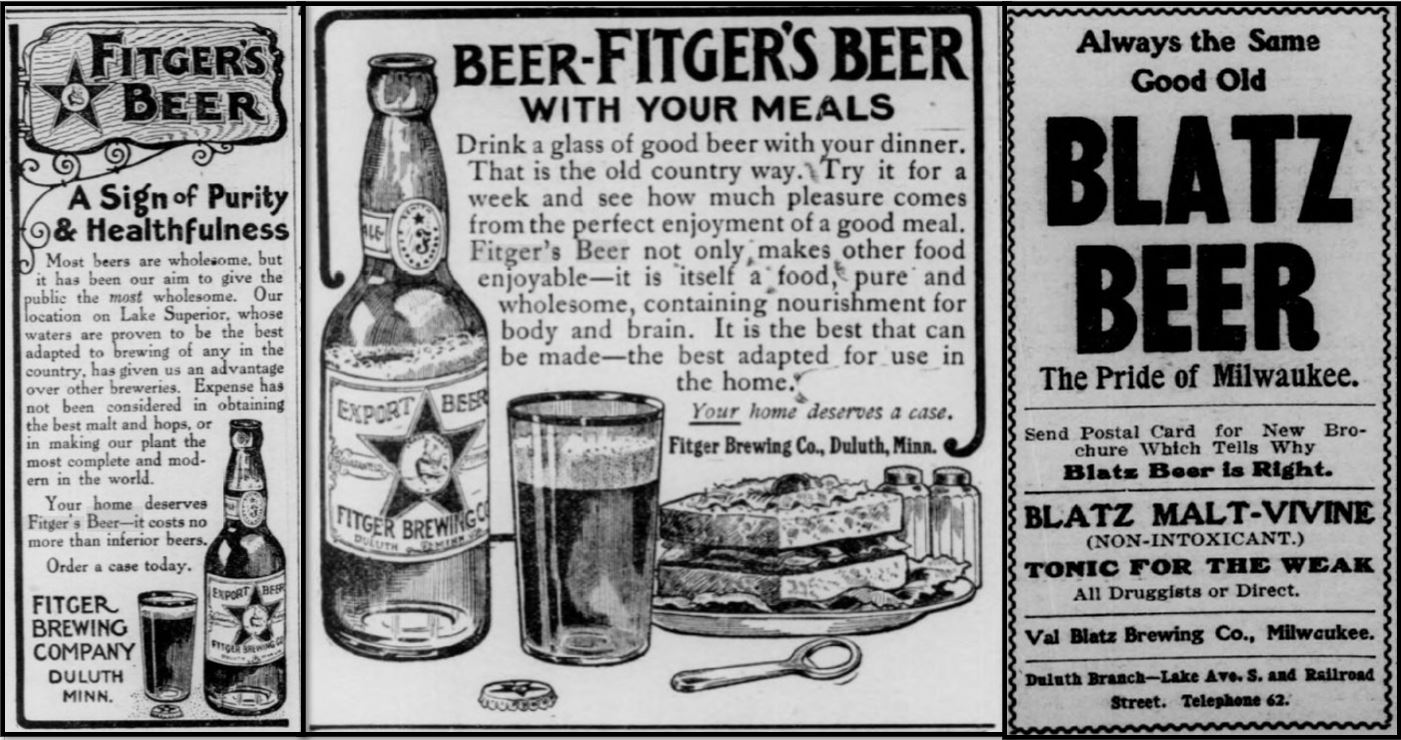
Fitger’s and Blatz beer ads. (Sources: Duluth Evening Herald, Sept. 6, 1907; Sept. 20, 1907; Feb. 12, 1903)
E. City Loan Bank, 506 W. Superior St.

A view of jewelry for sale at City Loan Bank along with a classified ad from the time. (Sources: Library of Congress, undated image and Duluth Evening Herald, May 27, 1905)
The sign advertising jewelry belongs to City Loan Bank.[21] The bank attached a number of different objects to the storefront to indicate their many services. The three balls hanging from the sign indicate they are also a pawn shop. The large clock surrounded by electric lights has text in the middle that says they sell watches and jewellery. Signs on top of the building and in the window announce “Bank and Time Cards Cashed.” An oversized wedding ring hangs beneath the awning.
F. Manhattan Clothing Company
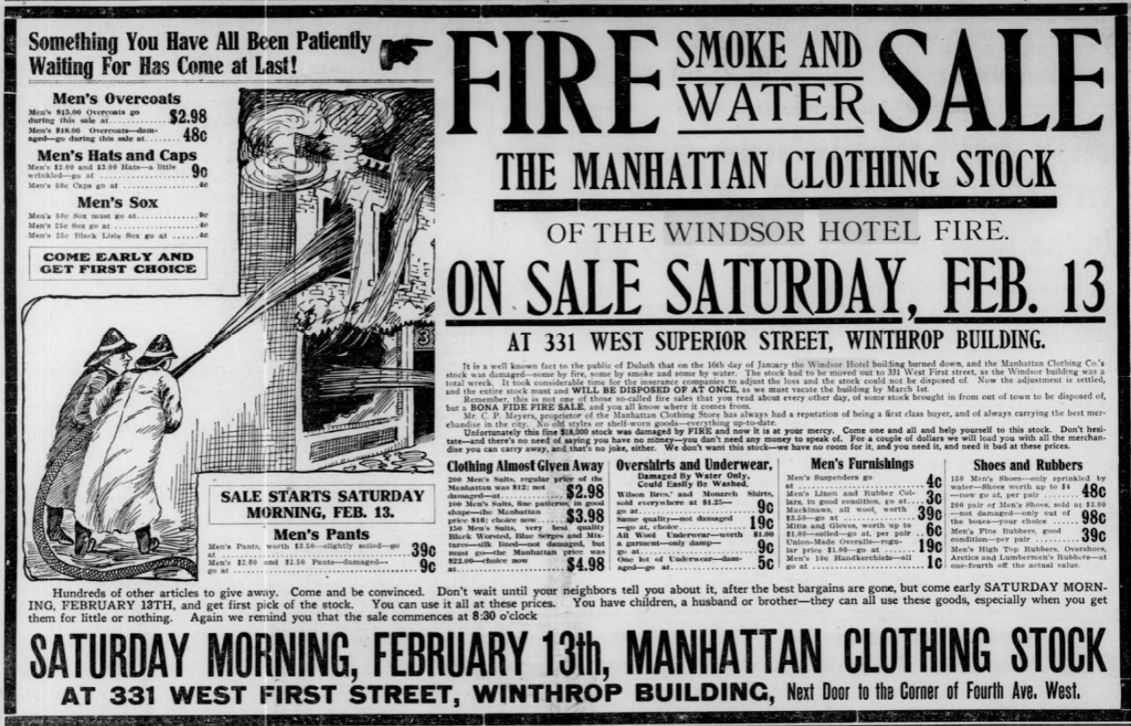
Ad for the Manhattan Clothing Company fire sale. (Source: Duluth Evening Herald, Feb. 12, 1909)
In the photo, the left edge of the entrance sign for the Manhattan Clothing Company is visible. The shop shared an address with City Loan Bank and was severely damaged during the 1909 fire.
Part three of the series will move across Fifth Avenue West to take a closer look at a hotel with a much better reputation than the Windsor, recounting the stories behind the more upscale stores that surrounded the Spalding Hotel.
Coming next month: Superior Street, Sept. 11, 1907, Part 3: The Spalding Hotel and Surrounding Businesses
Notes
[6] Duluth Evening Herald, April 9, 1883
[7] Duluth Evening Herald, May 29, 1905
[8] Duluth Evening Herald, March 24, 1888
[9] Duluth Evening Herald, March 19, 1889
[10] Duluth Evening Herald, Jan. 16, 1909
[11] Duluth Evening Herarld, Jan. 22, 1909
[12] Duluth Evening Herald, Jan. 16, 1909
[13] Duluth Evening Herald, Jan. 25, 1909, February 3, 1909
[14] Duluth Herald, April 19, 1912
[15] Duluth Herald, Aug. 3, 1912
[16] Duluth Evening Herald, Jan. 22, 1909
[17] Duluth Evening Herald, Aug. 3, 1906
[18] Duluth Herald, Nov. 10, 1900
[19] Duluth Evening Herald, Jan. 16, 1909
[20] Duluth Evening Herald, Jan. 21, 1909
[21] Duluth Evening Herald, May 27, 1905