

Superior Street, Sept. 11, 1907, Part 5: Even-Side Businesses from Third Avenue West
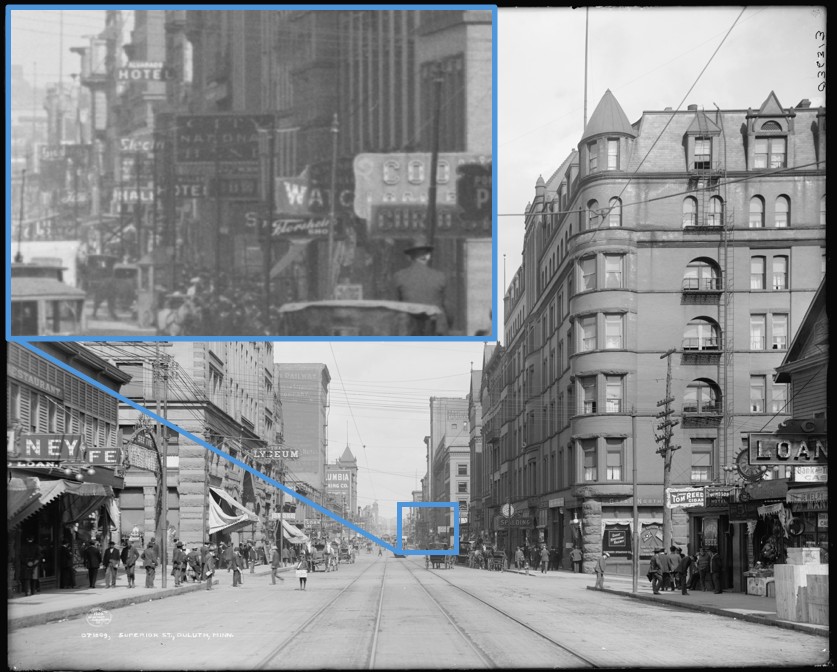
This series takes a detailed look at life on Superior Street on the afternoon of Wednesday, Sept. 11, 1907. The first part of the series provided background details on a photograph shot that day where the street intersects Fifth Avenue West. Part five looks at the businesses on two specific blocks of the south side of Superior Street, including the building that created U.S. currency with a Duluth stamp, the only bowling alley in Duluth, and two alleged houses of ill repute.
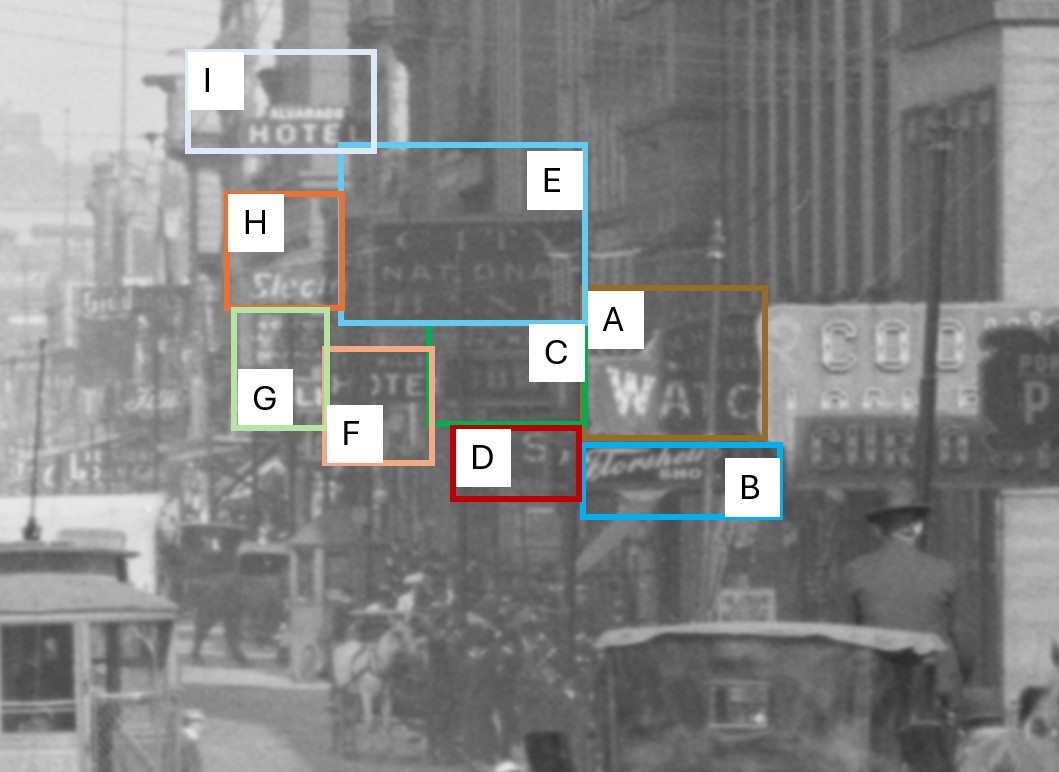
A. Maurius Henricksen Jewelry and Watches, 330 W. Superior St.
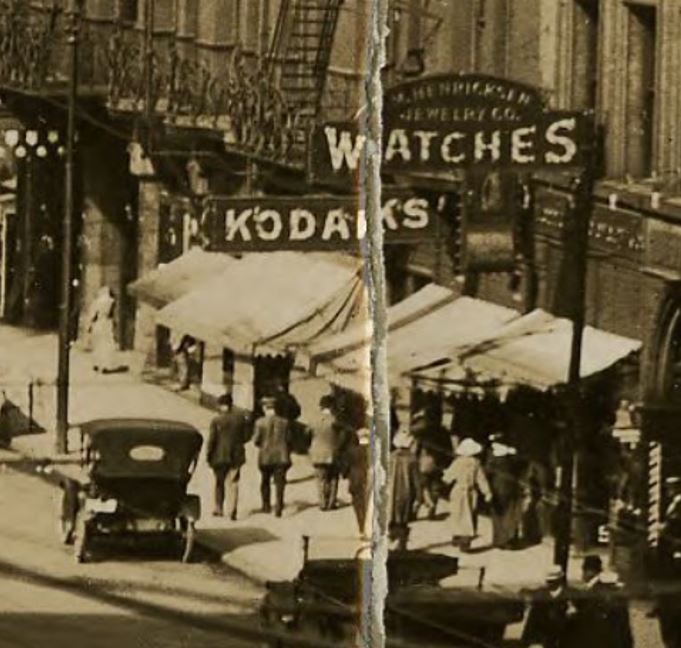
Maurice Hendricksen’s Watch Store in the early 1920s. (Source: Minnesota Digital Library
Maurice Henricksen was born in 1874 on a ship in the Atlantic as his parents made the journey to the United States from Norway.[56] He grew up in Duluth and by the age of 25 had opened a watch manufacturing and repair shop at 334 W. Superior St. in the Providence Building. In one of his first ads, placed in the Duluth Evening Herald in 1899, he described his business and his philosophy:
You carry in your lowest vest pocket the smallest, most delicate machine that was ever constructed of the same number of parts. About one hundred and seventy-five different pieces of material enter into its construction, and upwards of 2400 separate operations are comprised in its manufacture. On this tiny instrument you depend for nearly every action in your everyday life. However irregular your own habits may be, its habits must be unfailingly regular and whenever appealed to, at any hour of the day or night, in cold or in torrid climate, on the mountain top or in the mine, it must tell the time within a variation of a fraction of a second a day, or you will want to know the reason why …
I hope that you will believe I am a competent watchmaker. I will try to deserve your best opinion if you give me a chance to demonstrate my skill upon your ailing watch. The price is not the lowest in these parts, but the least that the quality of my workmanship will afford. Maybe after a little of experience, you will conclude that it is the cheapest in the end. ‘Cheap’ repairing is generally real extravagance.[57]
Henricksen’s watch business grew from repairing and selling watches to selling jewellery to the wholesale manufacturing of jewellery.[58] In 1905, The Labor World described his business as one of the most progressive in the country.[59]
In the late 1920s, he moved to Miami Beach, Florida, where he operated a gift and jewelry store with his daughter until his death in 1949.[60]
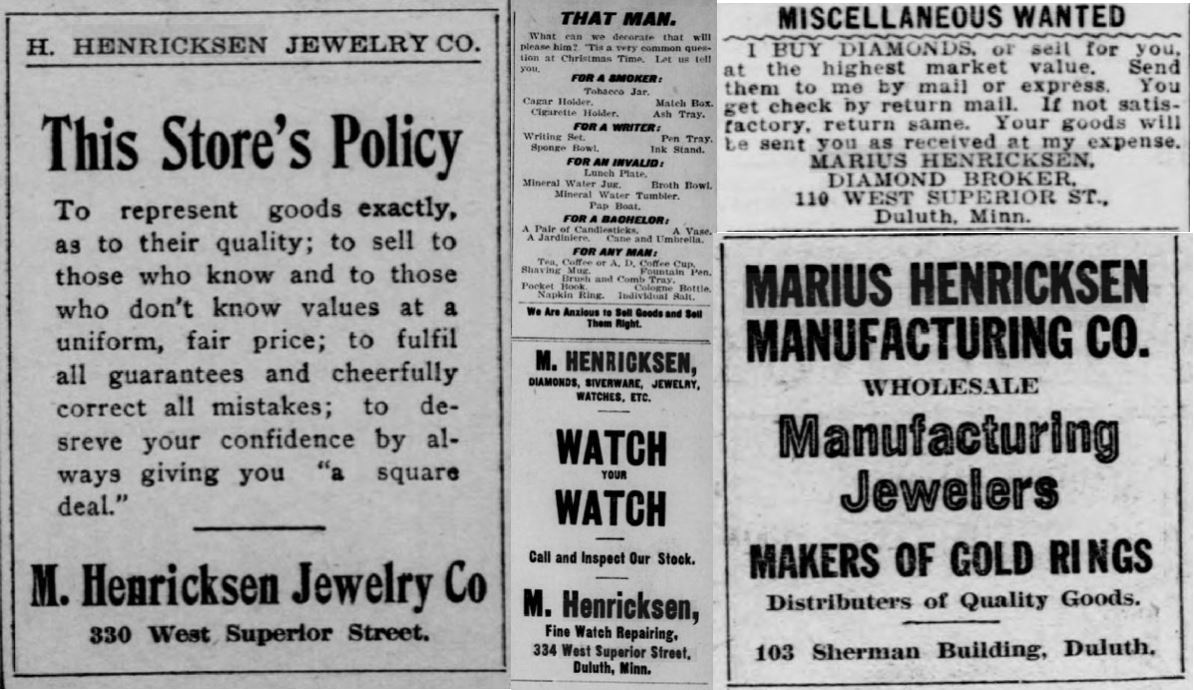
Ads placed by M. Henricksen over the years. (Sources from left to right, top to bottom: (Duluth Evening Herald, July 25, 1906; Dec. 19, 1899; The Duluth Herald, Aug. 25, 1919; Feb. 15, 1916)
B. Florsheim Shoe
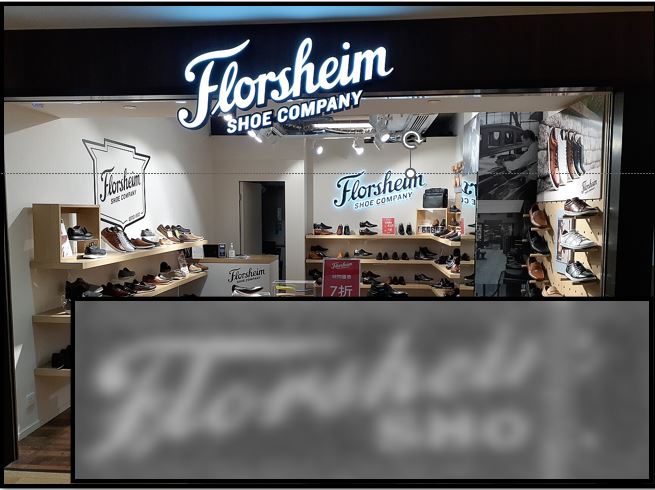
The Florsheim log as seen on a store in Hong Kong in 2021 and Duluth in 1907. (Source: Wikipedia, CHANGIMN SANGO Leigcz, CC BY-SA 4.0)
Just down the street from the jewelry and watch store is an ad for Florsheim Shoes. The company was founded in Chicago in 1892. By 1930, 9,000 stores across the United States were selling Florsheim footwear. The brand was purchased and exchanged by several corporations until 2002, when two members of the founding family, Thomas and John Florsheim, repurchased the brand. Throughout his career, Michael Jackson wore different Florsheim shoe models when he danced. The Hong Kong store shown above features a logo similar to the one seen on Superior Street at the time of the photo.
C. Central Billiard Hall and Bowling Alley
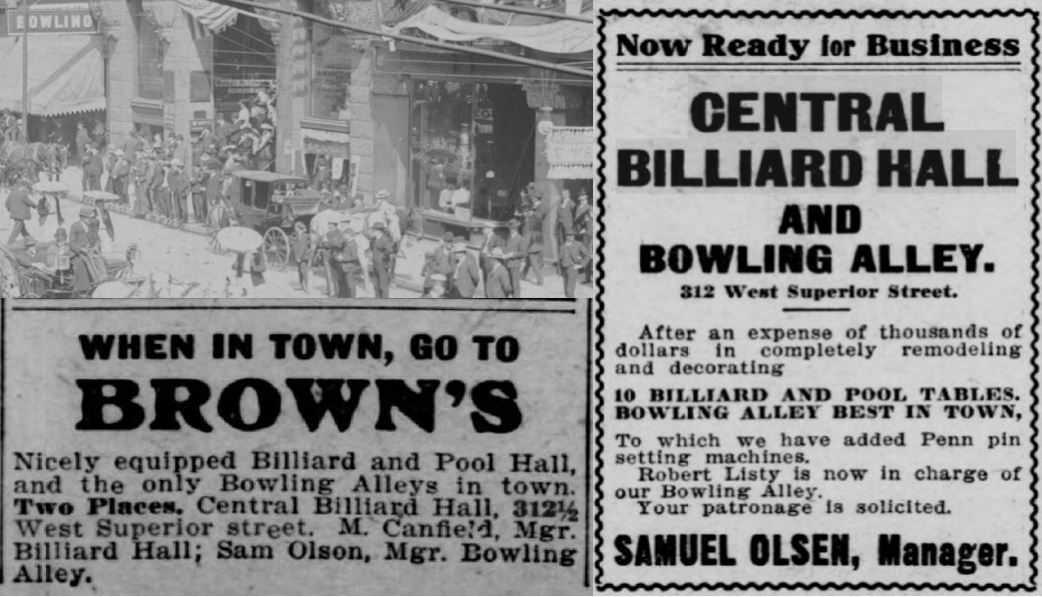
A parade goes by the bowling alley in 1899, with the sign visible in the upper left of the image; ads. (Sources: Northeast Minnesota Historical Collections; Duluth Evening Herald, Jan. 3, 1908; Sept. 18, 1909)
Henry Brown competed in pool tournaments himself[61] before opening his own pool hall and bowling alley in 1897.[62] The bowling alley was advertised as the only one in town in 1908.[63] After a remodeling in 1909, it was advertised as the best in town.[64]
Brown continued to play pool after opening the business. During a week in October 1909, he offered an hour of free play and a cigar to anyone who could beat him.[65] In 1905, he was fined $10 for allowing minors in his pool hall after a number of parents complained that their sons were skipping school to play pool at his establishment.[66]
He later opened a second location, the Grand Billiard Hall and Bowling Alley at 205 W. Superior St.[67] He died in 1917 at age 76 while living in the Park Terrace apartment complex.[68]
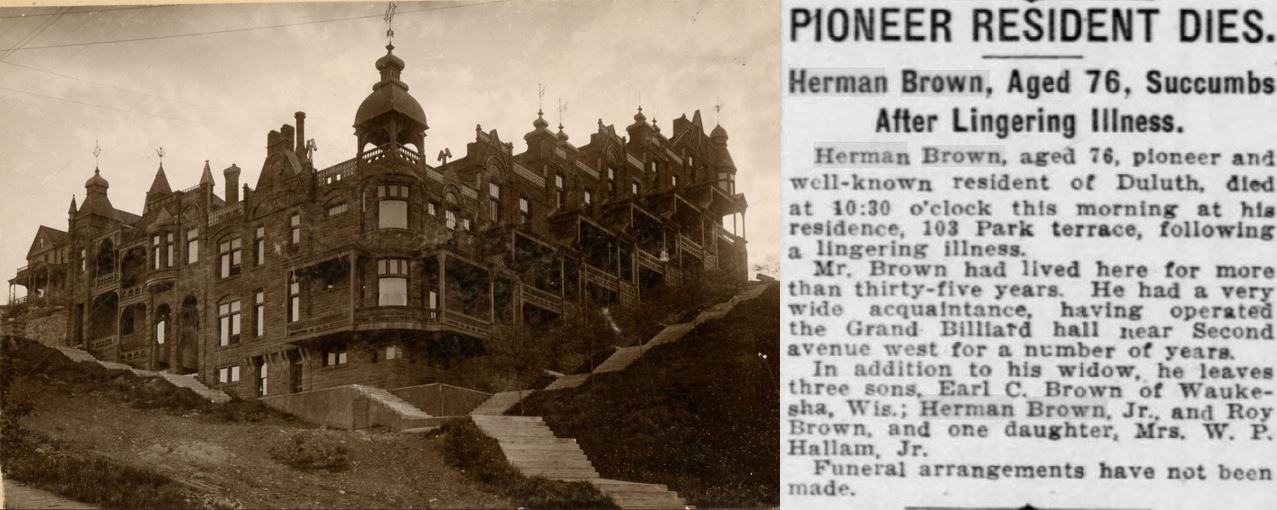
Left: The Park Terrace Apartment Complex; Right: Herman Brown’s obituary. (Sources: Northeast Minnesota Historical Collections; Duluth Herald, Aug. 3, 1917)
D. St. Louis Hotel, 324 W. Superior St.
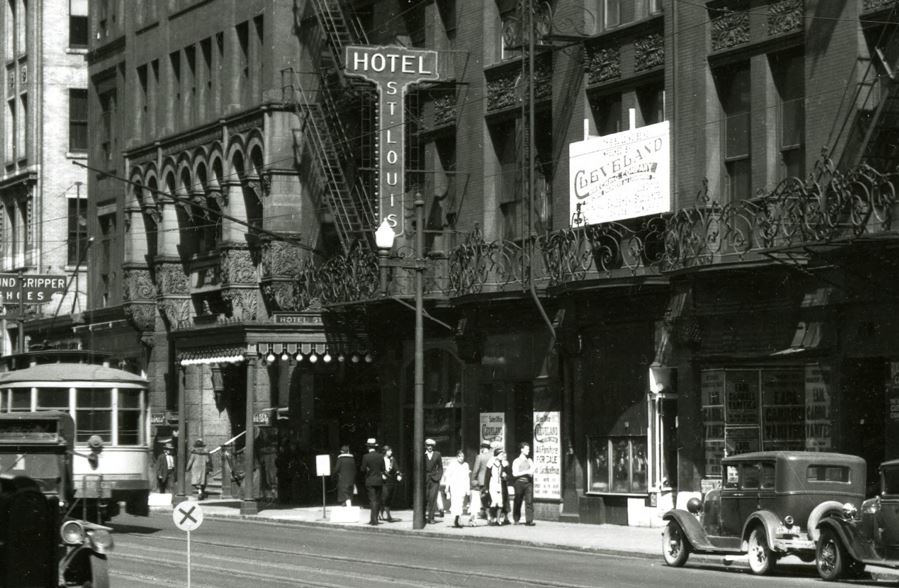
The St. Louis Hotel in 1931, a year before its demolition. (Source: The Northeast Minnesota Historical Collections)
The “S” of the St. Louis Hotel sticks out just past the Florsheim Shoe sign. Or in this case, the new St. Louis Hotel, as the original was destroyed in a fire in 1893 and the neighboring hotel became the New St. Louis. The St. Louis was demolished in 1932 and replaced with the current Medical Arts building. In 2020, Perfect Duluth Day featured an extensive history of the St. Louis Hotel.
E. City National Bank
City National Bank of Duluth was granted charter 6502 in 1902. For a 34-year period, between 1902 and 1935, it printed U.S. currency: eight different designs of $10 and $20 dollar bills. In total, the bank printed $4,518,440 worth of currency, meaning the money is not particularly rare as a collectors item, although some bills were printed in limited quantities and are still quite valuable. A first series McKinley ten dollar bill with a red seal (the seal was later changed to blue) remains highly prized by collectors.
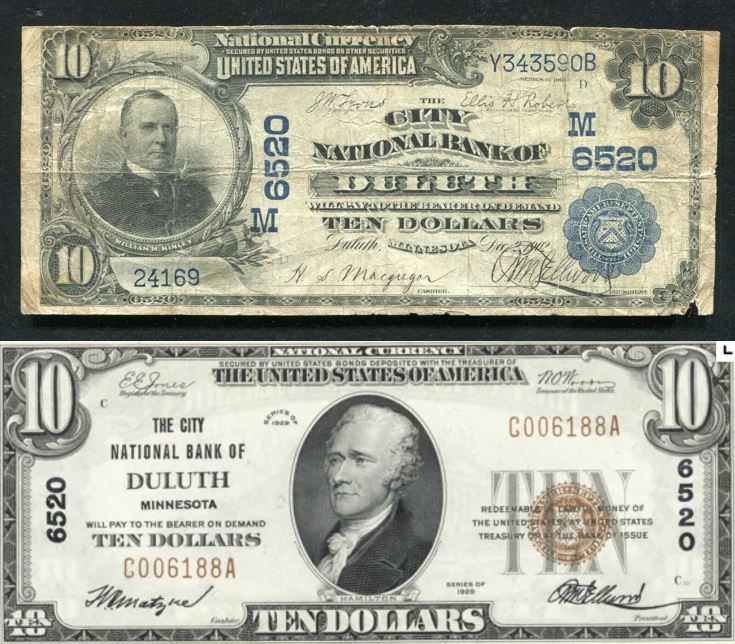
Top: A 1902 $10 blue seal City National Bank of Duluth bill selling for $199 Bottom: A 1929 City National Bank of Duluth bill listed at $375. (Sources: eBay; Rocky Mountain Coin)
In 1909, City National Bank joined with three other banks, including Northern National Bank, to form a clearinghouse to facilitate cooperation between the banks.[69] In 1957, City National Bank merged with Northern National Bank to become the Northern City National Bank as described in the history of Northern National Bank on Perfect Duluth Day.
F. The Miller Hotel, 224 W. Superior St.
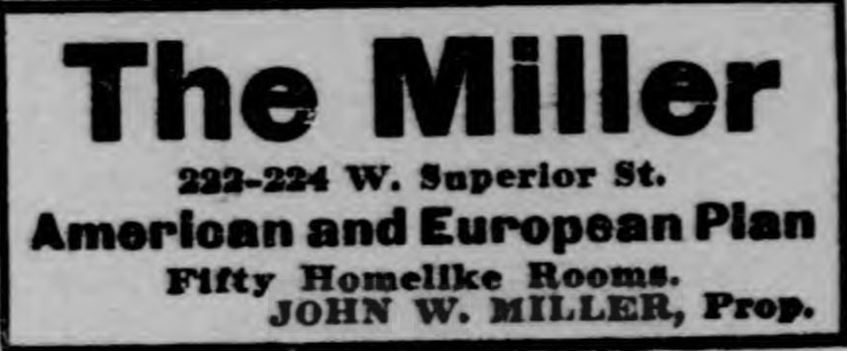
The Miller offered meals under both the American and European plan. (Source: Duluth Evening Herald, March 31, 1906)
Owned by John W. Miller, The Miller served both temporary guests and longer term residents. It offered rooms under the American Plan with three meals a day or the European Plan, without meals.
Its lobby contained a large aquarium with 85 trout and gold fish. It was reported as one of the finest trout collections in the state in a story about how the glass broke on the tank and the night cashier had to quickly fill tubs of water to save as many fish as possible.[70]
The stories of the business owners along Superior Street at the turn of the previous century are primarily the stories of successful rich white men. Because of their prominent place in the community, their lives are well documented in the papers. Accounts of the Miller Hotel come largely from classified ads placed by its residents. The ads, paid for by the word, are short, but they suggest a far greater diversity of life stories in early Duluth than the ones told by looking only into the people who owned and operated these businesses on Superior Street.
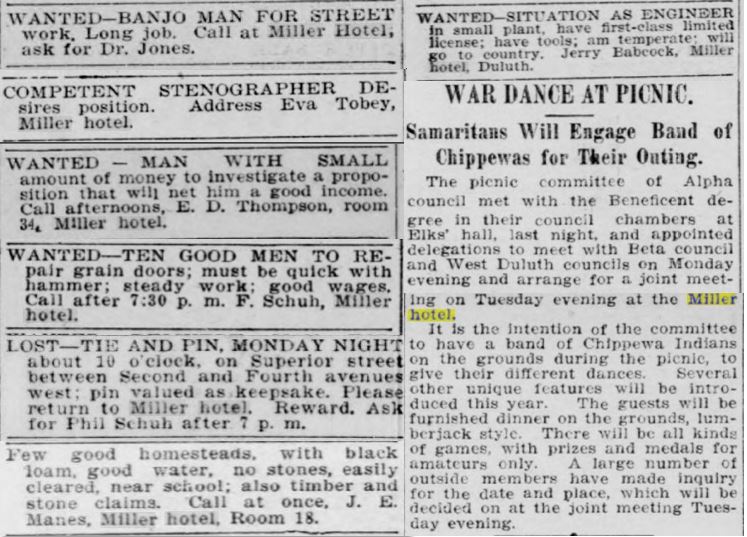
References to the Miller Hotel in the Duluth Evening Herald. (Sources, from left to right, top to bottom: May 17, 1906; Feb. 5, 1906; June 8, 1907; Sept. 14, 1909; July 20, 1909; Oct. 9, 1909; April 17, 1905; Aug. 9, 1908)
G. The West Hotel, 208 W. Superior St.
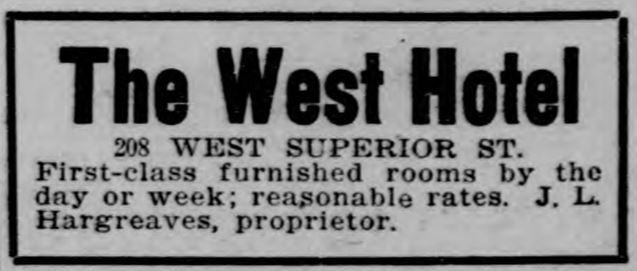
Ad for the West Hotel. (Source: Duluth Evening Herald, March 31, 1906)
In October 1908, Ellen Shea took over the West Hotel from J.L. Hargreaves, making it one of the few woman-operated businesses on Superior Street.[71] She remodelled the hotel and began placing ads offering spaces to local businesses. Unfortunately for her, one of the first businesses to take up the offer was a brothel, run by a woman who was arrested and fined two months after Shea took over the hotel.[72]
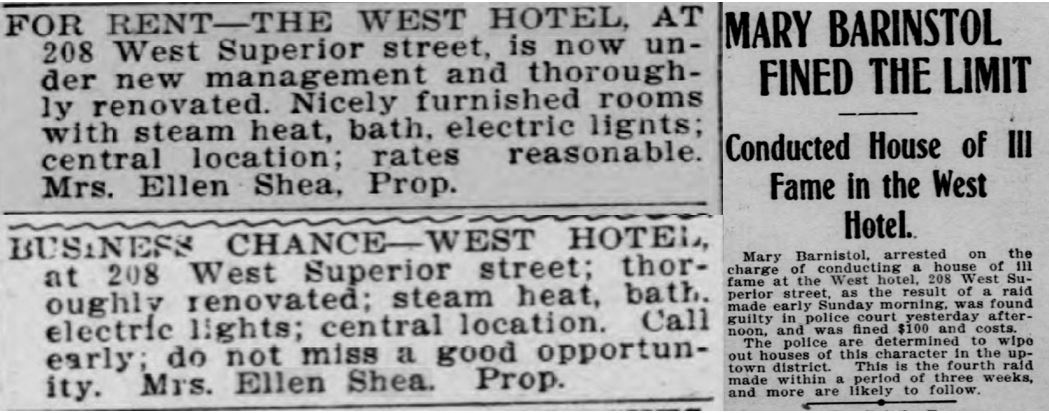
The West Hotel in the Duluth Evening Herald. (Sources, clockwise from top: Oct. 27, 1908; Dec. 8, 1908; Nov. 3, 1908)
Because there was a West Hotel operating at the same time at 1915 W. Superior St.[73] as well as a more prominent West Hotel in Minneapolis,[74] it is difficult to identify with certainty which events happened at the West Hotel in the photo. Not much information is available in the newspaper archives about Ellen Shea either, other than that she filed for divorce from a second husband in 1930, at the age of 65, on the grounds of habitual drunkenness.[75] She was denied the divorce because the judge found her evidence insufficient.[76] She passed away in August 1933 after a short illness.[77]
H. The Alvarado Hotel, 210 W. Superior St.
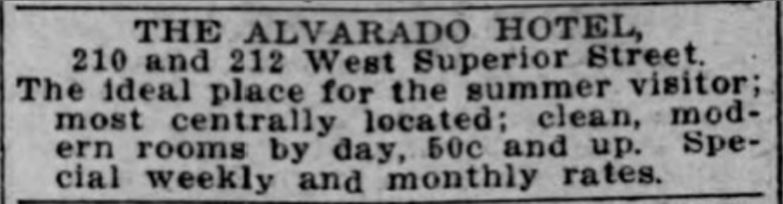
Ad for the Alvarado Hotel. (Source: Duluth Herald, July 15, 1913)
Around the time of the photograph, the Alvarado Hotel changed ownership several times[78] but few reports about the hotel appear in the newspaper archives. That changed after Jennie Elsey took over the Alvarado Hotel in the early 1910s, after which it appears quite frequently, mostly in arrest reports related to disorderly conduct, liquor law violations, and prostitution. In 1912, Elsey herself was arrested for “conducting a house of ill fame” out of the hotel,[79] but was found not guilty after she argued that Grace Clark, a sex worker from Duluth’s Red Light District on St. Croix Avenue (now Canal Park Drive), had been using her hotel without her knowledge. Clark received a suspended sentence “on a charge of being a disreputable woman.”[80]
Elsey’s son served John as a corporal in France during World War I where he received minor injuries.[81] Her niece, Minnie Adams, moved from Duluth to California where she worked as an actress in the movies, but no record of her film work exists online.[82]
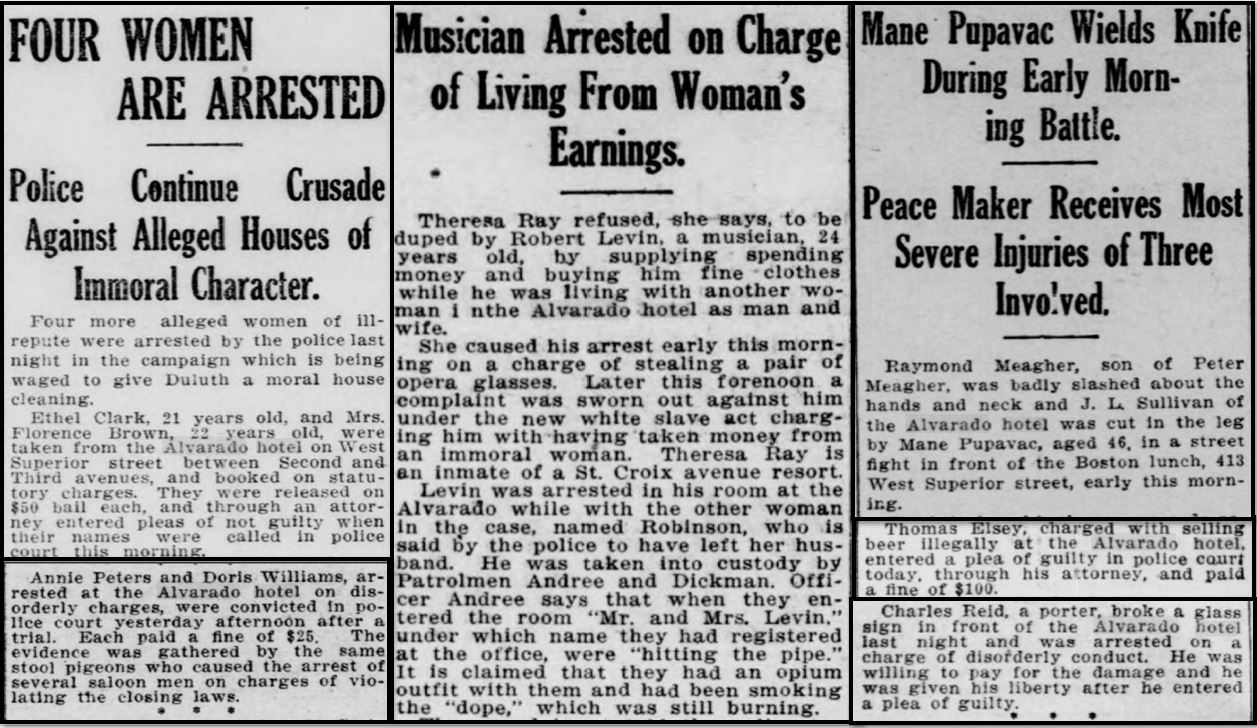
Reports from the Alvarado Hotel in the Duluth Herald. (Sources, from left to right, top to bottom: March 31, 1911; March 5, 1912; July 5, 1911; May 7, 1912; March 6, 1912; July 31, 1912)
I. Duluth Edison Electric Company, 216 W. Superior St.
Perhaps no other business in the photo better explains the appearance of Superior Street in 1907 better than the Duluth Edison Electric Company. The company incorporated in Duluth in January 1906[83] (changing the name to Minnesota Power & Light in 1923[84]). In November 1906, the company installed the largest generator in the state.[85] It ran large ads in the Duluth Evening Herald promoting the many benefits of lighting with electricity, with one ad proclaiming, “An electrically-lighted home permits flowers being kept in the room.”[86]
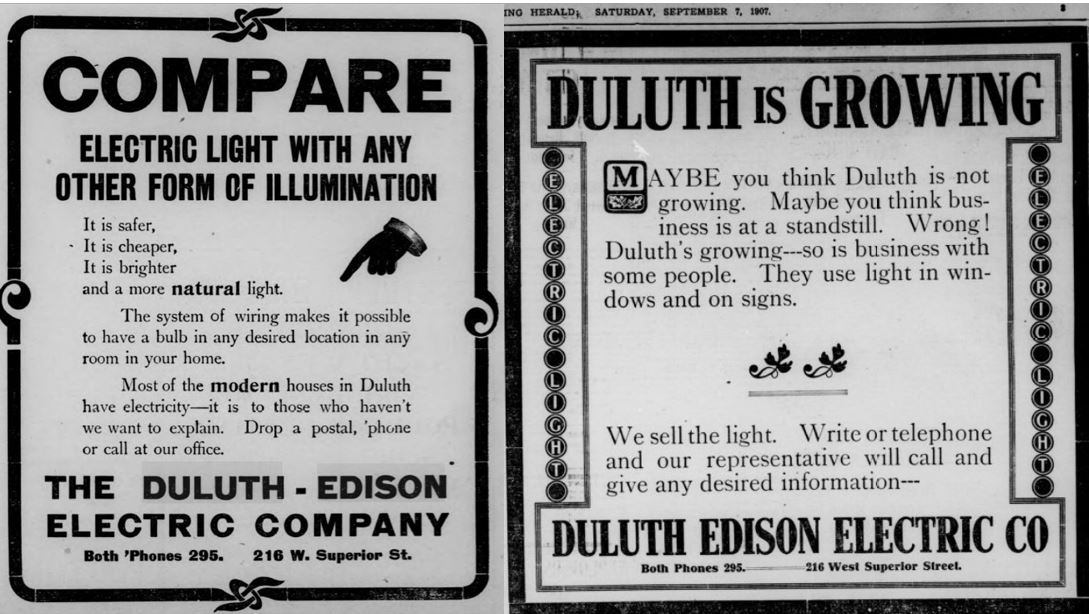
Ads for the Duluth Edison Electric Company. (Sources: Duluth Evening Herald, May 12, 1906; Sept. 7, 1907)
The new electric lights weren’t being promoted to just home owners. One Duluth Edison ad stated, “All plant and animal life has a tendency to ‘follow the light,’ and this applies just as much to the human race as to any other part of the animal kingdom. You will always find the greatest crowds in the brightest lighted store. Make this resolution — that YOURS shall henceforth be the brightest store in your vicinity.”[87]
By 1907, Duluth’s business districts were all glowing with the electric signs of local businesses. This wasn’t just a trend, but a city ordinance requiring the illumination of all advertising signs that hung over the sidewalk. The major buildings had their own rules for tenants, requiring a minimum number of lit signs for the building as a whole.[88] A photo from just a few years earlier taken at nearly the identical location shows a Superior Street fundamentally different in appearance, with only the Spalding Hotel having an illuminated sign hanging over the sidewalk.
Zooming in on nearly any of the dozens of sidewalk signs in the 1907 photo shows lightbulbs in different configurations. In an article published just four days after the 1907 photo was likely taken, the Duluth Evening Herald referred to Superior Street’s dense concentration of illuminated downtown businesses as “the Zenith City’s Great White Way.” The Herald noted, “The signs are of all sizes and are placed at varying heights above the sidewalks. The lack of uniformity adds to the charm of the scene, rather than detracts from it.” One commercial traveler was quoted as saying, “I know of no city in the country, regardless of size, that has a street presenting a more metropolitan appearance at night than Superior Street.”[89]
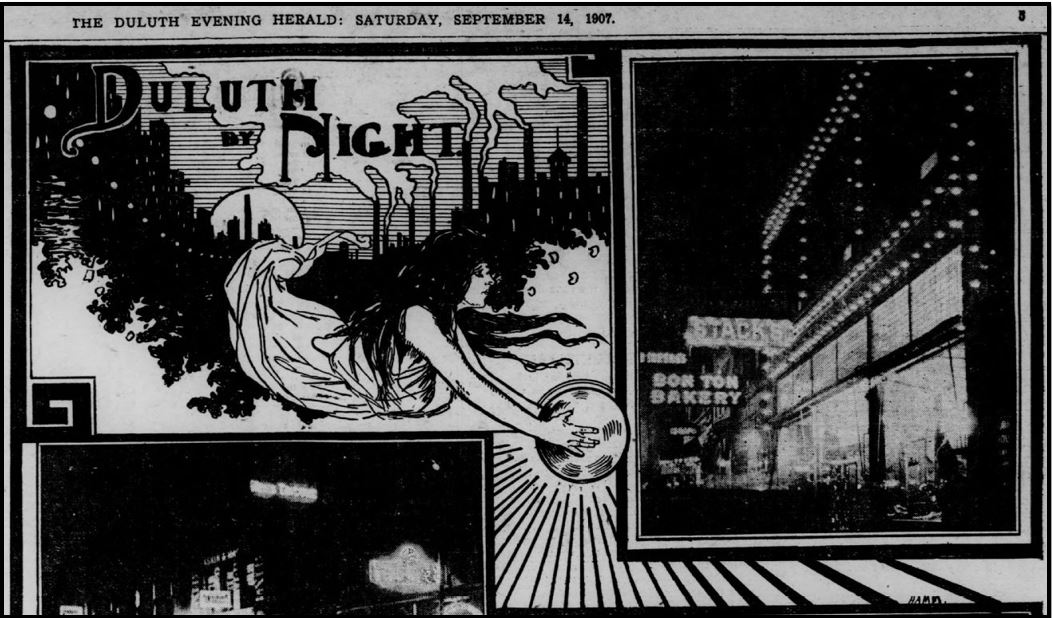
The Duluth Evening Herald ran a story titled Duluth by Night just three days after the photo was likely taken. (Source: Duluth Evening Herald, Sept. 14, 1907)
Next month, the journey through downtown in 1907 continues, looking at one specific business that started in Duluth before opening a store on Fifth Avenue in Manhattan, and the woman who made that possible.
Notes
[56] Duluth Herald, Nov. 19, 1940
[57] Duluth Evening Herald, Dec. 19, 1899
[58] Duluth Evening Herald, Dec. 19, 1899, April 6, 1906; Duluth Herald Feb. 15, 1926
[59] The Labor World, Sept. 2, 1905
[60] The Duluth Herald, Nov. 30, 1949
[61] Duluth Evening Herald, May 8, 1894
[62] Duluth Evening Herald, Jan. 27, 1897
[63] Duluth Evening Herald, Jan. 3, 1908
[64]Duluth Evening Herald Sept. 18, 1909
[65] Duluth Evening Herald, Oct. 2, 1909
[66] Duluth Evening Herald, June 10, 1905
[67] Duluth Herald, Feb. 26, 1912
[68] Duluth Herald, Aug. 3, 1917
[69] Duluth Evening Herald, Feb. 15, 1909
[70] Duluth Evening Herald; May 15, 1905
[71] Duluth Evening Herald, Oct. 27, 1908, March 31, 1906
[72] Duluth Evening Herald, Dec. 8, 1908
[73] Duluth Evening Herarld, Aug. 26, 1908
[74] Minneapolis Tribune, Jan. 1, 1908
[75] Duluth Herald, Jan. 3, 1930
[76] Duluth Herald, Feb. 4, 1930
[77] Duluth Herald, Aug. 14, 1933
[78] Duluth Evening Herald, April 21, 1906; Feb. 4, 1909
[79] Duluth Evening Herald, Oct. 21, 1912
[80] The Duluth Herald, Oct. 23, 1912
[81] Duluth Herald, Dec. 17, 1918
[82] Duluth Herald, Nov. 15, 1920
[83] Duluth Evening Herald, Jan. 26, 1906
[84] Duluth Herald, June 16, 1924
[85] Duluth Evening Herald, Nov. 16, 1906
[86] Duluth Evening Herald, Feb. 3, 1907
[87] Duluth Evening Herald, Feb. 13, 1909
[88] Duluth Evening Herald, Sept. 15, 1907
[89] Duluth Evening Herald, Sept. 15, 1907