

Miss Genevieve Grant: Modern American Venus
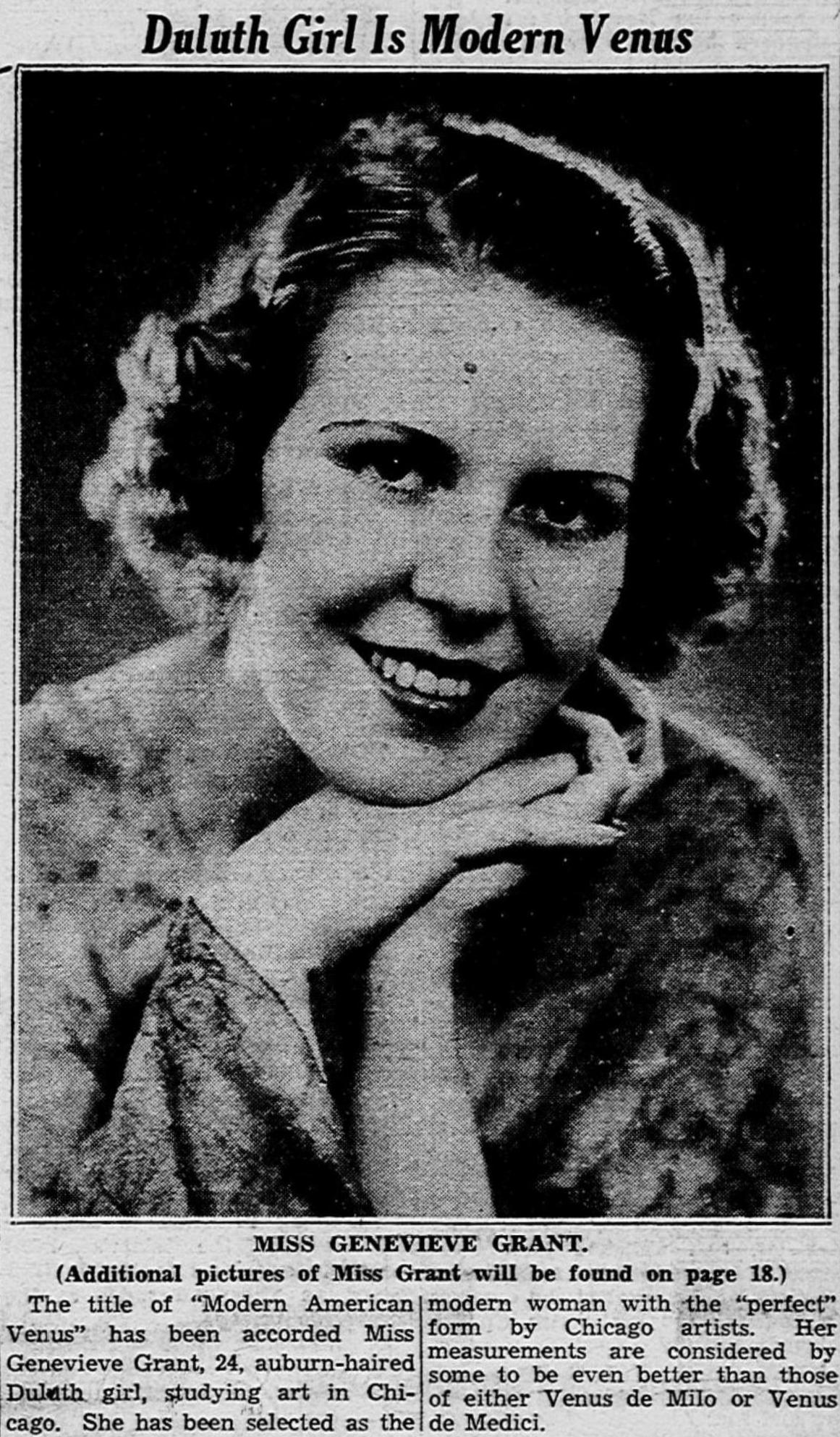
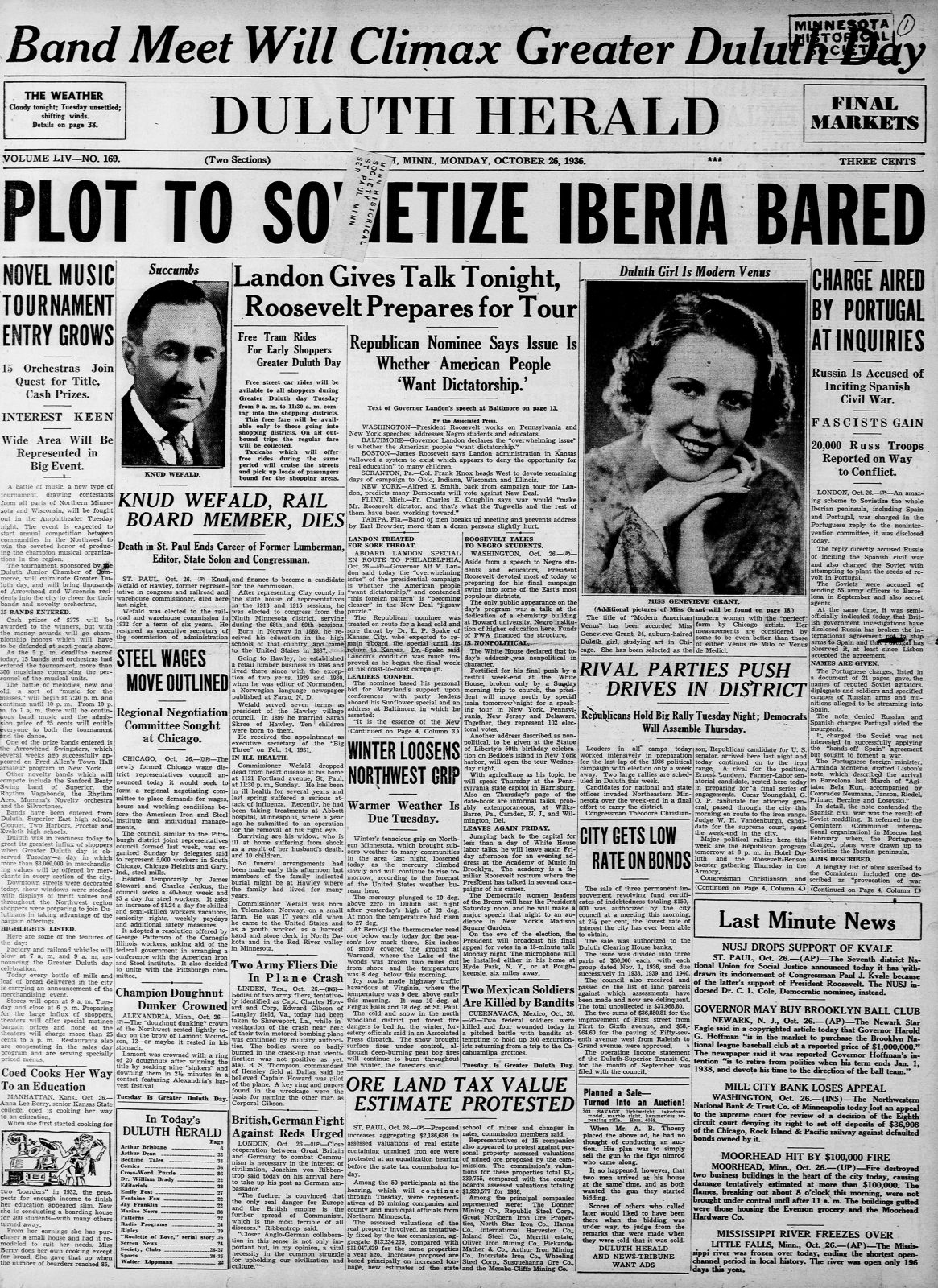
America’s “classical example of feminine loveliness” appeared on the front page of the Duluth Herald on Oct. 26, 1936 — 90 years ago today. Duluth’s own Genevieve Grant had been named “Modern American Venus.” The accompanying page 18 news story also notes Miss Grant is “a blood relative of Gen. Ulysses S. Grant, Civil war general and later president.”
The competition seems to have been created and perhaps judged by Carl Hallsthammar, a wood sculptor known for producing expressive folk-art figures. The concept was apparently to find a woman whose measurements compare as closely as possible to Venus de Milo and Venus de’ Medici, two classical marble sculptures that represent the same mythological figure — the goddess of love and beauty — known as Aphrodite in Greek mythology and Venus in Roman mythology.
Miss Grant came to Perfect Duluth Day’s attention because her newspaper clippings appear in a collection of scrapbooks that were dumped at the company headquarters.
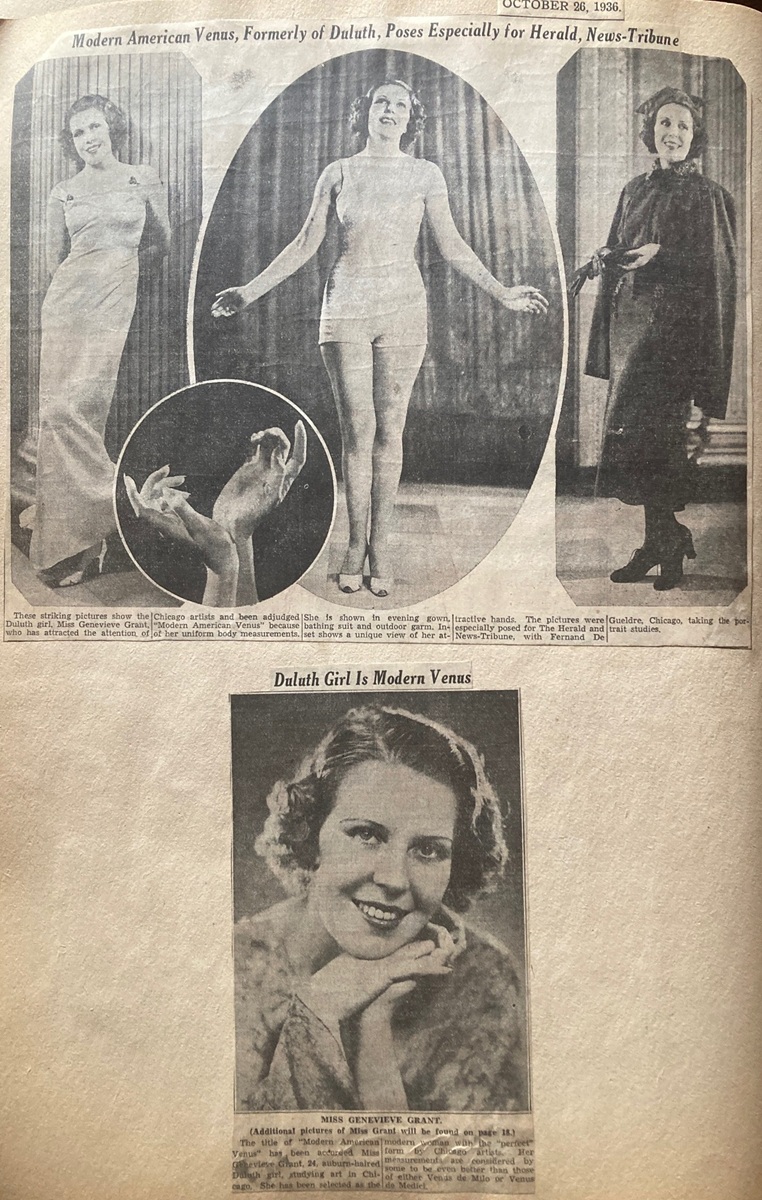
Below is the full text of the Duluth Herald article, complete with a chart of Miss Grant’s measurements compared to the aforementioned chunks of marble.

Via Google Translate:
Karl Took His Wooden Figurines to America
Published in Släkthistoria (Family History), 2018
Thanks to “Döderhultarn,” the age-old craft of whittling wooden figurines became internationally sought-after. Karl Andersson—the son of a crofter from Hallstahammar in Västmanland—was one of the first to head to America to try his luck.
When the idiosyncratic woodcarver Axel Petersson from Oskarshamn—known as “Döderhultarn”—made his breakthrough in 1909, no one realized that a snowball effect had begun. The very next year, his figurines were a hit at the Paris Exhibition, and his reputation spread across Europe. Between 1913 and 1915, he also established himself through exhibitions in the United States.
Across Sweden, men and boys realized that there was suddenly a demand for their creations—pieces they had whittled as a modest pastime during idle moments. One of these individuals was Karl Andersson, a crofter’s son from Valstalund, on the outskirts of the industrial town of Hallstahammar.
Döderhultarn was promoted by the duo behind the humor magazine Strix: Albert Engström and Hasse Zetterström. It soon became clear, however, that few could match the caliber of this star. Yet, Hasse Z could not shake the conviction that other great talents were out there. In the 1922 Christmas issue of the magazine Allt för alla—where he was serving as editor—he announced a nationwide woodcarving competition.
Karl Andersson, who that same year had won a wooden-figurine competition organized by the newspaper Vestmanlands Läns Tidning, was one of many who entered. When Döderhultarn rose to fame, Karl Andersson was 15 years old and had been carving figures since he was seven. It might seem remarkable that he was able to develop his artistic talent, given that he was the eldest son and would presumably have been expected to take over the family farm. But he did not.
His father, Karl Johan Andersson, was not cut out for farming; step by step, he was forced to move to increasingly modest properties—first becoming a tenant farmer, and eventually a crofter—while his wife, Emma, was relegated to the status of “farm laborer” (as recorded in the parish register) rather than “farmer’s wife.” “Things just went downhill,” a relative notes today.
Karl’s talent was discovered by the Västerås-based painter Gunnar Pers, who provided the boy with artistic training. The young carver’s work was showcased in the newspaper Vestmanlands Läns Tidning, where the painter’s brother served as editor-in-chief. “Such a pastime is better than card games or other dubious amusements,” the paper wrote when he was first introduced to its readership.
Karl continued to carve figures while working in the forests and as a carpenter in the construction trade. When VLT announced a competition in 1922, he entered with a piece titled “Funeral in the Finnish Settlement” (Begravning i finnbygden)—and won!
But it was on Christmas Eve that his big break arrived: a nationwide wood-carving competition organized by the magazine Allt om Alla. A couple of hundred carvers from across the country submitted individual figures and group scenes. The jury observed that many of the entries were merely imitations of Döderhultarn’s work; however, ten contestants were recognized for having a distinct style of their own. Karl Andersson won with the piece “Devotion” (Andakt), and Nygårds Emil Jansson from Dalarna took second prize.
By this time, Döderhultarn was world-famous, and the market seemed insatiable. A young man with a sharp knife, a flick of the wrist, and a quick, clever mind had the whole world at his feet. Both Andersson and Jansson emigrated to America.
Karl bids farewell to his sweetheart, Ebba Petterson—who grew up at Norrkvarn and worked as a kitchen maid at Valsta farm—and sets off for the promised land. He chooses his career over love; it likely offered little comfort to Ebba that his parting gift was a carved group titled “The Chimney Sweep and the Kitchen Maid,” in which he portrays the chimney sweep turning his back on the maid. Her white clothing bears black handprints from the sweep’s embrace.
In June 1923, he arrives in New York, where he settles. He is “a Swede, determined to make a name for the Andersson clan,” as he writes in a letter home long afterward. However, finding linden wood for his carvings proves difficult, so he moves to Jamestown, on the outskirts of New York State. There, he immediately draws attention.
Karl begins calling himself Carl Hallsthammar (missing one “a”). It is a fine tribute to his hometown—but, at the same time, a terrible stage name. It must be virtually impossible for an American to pronounce or spell correctly. Yet, he sticks with it for the rest of his life.
Back in Sweden, too, he receives press coverage. Newspapers report that he has “caused an absolute sensation.” He participated in several exhibitions each year and almost always won a prize. In 1927, he moved to Chicago and took home both the first prize and the museum’s $500 award at the Swedish Club’s exhibition.
In 1930, Carl Hallsthammar created a wooden figure of baseball star Babe Ruth and presented it during the halftime break at a game in Chicago. The Western icon Will Rogers was one of many other celebrities who wanted to see themselves rendered in wood.
In an art competition held in conjunction with the 1932 Los Angeles Olympic Games, he received an honorable mention. Following formal art studies, he opened his own studio in 1934—The Hallsthammar Academy—and began offering lessons in woodcarving. Interest was immense; clients and students lined up to join.
In 1937, he achieved great success in New York at the annual National Exhibition of American Art, which showcased the country’s finest artists. His piece, “Venus in Red Cherry,” was hailed as the best work to receive the Logan Prize in Chicago. At this point, he was at the pinnacle of his career. Two years later, he left his wife—Märta Lundgren from Piteå, whom he had met in his new home country—and their five-year-old son to marry Genvieve Grant, the scantily clad model he had selected from among a hundred applicants to serve as the subject for his “Venus.”
But just five days later, a scandal erupted. She filed for divorce, claiming he was cruel and violent, while he accused her of being an opportunist who had merely sought to exploit his fame as a ticket to Hollywood. As it turned out, no such career materialized for her.
A few years later, Carl married for the third time—to a British woman with whom he had three children. That marriage also ended in divorce, and in his later years, he remarried his first wife, Märta.
Carl Hallsthammar claimed to have studied under Anders Zorn—a detail that appears in various articles and art dictionaries. But Karl had made it up himself—he does not appear in the complete list of the painter’s students kept at Zorn-gården. The young woodcarver lied quite brazenly, hoping the name would open doors for him. And it did.
Yet, despite all the acclaim, Carl Hallsthammar struggled to make a living. Times were hard; during the Great Depression, he created sculptures and reliefs to decorate buildings in Chicago—part of President Roosevelt’s “New Deal” relief program.
After the war, Carl Hallsthammar became an industrial designer, initially working for the record label RCA. Among other projects, he created sculptures of the little dog sitting before a gramophone horn—”His Master’s Voice”—to mark the icon’s 50th anniversary in 1947. From the mid-1960s, he worked primarily for the toy industry, carving prototypes for plastic soldiers and other figures that were then mass-produced in miniature in Korea or Hong Kong.
Toward the end of that decade, Carl Hallsthammar moved to Los Angeles, where all four of his children lived. In the autumn of 1975, he was attacked and knocked down; forgetting that he was over 80 years old, he fought back. He suffered a broken arm, lost the sight in one eye, and lost the hearing in one ear. Carl Hallsthammar never fully recovered, and in early 1977, he died of a heart attack.
Remarkably, the same thing happened to Nygårds Emil Jansson—known as Emil Janel during his time in the United States. He was assaulted on an open street in San Francisco and never recovered; he died from the aftereffects in 1981. Emil Janel steadily built a solid reputation and is today considered one of America’s most accomplished wood sculptors. His figures sell there for tens of thousands of dollars.
Carl Hallsthammar’s fame, by contrast, was brief and intense; today, he is forgotten in both Sweden and the United States.
And what became of the abandoned Ebba? Well, she found work as a housekeeper in Västerås and, in 1947, married a man named Karl Sjöholm. They had no children, and Ebba passed away in 1975, a couple of years after her husband.
“The Chimney Sweep and the Kitchen Maid” remains in her family to this day—a memento of the successful woodcarver and the childhood sweetheart he betrayed.
Mats Karlsson
Prize winners in the Allt för alla competition, 1922
1st prize: Karl Andersson, Hallstahammar (75 SEK)
2nd prize: Nygårds Emil Jansson, Orsa (50 SEK)
3rd prize: V. Sjöholm (Höganäs), Albin Andersson (Mariefred), Frans Larsson (Slussen, Bohuslän), Otto Jan (Fågelöv), and A. G. Jansson (Lörstrand) (10 SEK each). Additional prizes: Milton Nilsson (Edsbyn), C. A. Rolander (Värnamo), and the contributor using the pseudonym “Wick” (25 SEK each).
Swedish woodcarvers in North America
Charles Haag (b. 1867; emigrated to America in 1903)
Oscar Sjögren (b. 1883; emigrated to Canada in 1923)
Carl Johan Trygg (b. 1887; emigrated to Canada in 1929)
His sons—Carl Olof, Nils, and Lars Trygg—were also woodcarvers.
Herman Rosell (b. 1893; resided in Sweden, but highly prominent in the USA)
Ah, it never ends well. 1939