

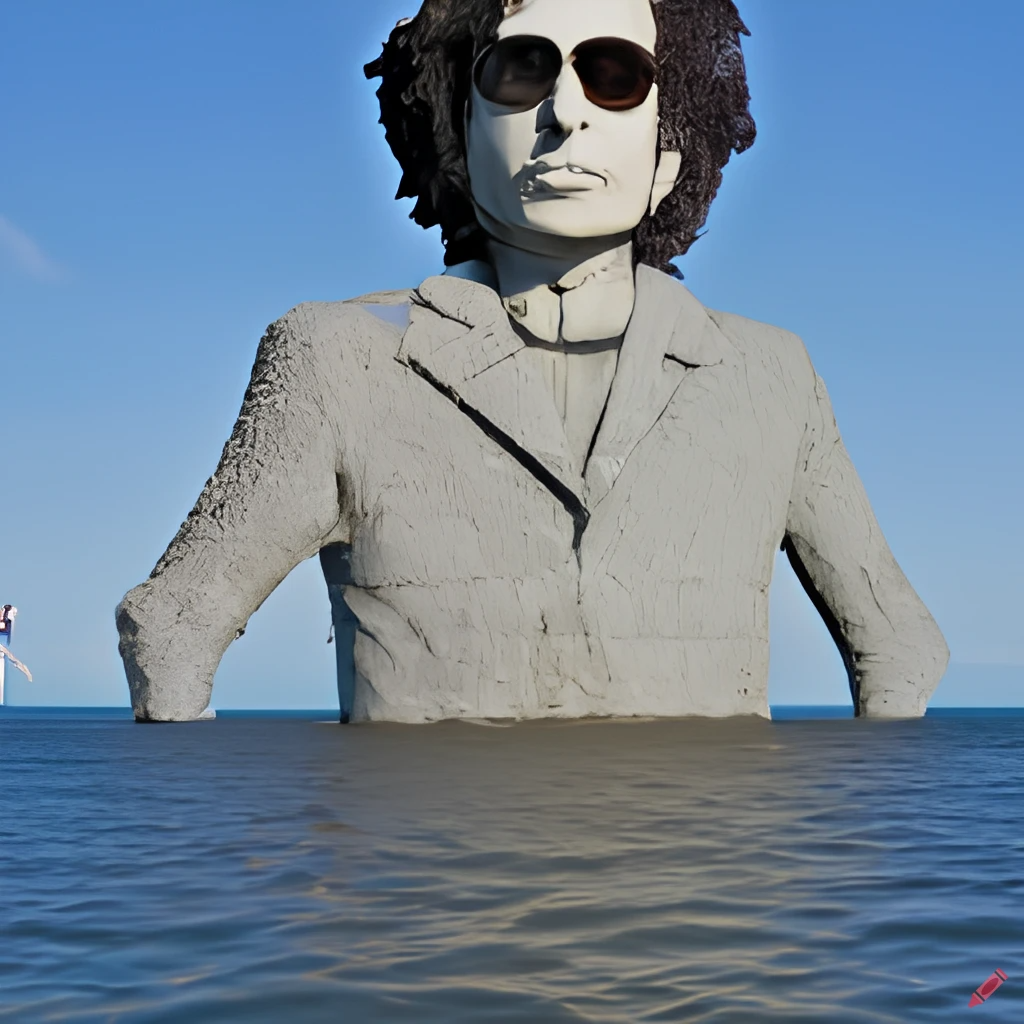
Jim Richardson (aka Lake Superior Aquaman)
Duluth in the novel ‘The Horn’

John Clellon Holmes’ 1953 beat jazz novel The Horn contains a couple references to Duluth. In the 1988 edition by Thunder’s Mouth Press, the first mention occurs on page 131. I cite it below with a couple paragraphs for context, which make it clear “Duluth” is used synonymously with “some out-of-the-way city on the road.” (more…)
Ice Racing Getaway Driver
 1983 St. Louis County jailhouse interview with “Turbo” Ted Van Brunt
Interviewer: Tell me about your escape from Duluth.
Turbo Ted: Escaping Duluth is a coin flip. Half my friends tried and couldn’t reach the velocity, came back after two or three years of getting kicked around out there. I tried a couple times.
What you’re really asking about started a couple springs ago, when it rained then the temperature plunged. The city woke up with a coating of clear ice on every surface. Branches falling in the road. Whole city shut down, nothing could move.
Except my black, street stock, ice racing stud car, a 1976 Chevette with a roll cage and 500 spikes on each tire — sheet metal screws we screwed in ourselves. Fender all chewed up. Commonly called the worst car of all time but it did everything we asked. And Johnny said it was go time. He was the brains, had it all worked, how to disarm the system at the Superior Street jewelers there. He got that with a bribe. It was only a question of when, and this was our crisis of opportunity. “The cops won’t stand a chance,” he said, and they didn’t. They even had chains on but they still didn’t know how to drive. Anyway so Johnny robbed it, but he didn’t get all the alarms. And I was the getaway driver but I still get half. Which wasn’t much — a couple display cases worth of diamond jewelry. Pulled him behind the car on a tether as we blew down Superior through deserted intersections, cross-training for frozen lake ice races at the same time we’re robbing a jewelry store. Just on his feet — no skis, just boots. And of course the cop shop is right there. But their interceptors fell behind. It was beautiful. (more…)
What Does William S. Burroughs Owe Djuna Barnes?
A lot of William S. Burroughs kind of sounds like Djuna Barnes. The prime example: Barnes created the character Doctor Matthew O’Connor in her 1936 novel Nightwood, and Dr. O’Connor could easily be confused with the 1938 Burroughs character, Dr. Benway (no first name). Each fictional physician is a comically amoral addict abortionist. I think it’s likely Burroughs created Dr. Benway within a year of reading Nightwood. Burroughs owes Barnes a debt of inspiration, and not just in the creation of Benway — many of his other characters could also be walk-ons in Nightwood, fitting in well among Barnes’ cast of liars, pretenders, and cheats. So it’s safe to say Barnes influenced the characters Burroughs created. I will also show her influence on his voice, style, and themes.
Since the 1980s, a Burroughs blurb appears on the back of every Nightwood edition, saying in its entirety, “I read Nightwood back in the 1930s and was very taken with it. I consider it one of the great books of the twentieth century.” That’s all he ever said about it; it says it all. It is commonly acknowledged that he admired her work, but I think Barnes had a larger influence. I think Burroughs took what he learned from Nightwood and then, in 1959, he wrote the actual number-one greatest book of the twentieth century, Naked Lunch. Barnes’ influence is found there, and throughout Burroughs’ work. (more…)
Essentia Health campus vs. a panel from ‘Ronin’

Essentia Health campus in Duluth on Aug. 4, 2022. Steve Kuchera / Duluth News Tribune

Panel from Frank Miller’s “Ronin” as shown in the Comics Journal.
In the graphic novel Ronin, by Frank Miller, an AI named Virgo grows its organic technology over and through a dystopian New York City. As the story progresses, the city completely transforms. I wondered if I could find a photo of the expanding hospital complex that matched this comic panel.
Avant Garde Women: Elsa the Dada Baroness, Djuna Barnes and Margaret Anderson
Introduction
The story of Elsa the Dada Baroness transpired in a milieu of literary queer feminist icons circa World War I. This story was best told in 1930, in the book My Thirty Years’ War by Margaret Anderson. Anderson was the radical publisher (with Jane Heap) of the Little Review, the international modernist-Dadaist-anarchist magazine that punched above its weight and first serialized Joyce’s Ulysses. I bought my copy of My Thirty Years’ War hoping for a great first-person account of the landmark obscenity trial that ensued over Ulysses, but Anderson barely mentions it. However she does say a lot about the Baroness. Anderson got to know the Baroness by publishing her poems; every history of the Baroness goes through Margaret Anderson.
My Thirty Years’ War is in the public domain and, as evidence of that, my copy has a typo in the title on the front cover, and a couple pages are in the wrong order. But it has the goods. I also read Baroness Elsa: Gender, Dada, and Everyday Modernity — A Cultural Biography by Irene Gammel. My copy of that has no typos and a hundred pages of footnotes, and it’s where I found accounts of the Baroness by another writer Anderson was publishing: Djuna Barnes. Like Anderson, Barnes became a supporting character in the Baroness’ story. (more…)

Fun with Google AI Overview
Google search results are now summarized by an “AI Overview.” I tested it with three questions. (more…)
The FBI Paid for My Co-op Membership: Minnesota Food War 1975
Transcript of interview with former co-op volunteer / FBI confidential informant
Interviewer: How did you become an FBI informant during the Minnesota food co-op wars of 1975?
Name redacted: Well, when co-ops started forming in the late ‘60s, the FBI thought it was a communist plot. That theory got a lot of traction because many early co-op’ers were actual, literal Communists, mimeographing typewritten Leninist newsletters. You would’ve thought downtown Minneapolis was the Red Square. So it was a case of “let’s just keep an eye on these people.” But since there was a cooperative warehouse in Wisconsin serving as a distribution hub, when co-op-related violence broke out, it crossed state lines. So the FBI went from passive surveillance to active infiltration. When the Minneapolis co-op wars spread to the North Shore in ’75, I was on the short list to infiltrate the Duluth one. A native Duluthian, I had worked undercover before, and I was already a Co-op shopper. I was not a member, but knew some of the early Co-op’ers from church. I wasn’t on the anarcho-communist continuum, and I wasn’t a hippie — I just wanted better food. This made my handlers a little nervous. They started thinking I was a pinko. But I told them, “You couldn’t find a loaf of whole wheat bread in Duluth until the Co-op opened in 1970.” They were eating Wonder Bread baloney sandwiches with mayonnaise, but that convinced them. So the FBI paid for my Co-op membership. Then I signed up for member volunteer work shifts to get on the inside. I stirred buckets of nut butter with a drill attachment, but I heard stuff. I wasn’t the only one, the Feds had an informant in Grand Marais too, and some as far south as Iowa. Minneapolis was the hub, of course; the co-ops down there were popping off like popcorn. (more…)
Christian Boarding School Texas Football
I still have bitter high school football recriminations. My 1980s Episcopal boarding school in Texas glorified football above other sports. I attended on a scholarship from family connections, not through any academic or athletic merit. And I learned the wrong lesson about authority from the sports program.
A recent obituary in the alumni newsletter helped spur me to write this, although I’ve been kicking it around for 40 years. Nothing personal against Coach P who I don’t have to name. For the purposes of this story he is the universal coach. This is not to disrespect his essential personhood or whatever. But I learned things I did not want to learn about society and all the rest of it — universal things I never forgot.
Coach P’s obituary said he was the decades-long athletics director, had coached thousands of games and taught thousands of history classes, too. He is fondly remembered by nearly everyone, including myself. He was a real Texas character. His knees were busted up and it crabbed his walk. I assumed it had happened on a football field in his younger days, a brutal hit or series of hits marking him, claiming him for the sport. You knew he was committed. He was gray and had the hairy ears of an old man if he let it go, something I noticed sitting behind him in chapel once or twice, and it made me swear to never get old or sentiments to that effect. He wasn’t really that old but he was weathered. He was not without warmth or humor, and he bonded with his players particularly. Like in the Lou Reed song, they “wanted to play football for the coach.” They liked how, when he was consternated at you, he would exclaim “Hellfire, son!” (more…)
Last Call at the Pilot House
Duluth Herald late-edition special report
Thursday, Jan. 28, 1915
By Joe Crisp, Senior Shipping Reporter
A famed local maritime drinking establishment has shut its doors. This is the ship’s pilot house on the tip of Timber Point in the harbor. For 16 years it has operated as the Pilot House bar. Initially serving a clientele made up exclusively of members of the Great Lakes Life Saving Service, soon it caught on with sailors and dock workers. Older Duluthians recall its origin, as the pilot house of the doomed Marchande which stuck out of the water in the shipping lanes for weeks in 1899. She had sunk by the stern as her cargo shifted, but her nose bobbed up. Using a floating crane, the Life Savers salvaged the pilot house and installed it on Timber Point. There they collectively owned and operated it as a business, until last night.
Because today, as the war in Europe heats up, the 45-year-old Life Saving Service has been officially subsumed into the Revenue Cutter Service. The resulting compound organization forms the newest branch of the armed forces, the United States Coast Guard. The Pilot House is a casualty of new regulations and a wave of retirements. Some old-timer Life Savers don’t wish to adapt, nor to compete against much younger men in basic training, to re-qualify for what will be different jobs. Many jobs are being eliminated. All three of Duluth’s Life Saving stations — at Park Point, Lester River, and Stony Point — have been officially replaced by the single new Coast Guard station in the harbor. The oars and battered wooden surfboats of the Life-Savers have given way to a steel steam-powered Coast Guard cutter, and a modern Life-Saving station complete with radio equipment and a machine shop. Among the sweeping changes are rules prohibiting Coast Guard personnel profiting from salvage. And since all the booze served at the Pilot House was salvaged from local shipwrecks, this effectively puts the bar out of business. Last night was last call. (more…)
R.I.P. Lumpy G

AKA Chris Marshall. (more…)
Minnesota Land Surveyor’s Deathbed Confession, 1907
The text below is reproduced from a handwritten document that slipped out of a book of maps at the Minnesota Historical Society. Its authentication remains in progress.
I die happy seeing the completion of the Minnesota land survey, and the dissolution of the Office of the Surveyor General. He surveyed himself out of a job. We all did, the great work of our lives. It took five decades. But holes were chopped through the state that cannot be filled. I discovered a flaw in the measurements in the summer of 1855 when we were still just a territory. And I have knowledge of the disappearance of my hated competitor as he fell between the parallels, in the woods of what is now northeast Duluth.
Many surveying companies were employed by the Surveyor General. Mine was one and I was sworn in as a deputy surveyor. Rough work. We camped away from home for months, in 10-man teams: axe-men, chainmen, cooks, and muleskinners. Our families didn’t know if we were alive or dead until we returned (or failed to) for the winter break. (more…)
Great Lakes Now: A Different Perspective on the Fur Trade
Great Lakes Now interviews artist/historian Carl Gawboy about his book Fur Trade Nation: An Ojibwe’s Graphic History.
BBC: Duluth as climate refuge
The spotlight is on Duluth in this BBC article on “climate havens.”
The Grateful Dead vs. The Velvet Underground
The 2024 death of Grateful Dead bassist Phil Lesh reminded me: I discovered the Grateful Dead and the Velvet Underground at the same time. The bands still exist as a unity in my mind, even after I figured out they were polar opposites.
My 1980s high school girlfriend was from the Northeast around Connecticut and New York City. She fused goth, punk, and hippie vibes. When we were 18, we took acid in her Austin, Texas shack. That’s where she DJ’d for me, on vinyl, the Grateful Dead and the Velvet Underground.
I’d heard the bands but never listened. She played the 1970 Dead tune “Box of Rain,” written by Lesh about the death of his father. Then we listened to “Rock & Roll,” the 1970 VU tune by Lou Reed about music as refuge, with Sterling Morrison on lead guitar. It all sounded like sheer Americana to me.
In the 1990s I became more of a Velvet Underground guy, from the band’s proto-punk stuff. But then I dated a Deadhead in Berkeley, and she took me to some Dead shows. That’s when I really got what the Dead fuss was about. I enjoyed my first show plenty, just for the carnival atmosphere, not having a deep knowledge of their discography. But then they covered “Johnny B. Goode” and the top of my skull lifted off. The secret of Dead shows is they piled crescendo on crescendo until you hit peak bliss, then they kept climbing. Yes I was on mescaline. (more…)
Coast Guard vs. Illegal Fishing Shelter
The Duluth-based YouTube channel Vibe with Mike has the story. Spoiler alert: Coast Guard wins.
How Minnesota shaped the ‘freewheelin’ Bob Dylan
This installment of the WCCO radio program A Closer Look with Laura Oakes delves into Bob Dylan’s Minnesota roots. It aired Dec. 19. Duluth comes up.
Duluth on Chalamet’s lips
Duluth keeps getting mentioned in the publicity tour for the Bob Dylan movie A Complete Unknown. At the 6:53 mark in the clip above Timothée Chalamet says, regarding singing live-to-camera in the film, “The worst thing we could have done with a Bob Dylan biopic is sanitize it, to make it sound clean … This is a man from iron ore country, Minneapolis, Minnesota; Hibbing, Duluth.” Not that Minneapolis is so dirty, but OK.
Chalamet in Minnesota on Dylan Film
Duluth comes up throughout.
Video History of the Duluth Armory
From local architecture enthusiast channel Arches and Columns, pulling from local sources including Duluth Urbex.
Chalamet utters the word Duluth in recent interview
Around the 43-minute mark, Timothée Chalamet talks for a couple minutes about visiting the region, specifically the Duluth-Hibbing axis. He made the trip alone while preparing to play Bob Dylan in the current biopic. The Bob Dylan house gets a mention around the 47-minute mark.
Duluth Hillside Cam
The live view from one of the 11 Duluth Harbor Cam locations.
DNT: Sarah Krueger leaving Duluth

According to this lavish article in the Duluth News-Tribune, Sarah Krueger (aka Lanue) is leaving town for Eau Claire, Wisconsin. She has provided our city with one of its most unforgettable stage performers and recording artists. Her music videos are pure celebrations of Duluth. (more…)
Synchronicity in Action: How I Met the Late Ralph Abraham
Among the mind-blowing coincidences of my life is how I met the countercultural chaos mathematician Ralph Abraham, who died on September 19. He was a huge influence on me and the moment we met was extraordinary.
Coincidence is not technically the same thing as synchronicity. To believe in synchronicity, you must believe in meaning. And I did.
It was the 1990s and I was a young hippie newlywed in Bonny Doon, the backwoods of Santa Cruz, California. Like a lot of folks, my wife and I lived at the end of a long winding dirt road at the end of another long winding road. It was like a miles-long driveway. People with land out there had sprinkled the place with trailers and shacks, and they let people rent them cheap on the down low. One of those shacks was home sweet home. You could hear the ocean in the distance. The outhouse had no walls or roof, it was just … out. (more…)
Duluth Traverse Bike Ride Time Lapse
Lane Ellis presents this GoPro 10 time-lapse video showing most of his recent 43-mile west-to-east mountain bike ride on the Duluth Traverse, ending at Lester Park during the Lester River Rendezvous.