

Research paper on prescribed fire sparks multimedia project

Ishkode: A Story of Fire is Duluth artist Moira Villiard’s first experience illustrating a children’s book.
A research paper about prescribed fire on Minnesota and Wisconsin Points has sparked a movie, a cultural burn on Park Point and a children’s book illustrated by Duluth artist and Fond du Lac Ojibwe descendant Moira Villiard.
Ishkode: A Story of Fire is written by University of Wisconsin-Platteville professor Evan Larson and University of Minnesota graduate student Nisogaabokwe Melonee Montano of the Red Cliff Band of Lake Superior Chippewa, and follows a generic point on the shoreline of an unnamed body of water. Once heavily populated with red pines and blueberries, decades of forced neglect and mismanagement changed the makeup of the land, until only one dying red pine remains, surrounded by birch trees and thick underbrush.
The solution? Fire.
“We are taught from a very early age that fire is bad, that we should be essentially scared or worried about it, and all of the terrible things it can do, and those ideas feed right into this notion that ‘Oh no, the wilderness is ruined by fire!’” Larson said.
Larson argues that anti-fire mindset is an understandable reaction to human activities that create largely negative impacts on the environment, like industrialization and logging, but ignores beneficial reciprocal relationships between people and the environment. Montano describes cultural burns as a sort of natural maintenance undertaken by tribes for centuries.
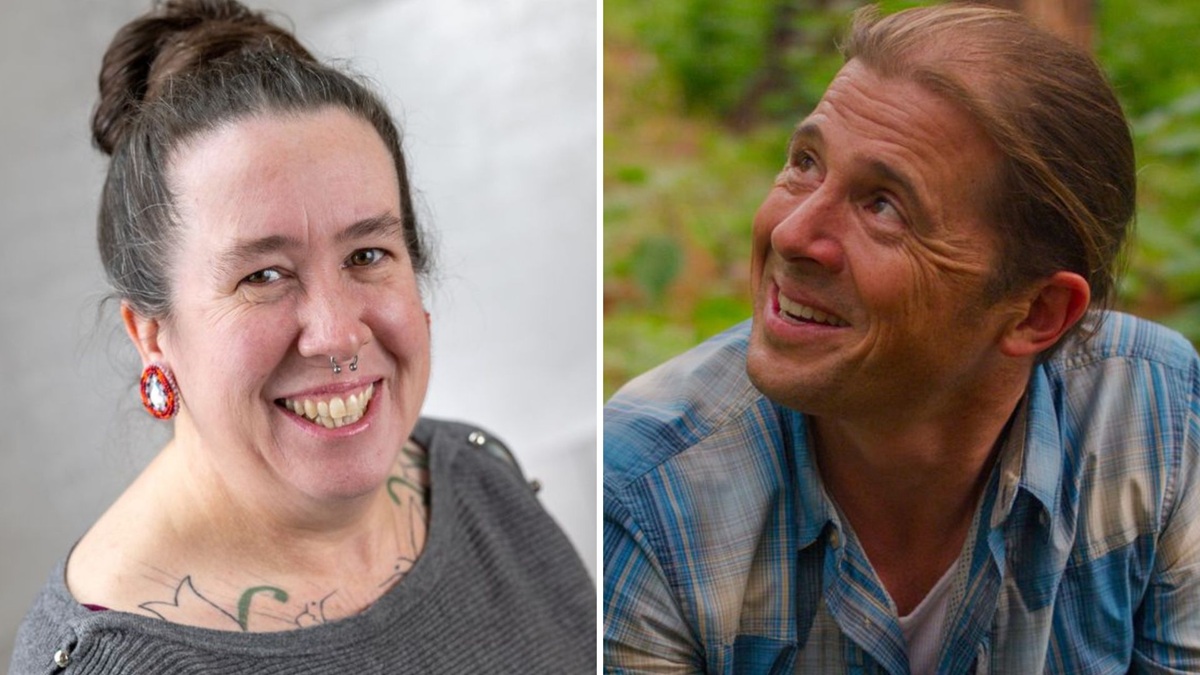
Ishkode authors Melonee Montano and Evan Larson.
Larson and Montano first collaborated on their research paper Indigenous Fire Stewardship Shaped North American Great Lakes Forests, which braids the Indigenous history of prescribed burns on Minnesota and Wisconsin Points with dendrochronology, the study of tree rings.
Prescribed burns, also called cultural burns, are controlled fires set to accomplish conservation initiatives. The burns prevent vegetation overcrowding the forest floor, allowing more desirable plants the opportunity to grow; some plants, pyrohiles, require fire to propagate; and burns are sometimes recommended to control pest-insect populations.
Semi-frequent controlled burns also reduce the amount of dead wood in forests, giving wildfires less fuel.
“Caution — that’s key,” Larson said. “We’re not saying “flippantly throw matches,” but what we’re saying is that when done well, it is a process that we understand well enough to do safely.”
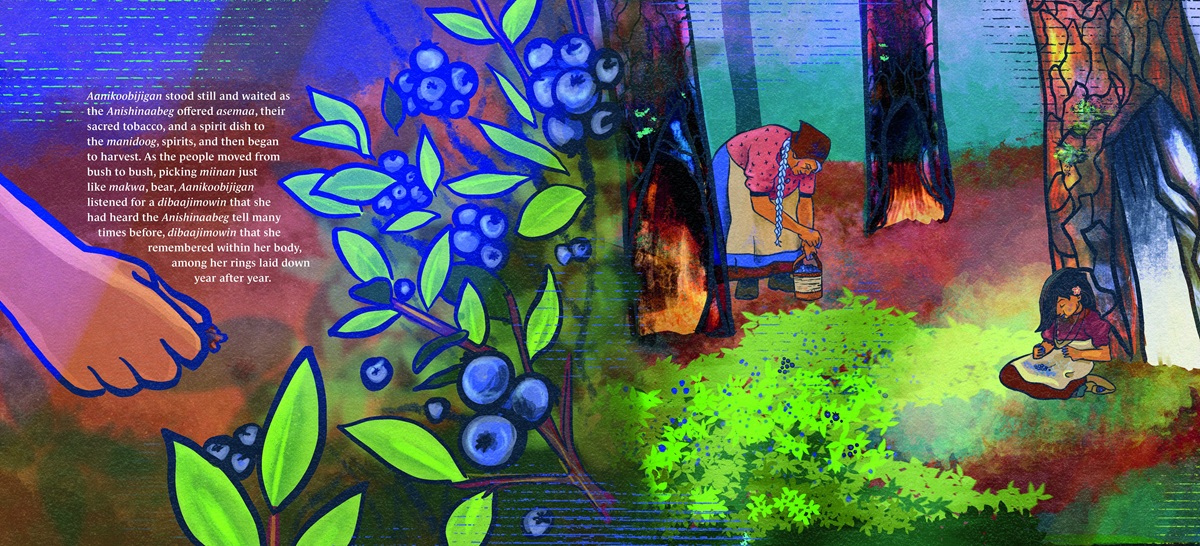
“I didn’t want my characters to have big buggy eyes or (be) ill proportioned or anything like that because as a kid, I feel like I wasn’t drawn to that style of illustration,” Moira said. “If I were to describe it, it was more like I drew what Little Moira would pick up on a bookshelf.”
The book opens with a grandmother and granddaughter picking blueberries on the point. Years pass, and the two do not return for another harvest. When loggers discover the area sometime later, they chop down nearly every tree save one, being too old and twisted for lumber.
Decades after the loggers, a young woman ventures to the point and, recognizing the land isn’t as fruitful as it once was, weeps under the bent tree, resolving to return the land to its pre-logged state. After preparations by researchers, fire is set to the point again, ushering in the return of blueberries and red pines.
In the Great Lakes area, including the territory that is now Minnesota, treaties in 1837, 1842 and 1854 ceded land to the US government, which did not recognize the benefits of prescribed fire. Those treaties, and the ensuing fire suppression tactics of the Forest Service and state of Minnesota in the early 1900s, meant cultural burns all but ceased in the area for the 180 years.
“I can’t say enough about how important it is to learn about the purpose of fire — it can give and take life,” Montano said. “But the problems are where we haven’t returned it to the landscapes and various areas, and they are at risk for catastrophic fires because of climate change and other conditions. But also, these lands, they just need it. The trees need it, and the berries.”
Though inspired by Minnesota and Wisconsin Points, as well as the Boundary Waters, the point in Ishkode is intentionally left unnamed.
“It’s just incredibly important to recognize that that point of land could be anywhere, and is in fact representative of everywhere,” Larson said. “There is not a place in northern Minnesota that doesn’t have a story of the Indigenous communities who lived there imprinted upon it.”
Ishkode heavily features anishinaabemowin vocabulary, and the back of the book includes a pronunciation guide and brief Ojibwe dictionary; Montano and Larson are currently looking for funding to create a full translation of Ishkode in Ojibwe. An animation for Ishkode is also planned for the future, headed by Villiard.
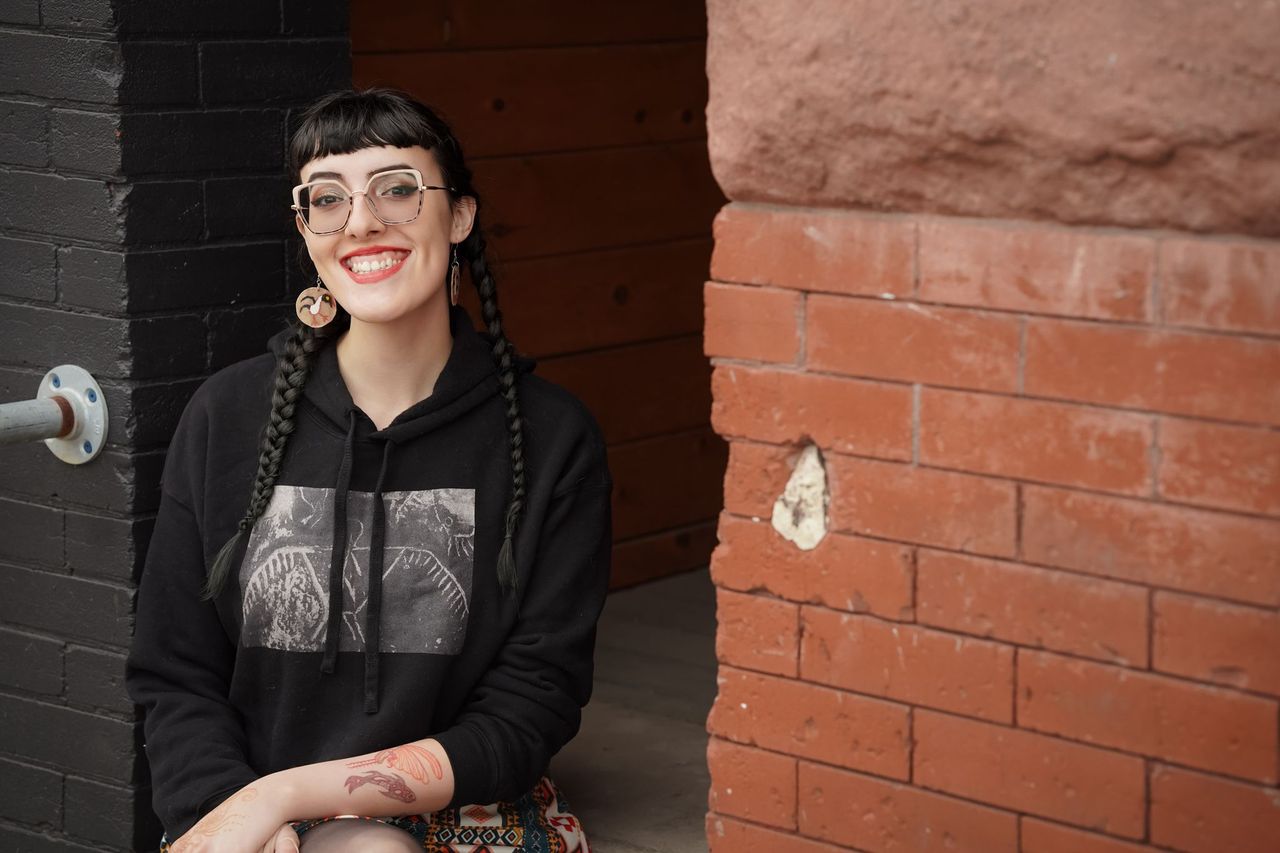
Ishkode illustrator Moira Villiard.
Cultural burns increase the mineral content of the soil, minerals that Minnesota’s state tree pinus resinosa, or red pine, depend on for growth. In Ishkode, as well as the Oct. 8 burn on Park Point, fire was used to aid the propagation of red pines and blueberry bushes.
The history of cultural burns is recorded in the tree rings of the fire resistant, resin-rich red pine. When a fire partially scorches a red pine and kills a section of the trunk, but not the entire tree, the pine will respond to its injury by thickly packing the dead area with resin to reduce the chances of infection and rot. Over time, callus tissue grows around the fire-affected area. These scars are less severe than those left by wildfires.
“If you look at the pictures and footage of fires on the news, those are these huge, just intense fires where trees just aren’t going to survive,” Larson said. “But now think about the type of fire that can burn by a tree 10, 15 times over the course of a few centuries, and never once does it actually kill the tree. Right there, in and of itself, is that implicit message that these fires are not like the ones that we see on the news.”
“These fires are these low surface fires that are just kind of creeping and winding among the trunks of the trees, kind of leaving that mark, but not resetting that stand entirely to ash,” Larson continued.
The prescribed burn on Minnesota Point was undertaken by the DNR, in collaboration with tribal agencies, Minnesota Point 50, Good Sky Guidance and other organizations.
Montano’s son Bazile Panek, CEO of Good Sky Guidance and a project lead on the Minnesota Point burn, approached Montano and Larson to aid with dating the last cultural burn on Park Point and help create the project proposal, due to their research paper.
“It was a really nice low and slow burn, which is what we’d hoped for,” Montano said. “Partially because the forest needs it, but it had also been 180 years, so you need to really start with a low and slow burn so that the forest can get used to it and everything. There was a chance — because it was so long—things could have been pretty wild in there.”
Preparations for the burn included removing snag trees, or dead trees that remain standing, and removing the duff — the layer of detritus composed of pine needles and other organic matter — that had accumulated around the pines in the area after decades of mismanagement. Before the fire was set, an offering of asemaa, tobacco, was made to the forest and the collaborators.
“I consider myself a student of fire, but I also think that fire has chosen myself and all of these other people, rather than us choosing fire,” Montano said. “It’s the way our paths have been brought together, because of fire, and so a lot of us think there’s a spirit of fire that’s basically having us help to return it and help to speak on its behalf.”
Montano emphasized that the Oct. 8 burn was just the first step in maintaining a healthy natural area on Park Point, and frequent burns will be necessary upkeep in the future. Larson is hopeful that Ishkode will aid in shifting cultural attitudes about fire, and will help familiarize readers with the concept of “good fire” from a young age.
“The book is what we’re really excited about,” Larson said. “It’s engaging youth in that kind of oral tradition. Because there’s a lot of words in here, and it’s a pretty thick book, to see a parent or a grandparent or caregiver reading this out loud to a child is bringing those words into that spoken context. And what that will hopefully help do is start people off from a fundamentally different starting point than what most people in our society start with.”
More information about Montano and Larson’s multimedia partnership can be found at ishkode.org. Ishkode: A Story of Fire is available via University of Minnesota Press at upress.umn.edu.