

Public Good or Pay Me
 I was about five years old when I had my tonsils out. My mom gave me ice cream, but I still felt pain. My mom went to the public library in Gorham, New Hampshire and got me a book. It was a collection of every single Peanuts comic strip up to that point. I read page after page and my throat didn’t hurt. That’s probably why I still read every single comic strip in every edition of my Duluth News Tribune.
My dad’s career in the U.S. Forest Service took us all around the country. My parents recently told me that they tried to pick a house in each town that was near the library. We moved from Gorham to Two Harbors, Minnesota and then to two towns in Michigan: Harrisville and Cadillac. We then moved to Plymouth, New Hampshire, where my sister and I graduated from high school. In all those towns, I walked and rode my bike to the library. I became a reader and eventually, a writer. So, you can blame a tonsillectomy and public libraries for what you’re reading here.
My wife and I recently drove by the library in Two Harbors on the way back from looking at some waterfalls. Bright letters spell out “Carnegie Library” on the building. Andrew Carnegie was one of the richest Americans in history. But he gave away most of his wealth and built around 1,700 libraries all over the globe. There are about 3,000 libraries in the United States. Around half of them were built by Carnegie.
My parents shaped their life around me and my sister. They took advantage of the Two Harbors public library built by a wealthy industrialist and supported by the public through taxes. The Gilded Age giants were not saints. But at least Carnegie made an attempt to create public good. My father’s paycheck for being a steward of public land was funded by the taxpayer. Which means, along with library books, even my childhood breakfast cereal was paid for by my neighbors. When I look closer, that was true for many parts of my whole life.
I went to public schools. During spring break from those schools, my family climbed into our station wagon and drive on the interstate highway system (built by the taxpayers) from the Midwest to Florida to see my grandparents. After Christmas, my mom coerced me into writing a thank you note to my grandparents for the presents they gave me. I put that note in the mail and the U.S. Postal Service delivered it to my grandparents for just a few cents. My dad and I hiked in the White Mountain National Forest in New Hampshire and climbed mountains in our federal public lands. The taxpayers paid for my education to get an aeronautical engineering degree at the U.S. Air Force Academy. I served my country in uniform for over 20 years. The taxpayers now pay my retirement pension which means my neighbors help pay my mortgage. The taxpayers funded the post-9/11 GI Bill. It was my entitlement, but I was allowed to transfer it to my kids to pay for their education. Two generations of my family got their education paid for by my friends and neighbors. Now, I work as an airline pilot in the National Airspace System. That airspace is managed by the Federal Aviation Administration and administered by air traffic controllers, all of it funded with our taxes. Commercial airlines are the safest form of transportation in the world. At my job, I use the resources of the National Weather Service every single day to determine my ability to take off and land. My entire life, from cradle to my eventual dirt nap, has been supported by my fellow Americans and their taxes.
We have all collectively built, managed, and protected the infrastructure, institutions, and resources that we brag about to the world. We did these things together. We made choices that helped everybody. Our American persona is that we are rugged individualists who earned everything by the sweat of our brow. I am not discounting hard work. I’ve worked hard. But I am also honest about my circumstances: My neighbors helped me every step of the way. I am filled with an overwhelming sense of gratitude. The billionaires, raised in the same country I was, don’t see themselves as fortunate. Like E.B. White said, “Luck is not something you can mention in the presence of self-made men.”
But it’s not enough for billionaires to retreat to their private islands on their mega-yachts. They need to pull up the ladder behind them. Oligarchs see the taxpayers and the public institutions we built as another way to line their pockets. Public schools? Let’s bring in vouchers so that taxpayers fund your tuition at a private school, which the wealthy were doing anyway. The US Postal Service? A taxpayer-funded government service that should be signed over to private contractors. Public land? Well, that needs to be “transferred” to the states where it can ultimately be sold off to private interests. Air traffic controllers? They need to be privatized. The National Weather Service that I use every day? Those tasks need to be transferred to private contractors. The Department of Veterans Affairs? They have decimated its workforce in the VA and started to farm that out to local for-profit healthcare providers. All designed to funnel taxpayer money away from public goods and services toward private entities. Those billionaire spaceship joyrides aren’t going to pay for themselves.
John Ralston Sauls, political philosopher, describes the shift this way: “Now listen to the first three aims of the corporatist movement in Germany, Italy and France during the 1920s. These were developed by the people who went on to become part of the Fascist experience: (1) shift power directly to economic and social interest groups; (2) push entrepreneurial initiative in areas normally reserved for public bodies; (3) obliterate the boundaries between public and private interest — that is, challenge the idea of the public interest. This sounds like the official program of most contemporary Western governments.”
The Lester Park Golf Course is a local example of something that was a public good that is moving toward private ownership. The city council last year voted to transfer 230 acres to the Duluth Economic Development Authority. It was done while the land was still zoned as parkland. And now, the city council has voted that it is not going to honor a petition to put the Lester public land question to a citywide vote.
So, land that was owned by the public has been moved on that spectrum from public toward private. Around 1930, wealthy residents of the city of Duluth put up the money to build the Lester Park Golf Course. From the book, Duluth’s Historic Parks: Their First 160 Years: “None of the investors owned any of the land involved, and nearly all of them were members of Northland or Ridgeview Country Clubs — they already had a place to play golf, but saw the greater community need for more public links.” The book shares more details. Duluth’s City Works Administration raised $16,000 for work on the city parks. Seventy-five unemployed men were hired to start construction of the golf course by hand. Affluent private citizens partnered with the city’s taxpayers to build a public outdoor recreation venue and create jobs in the heart of the Great Depression. I think it’s a shining example of how we as a society are capable of working together and doing good things. And now, Lester will be turned into a profit center by becoming house lots or apartments or McMansions or restaurants or shops. It remains to be seen how much housing and tax revenue this will create.
The special irony of this whole thing is that the front page of the DEDA website brags about Duluth’s 7,000 acres of parks on a 900-foot bluff overlooking Lake Superior while planning to eliminate some of those same acres.
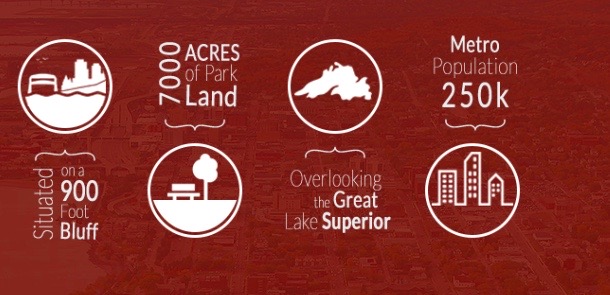
Excerpt from the front page of the Duluth Economic Development Authority website.
Many of the good things in this country were built over the past 250 years by choice. Public land. Public science and health. Clean air and water. The North American Model of Wildlife Conservation. Public education. Public support for higher education and research. Government agencies that support and maintain transportation infrastructure. Meteorology in the interest of public safety. I believe that government is here to do the things that private entities are unable, and, more specifically, unwilling to do on behalf of their neighbors. I don’t believe that every government agency should run like a business. Corporations are designed to believe in one thing: the bottom line. I have no problem with that. I’m a member of a labor union and I make my living in a business. But I believe there are things more valuable than money.
Let’s say a small public park has a swingset for children. Are those swings supposed to turn a profit? What is the rate of return for mowing the lawn in that park? How much profit does the city of Duluth make by emptying the garbage cans in that park? Is it possible that some things can be for the public good and don’t turn a profit? That some things are a service that we collectively agree to fund? I think the Board of Park Commissioners in Duluth got it right in 1911 when they wrote: “The parks of a modern city bear witness that its people are members of one great family. They are the concrete expression of civic consciousness in its highest visible form.”
By contrast, our billionaire overlords are here to “break it, then take it” when it comes to public goods. In their view, anything owned by the public is a lost revenue opportunity. In their world, everything can be a subscription model. They would charge you for oxygen if they could. Most people wouldn’t be able to afford Duluth Premium, but maybe they’d let us live under Duluth Standard. They’d let us look at Lake Superior if we’re willing to watch some ads.
We have a choice: Brad Pitt or John Ralston Sauls. I recommend that we choose the advice from Sauls here: “The best defense [for a democracy, for the public good] is aggressiveness, the aggressiveness of the involved citizen. We need to reassert that slow, time-consuming, inefficient, boring process that requires our involvement; it is called ‘being a citizen.’ The public good is not something that you can see. It is not static. It is a process. It is the process by which democratic civilizations build themselves.”
Or we could continue down the current Brad Pitt route. His character in the movie Killing Them Softly says this while overhearing a speech by the President: “This guy wants to tell me we’re living in a community. Don’t make me laugh. I’m living in America, and in America, you’re on your own. America’s not a country. It’s just a business. Now fucking pay me.”
Eric Chandler of Duluth is a retired U.S. Air Force F-16 pilot who has written about outdoor recreation for more than 20 years. He is a member of the Outdoor Writers Association of America and Backcountry Hunters and Anglers.
As always, Eric has expressed what many folks are feeling as all around us every good that our country has created in the past 250 years is torn to shreds. It is going to be a monumental task to undo all the damage.
What a great piece. As we see our country and, indeed, our parklands and public institutions and memorials being torn up and sold for parts, it is those who fight for the preservation of public lands and public institutions and memorials who are the true patriots and the good neighbors the good book says we are to love.